

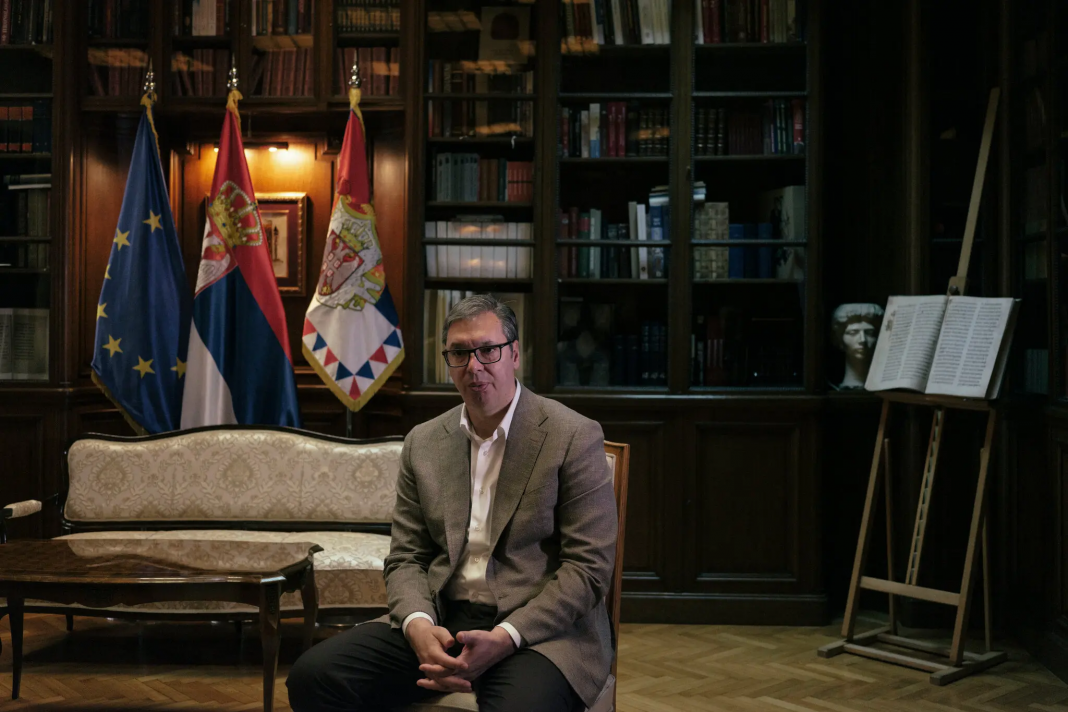
The “New York Times” has dedicated yet another article to the President of Serbia Aleksandar Vučić, following the one that accused him of links to organized crime.
While noting that Vučić is praised by American and European diplomats and receives applause from a media machine that only crushes his critics, the newspaper writes that the Serbian leader is also in a weak position due to the situation in which Serbia finds itself.
According to the American daily, after the protests that began in May and have been ongoing for several weeks, Vučić is now in the position of the victim, and tabloids and loyal television stations are coming to his defense.
“I’m not betting on his downfall because leaders like Vučić have very powerful survival techniques, but there is an open wound, and the sharks are circling,” commented Vuk Vuksanović from the Belgrade Center for Security Policy, an independent research institute.
According to the newspaper, who lurks in these troubled waters is Russia, which blames the West for the turmoil in northern Kosovo and does not recognize its independence.
But for Čedomir Čupić, a professor of political science at the University of Belgrade, Kosovo is already lost to Serbia.
“There is no realistic possibility for Serbia to regain control over it and rule over more than a million unruly ethnic Albanians,” said Čupić.
However, he emphasized, such a situation is a “gift from God for Moscow”, which holds a “toothpick that it can always poke around to make the United States and Europe feel nervous”.
On the other hand, the “New York Times” continues, the violence in Kosovo has also offered a rare reflection in the news of Vučić, who has taken on his powerful role as the defender of Serbian interests at a time when he is struggling to quell protests on the streets.

Also, while high-ranking American and European diplomats have expressed anger over what they see as provocation from Kosovo, Serbia is pleased to be treated as an important partner.
The newspaper refers to the visit of the American General Daniel Hokanson to Belgrade this week, where he praised what he called the “fantastic partnership” between the United States and Serbia.
“The positive assessment given to him is part of American efforts to distance Serbia from Russia and move it towards the European Union,” writes the American daily.
But one positive aspect is that the scale of the popular protests and Vučić’s failure to mobilize as many people in his rally on May 26th has united the divided opposition in the Balkan country.
However, opposition parties reject the proposed snap elections by the Serbian president himself, as the ball is not in their court.
Read the full article here.