

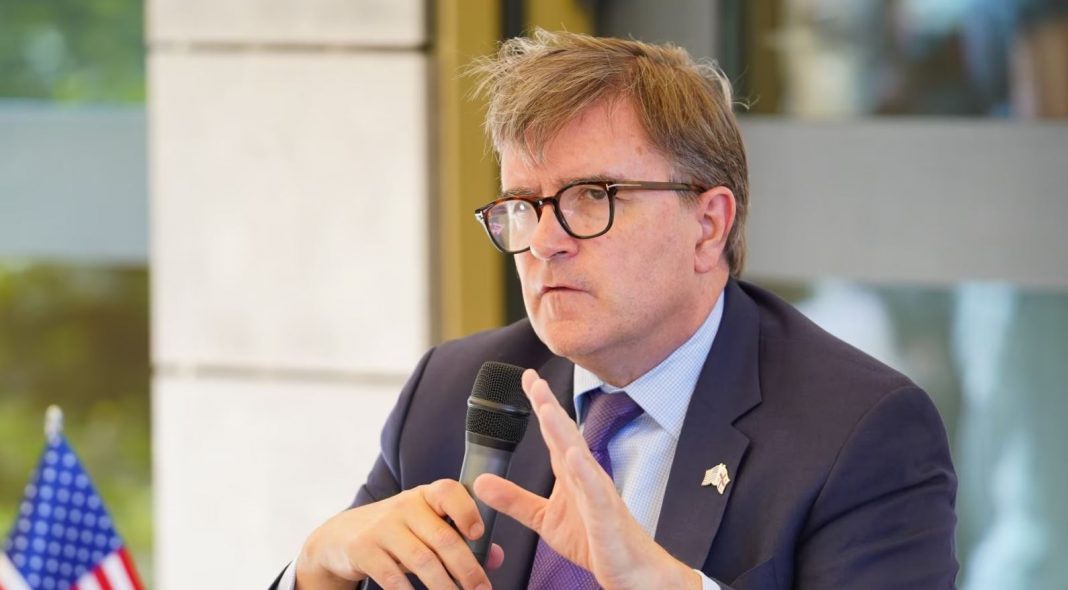
The United States expects the next government of Serbia, emerging from the December 17 elections, to continue talks on normalizing relations with Kosovo, as well as the path toward European integration, said U.S. Assistant Secretary of State for Europe and Eurasia, James O’Brien.
“The Serbian people will vote as they wish. We expect the government to adhere to the agreement it has made regarding Kosovo,” O’Brien said in an interview with Voice of America.
He mentioned progress in recent months on the Kosovo issue, adding that “some of the major contested issues have started to be resolved, such as license plates, customs…”.
The U.S. official stated that further progress must be made, emphasizing that the future of the Balkans lies in the common European market and EU membership.
“To truly join the common European market, both parties must resolve their disagreements, recognize borders, and agree to cooperation. We expect them to work again – starting with the commitments they have already made,” O’Brien said.
While speaking about the continuation of negotiations for the normalization of relations between Kosovo and Serbia, O’Brien said the U.S. expects a reduction in tensions in the northern Kosovo municipalities, predominantly inhabited by Serbs.
“It’s an area where KFOR, NATO forces, have been strengthened. And the European mission, EULEX, has also been very active lately. Therefore, neither party has a reason to cause tensions there, and that area should remain calm,” he said.
The situation in north Kosovo, a region predominantly inhabited by Serbs, has remained tense since the beginning of this year when local Serbs opposed Albanian mayors in four predominantly Serb municipalities who emerged from elections boycotted by Serbs in April.
On September 24, tensions escalated after the Kosovo Police was attacked by an armed group of Serbs in the village of Banjska in Zvecan, where police officer Afrim Bunjaku was killed. Three Serb attackers were also killed during the ensuing clashes.
Kosovo has blamed Serbia for the attack, but Belgrade has denied involvement.
The return of Serbs to public institutions is one of the steps O’Brien mentioned to reduce tensions.
“Serb citizens of Kosovo living in that region should be welcomed back into public institutions, and this will reduce tensions. And, honestly, both parties have a lot of work to do to ensure they continue the path of normalization they agreed upon in March, in Ohrid. So, there is work to be done,” he said.
O’Brien also stated that the U.S. will continue to emphasize how important it is to “finish this job in the coming months”.
“Their economies are already linked to the European Union, and now they must implement reforms and commit to being part of that community. And as they do this, I think tensions will decrease, and they will have a greater relationship,” he said.




