

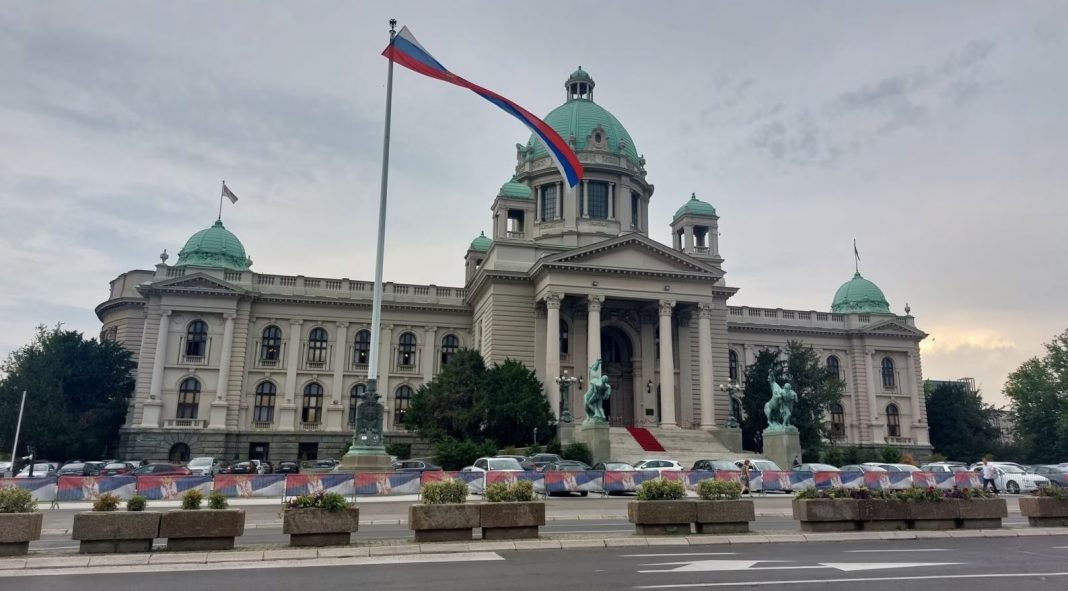
During the initial session of the autumn season on October 23, a segment of opposition lawmakers in the Serbian Parliament brought up the matter of the Serbian leadership’s involvement in the attack that occurred in Banjska, located in north Kosovo.
On September 24, a group of armed Serbs launched an assault on the Kosovo Police in Banjska, leading to the tragic death of police officer Afrim Bunjaku. In the ensuing confrontations, three Serb attackers also lost their lives.
Kosovo has attributed responsibility for the attack to Serbia, while Serbia categorically denied any role in the incident.
The responsibility for the Banjska attack has been assumed by Milan Radojičić, the former deputy leader of the Serb List, the largest Serbian political party in Kosovo, which receives support from Belgrade.
“Let’s inquire now of [the director of the Security and Information Agency – BIA, Aleksandar] Vulin, [the President of Serbia, Aleksandar] Vučić, and [the Serbian Minister of Internal Affairs, Bratislav] Gašić how it is possible that they were unaware of Radojičić’s activities in Banjska, where he was seen with individuals armed with machine guns, a type of firearm that is not privately permitted in any Serbian city,” Nebojša Zelenović, co-chair of the opposition party Together, addressed the parliamentary session.
Meanwhile, the head of the Parliamentary Group of the Serbian Progressive Party (SNS), which is in power, Milenko Jovanov, responded by asserting that Zelenović is quick to blame Serbs for everything without considering the responsibility of the other party.
“He claims it’s terrible that Aleksandar Vučić had no knowledge of the situation, but he does not find it distressing that three Serbs lost their lives. He never made such a statement,” Jovanov remarked.
A faction of the opposition in Serbia had called for an urgent Parliament session on October 3, with the intention of establishing an Investigative Commission to ascertain the accountability of Serbian President Aleksandar Vučić, as well as the role of Milan Radojičić in the Banjska incident. However, this proposal was not accepted.
This development coincided with the day when Kosovo’s Prime Minister Albin Kurti alleged that the attack in Banjska was executed by the “Novi Sad Clan”, led by Serbia’s Minister of Defense Miloš Vučević.
“Two decades ago, the Zemun Clan held power in Serbia, but now, the Novi Sad Clan has taken its place. Criminals during wartime, criminals during peacetime; criminals in Serbia, criminals in Kosovo. The President of the state, Aleksandar Vučić, akin to a capo-di-tutti-capi, is there to demonstrate that although crime may appear to dictate the state, it is actually the state that dictates crime,” Kurti shared on Facebook on Monday.
Vučević dismissed the remarks of Kosovo’s Prime Minister Albin Kurti as “entirely preposterous and glaring falsehoods”.
Nemanja Starović, State Secretary in the Ministry of Defense of the Republic of Serbia, in a X update, suggested that Albin Kurti’s “wild accusations” against Vučević, are “more self-projection than anything else”.
Should I feel neglected since @albinkurti didn't accuse me of being part of the "Novi Sad Clan" and I was born & raised in that place?!
On a more serious note, accusations against @milos_vucevic for organizing some sort of "clan" while being a mayor of Novi Sad are pure… https://t.co/tCpgRpwNpZ
— Nemanja Starović (@nstarovic) October 23, 2023
Kosovo has called for an international investigation into Serbia to determine Belgrade’s role in the attack, an incident that Pristina views as an act of terrorism.
The United States and the European Union have both issued strong condemnations of the attack and have urged for those responsible to be brought to justice.