

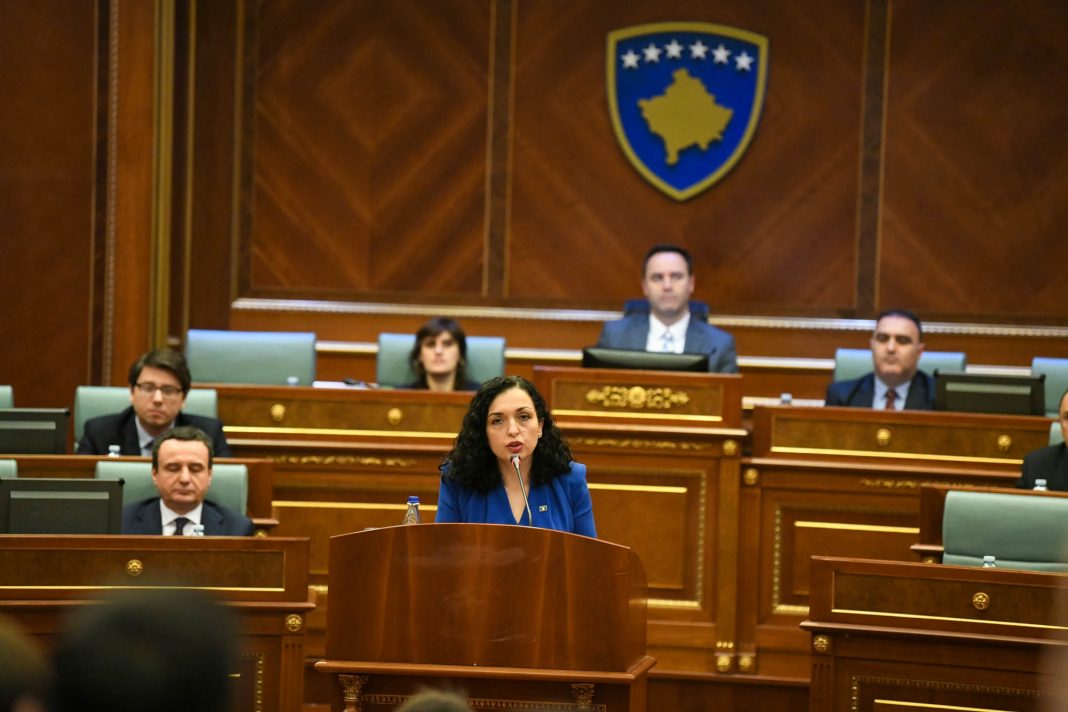
Kosovo’s President Vjosa Osmani has described the year 2023 as the most challenging for Kosovo in terms of security.
In her annual address to the Kosovo Assembly on December 15, Osmani stated that Kosovo faced the “most challenging situation since its independence” on September 24.
“The armed attack in Banjska was just a warning that Serbia will not abandon its dark plans,” declared Osmani.
During her speech, boycotted by opposition parties, the Democratic Party of Kosovo (PDK) and the Alliance for the Future of Kosovo (AAK), the President accused Serbia of aiming to destabilize not only Kosovo but the entire Western Balkans.
“A terrorist and paramilitary group, funded, trained, and supported by Serbia, and above all, commanded by the leadership of this state, carried out the act of aggression with a clear plan to annex north Kosovo and cause destabilization, not only in our country but throughout the region,” stated Osmani.
She emphasized that “Kosovo will defend its borders in every corner and at any cost”.
The armed attack in Banjska on September 24, where a group of armed Serbs attacked the Kosovo Police, resulted in the death of officer Afrim Bunjaku. Later, three Serbian attackers were killed during an exchange of gunfire.
Milan Radojičić claimed responsibility for the Banjska attack, admitting he personally organized it and all logistical preparations, without informing anyone about those plans.
Kosovo accused Serbia of being behind the attack, a claim officially denied by Belgrade.
Osmani asserted that the Banjska attack undoubtedly affected the progress in the Brussels dialogue for the normalization of relations between Kosovo and Serbia.
According to Osmani, this process is continually obstructed by what she called Serbia’s obstructions against Kosovo.
Osmani criticized the international community for imposing sanctions on Kosovo. She stated that the lack of balance and unequal treatment in the dialogue has had an extraordinarily damaging impact on the process, subjecting Kosovo to unfair and disproportionate measures affecting its citizens directly.
At the same time, Osmani criticized the failure to impose such measures on the state of Serbia, which, according to her, primarily aims to destabilize Kosovo and the region. She stated that “the unequal treatment would be a severe blow to the credibility of the dialogue process and a major obstacle to its progress”.
Referring to the draft statute for the Association of Serb-majority municipalities in Kosovo, Osmani said the final assessment of the draft must come from the Constitutional Court of Kosovo.
However, before this happens, she called on all political parties in Kosovo to sit together and write common comments.
“Our common goal should be to ensure full compliance with the Constitution of Kosovo and not allow any intermediate power of governance or other anomalies that endanger the internal functioning of our state,” Osmani said.
The draft statute for the Association has been presented to Pristina and Belgrade in October, and both Kosovo Prime Minister Albin Kurti and Serbian President Aleksandar Vučić have said they find it acceptable.
However, due to party conditions, progress is currently stalled.
In recent days, the draft has also been submitted to opposition parties in Kosovo.
In some statements to Radio Free Europe, their representatives expressed concern and disagreement with it.
According to them, the draft statute, as such, compromises the unitary character of the state and creates parallelism in powers.
President Osmani also spoke about Kosovo’s disagreements with the international community, saying that disagreements may occur but stressed that mutual trust should not be questioned.
Osmani also commented on the increase in cases of gender-based violence in Kosovo in 2023, stating that tragically, several women were killed during the year.
“Gender-based violence is not just a women’s issue. It is a test for humanity in a social crisis that requires our unwavering commitment to change,” emphasized Osmani.
According to President Osmani, gender-based violence should be seen as a collective issue that everyone must face.
Based on reports from the Kosovo Police and the Kosovo Women’s Network, the total number of women killed in Kosovo from 2010 to November this year is 55.
Osmani said that to prevent gender-based violence, every link in security and justice institutions should be strengthened.
The annual speech by the president was attended by accredited ambassadors in Kosovo, including the United States Ambassador, Jeffrey Hovenier.




