

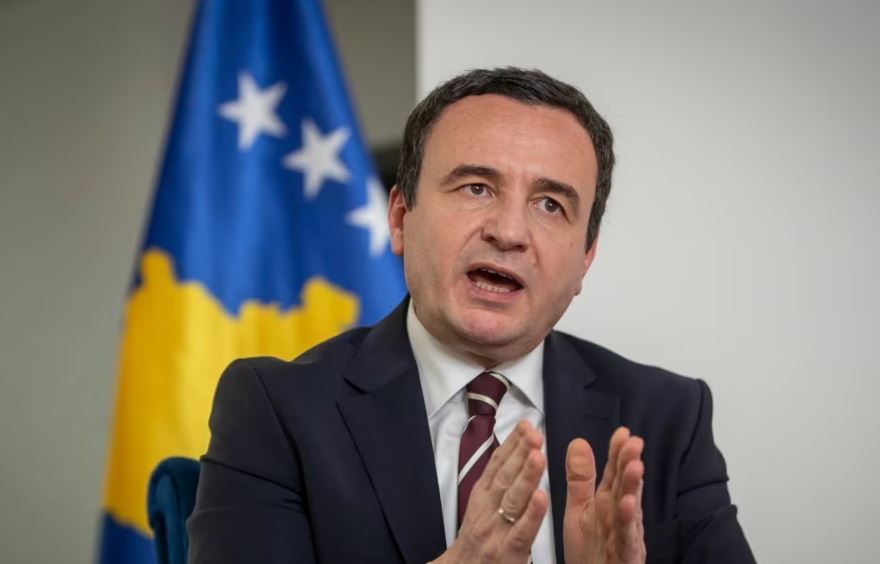
Kosovo’s Prime Minister Albin Kurti emphasized on Wednesday that the Sunday attack in Banjska, Zvecan, highlighted the challenges and the imperative for international collaboration in preserving, safeguarding, and monitoring Kosovo’s borders with Serbia.
On September 24, in that region, Kosovo Police engaged in a confrontation with an armed group, resulting in the death of a police officer and three assailants. Eight other suspects were apprehended.
According to Prime Minister Kurti, the security of Kosovo’s national territory was jeopardized on September 24, revealing the readiness of “criminal and terrorist groups, which we have been combating for over two and a half years”.
“With over 5 million euros worth of military equipment and sufficient quantities for a group of hundreds of fighters, a scenario for violence and bloodshed in Kosovo has been demonstrated,” Kurti stated.
Kurti initiated the Government meeting with a minute of silence in tribute to the slain police officer.
“The border with Serbia, more than just the physical demarcation and mountainous terrain, especially in the northern part, makes the conduct and intentions of official Belgrade particularly risky and challenging,” he remarked.
Kurti also highlighted that the involvement of Milan Radojičić, Deputy Chairman of the Serb List, in this attack, which the Prime Minister referred to as a terrorist act, underscores “the crucial importance of reviving political pluralism among Serbs in Kosovo”.
“There can be no democracy and freedom without pluralism. The Serbs in Kosovo must be liberated from Serbia’s guardianship,” he added.
Kosovo’s Minister of Internal Affairs Xhelal Sveçla accused Radojičić of orchestrating and participating in the attack.
Kosovo authorities have held Serbia accountable for this attack, while Serbian President Aleksandar Vučić asserted that the attackers were Kosovo Serbs driven by Kurti’s “terror”.
The road leading to the village of Banjska in Zvecan remains blocked by the Kosovo Police.
Veton Elshani, Deputy Director of the Police for the Northern Region, stated to Radio Free Europe on Wednesday that the village will continue to be inaccessible until the afternoon, when authorities are expected to make a decision.
The attacks on Kosovo Police have received condemnation from the United States and the European Union, with calls for the perpetrators to face justice.
“Cultural monastery sustained significant damage”
Kosovo’s Minister of Culture, Youth, and Sports Hajrulla Çeku noted that the September 24 attack had an additional troubling dimension: “the utilization of a cultural and religious heritage site for criminal purposes”.
“The Orthodox Monastery in the village of Banjska in Zvecan, a cultural heritage monument protected by the laws of the Republic of Kosovo, was used as a refuge by a terrorist group, including their weaponry”.
He stressed that the monastery had suffered substantial damage from the armed group.
“I firmly believe that the intent of the members of this group, as well as their instigators, was not solely to inflict physical harm to the monastery but also to detrimentally impact interfaith and interethnic relations in Kosovo,” he stated.
The Minister emphasized that the Kosovo Government has demonstrated its commitment to protecting cultural heritage, particularly Orthodox churches and monasteries.
“The Kosovo Government possesses the budget allocation and necessary resources for restoration efforts at the Banjska Monastery,” he added, among other remarks.




