

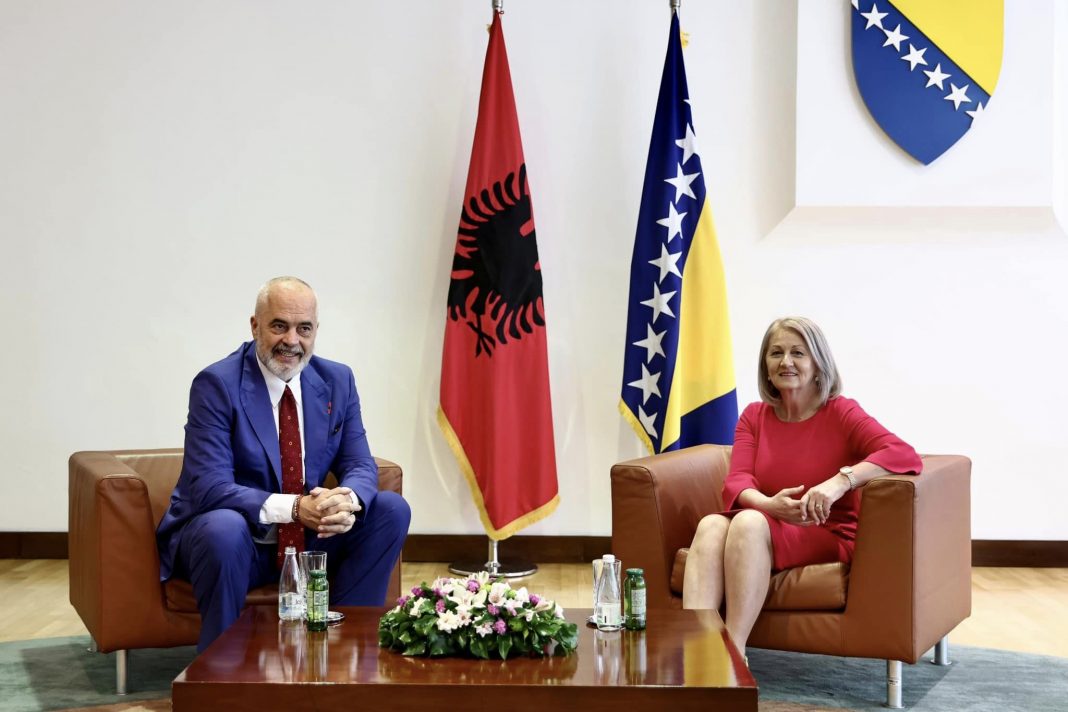
“It is no secret that we want to protect the interests of Kosovo through the Berlin Process, and we want to achieve freedom of movement, and the best way to do that is through the use of identity cards,” said the Prime Minister of Albania, Edi Rama, in Sarajevo after meeting with the Chairperson of the Council of Ministers of Bosnia and Herzegovina, Borjana Krišto.
“I hope that Bosnia and Herzegovina will sign such an agreement, following the model of Serbia. In October in Tirana, we must have a common position on all the issues that concern us, the issues that have been raised and that concern us all,” said Rama.
The entity of Republika Srpska in the National Assembly of Bosnia and Herzegovina blocked the adoption of the freedom of movement agreement with identity cards in the Western Balkans on 27 June. This consequently blocked the establishment of a visa-free regime between BiH and Kosovo, although this was agreed upon in November 2022 with the signing of the Agreement on Free Movement in the Western Balkans within the framework of the Berlin Process.
Prime Minister Edi Rama continued his tour on Friday to the capitals of Western Balkan states, which, according to Rama, aims to inform the regional states about Albania’s preparations to host the Berlin Process Summit.
The Berlin Process Summit will be held in Tirana on 16 October, where, according to the Albanian Prime Minister, an assessment of the achievements of this process will be made.
Rama’s first stop was in Bosnia and Herzegovina, where the Albanian Prime Minister met with the Chairperson of the Council of Ministers, Borjana Krišto.
Prime Minister Rama also stated that Albania wants to strengthen cooperation with Bosnia and Herzegovina and that they are working to open the Albanian Embassy in Bosnia.
Krišto, on the other hand, said that she and Rama discussed “good and friendly relations” between the two countries.
“We do not have any open issues. We emphasize regional cooperation and that we remain committed to the Berlin Process,” said Krišto.
After this visit, Rama will continue his journey to Montenegro, where he will hold a working lunch and a joint press conference with the Montenegrin Prime Minister, Dritan Abazović. He will also meet with the President of Montenegro, Jakov Milatović.
Rama’s tour concludes with a visit to Serbia, where he will meet with Serbian Prime Minister Aleksandar Vučić. The Prime Minister announced that he, together with Vučić, will hold a joint press conference.
A day earlier, Edi Rama visited North Macedonia and Kosovo. During his first visit to Skopje, he stated that the Open Balkans initiative has yielded “fantastic” results. However, according to him, the Western Balkan states need to “engage with mind and heart in the Berlin Process”.
“We hope that now we can give it a new boost, considering that it is no longer a process like before, but we hope to turn it into such a process with the new financing plan from the European Union,” said Rama during the joint press conference with Macedonian Prime Minister Dimitar Kovačevski.
After the stop in Skopje, Rama continued his visit to Pristina, where he was received in a meeting by the President of Kosovo, Vjosa Osmani.
After the meeting, the President stated that they discussed “upcoming processes on the international agenda, with a focus on the NATO Summit and the Berlin Process Summit”.
“We discussed the necessity of implementing all the agreements reached so far in this [Berlin] process, especially those related to freedom of movement, as well as the possibility of increasing projects and funding opportunities for the Western Balkan countries within the framework of the Berlin Process,” stated the Office of the President of Kosovo in a media release.
Before the visit to Kosovo, Rama announced that 13 signed agreements had been sent to official Pristina, which were supposed to be signed during the joint meeting of the two governments in Gjakova on 14 June but were canceled by Rama due to tensions in northern Kosovo. The Government of Kosovo has confirmed that all these agreements were signed on Thursday as well.
Rama’s movement came after Kurti stated that he would only hold a meeting with him within the framework of the joint meeting of the two governments “to sign the agreements” that have been agreed upon and are in the drawer.
“I remain hopeful that after the publicly expressed concern by Prime Minister Kurti regarding the citizens who were deprived of the benefits of the 13 agreements, we will also have confirmation of the meeting with Albin on Thursday afternoon,” Rama wrote on Twitter.
However, although Rama was expecting a possible meeting with his counterpart from Kosovo, a meeting between the two prime ministers did not take place due to Kurti’s refusal to meet him.
The Berlin Process was established in 2014 with the initiative of the then German Chancellor, Angela Merkel, with the aim of connecting and integrating Western Balkan countries before their accession to the European Union.
The Berlin Process focuses on freedom of movement and the creation of a regional common market.
The process also involves EU institutions, international financial institutions, and civil society in the region.




