

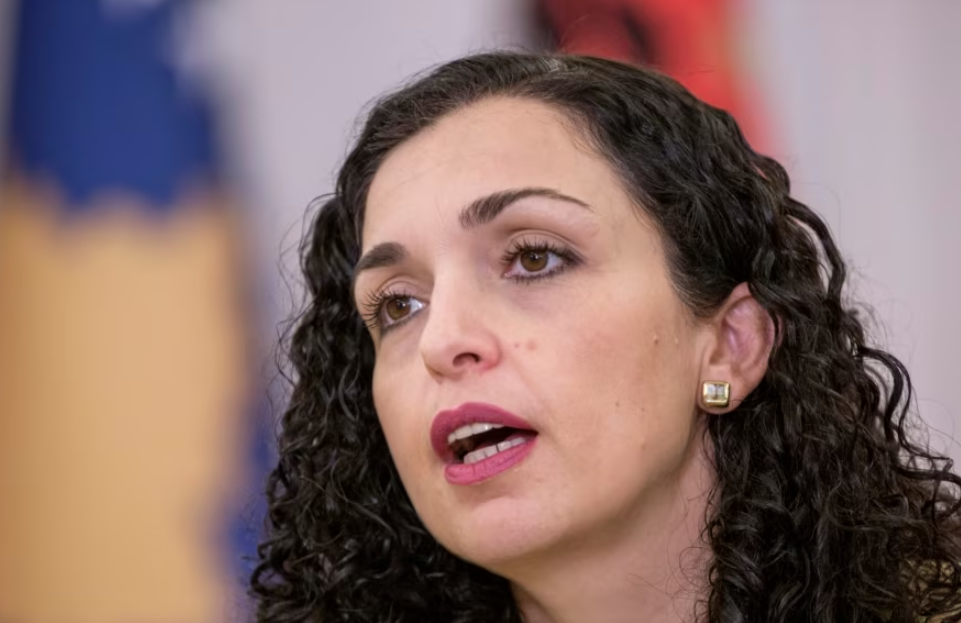
Kosovo’s President Vjosa Osmani stated that there are several options being discussed regarding the implementation of the regulation by the Central Bank of Kosovo concerning cash transactions, which stipulates that only the euro should be used for such payments.
During a press statement on January 31, Osmani said that she expects an agreement on the implementation of the decision within two days, which is scheduled to come into effect on February 1.
The decision of the Central Bank of Kosovo has been opposed by Serbs in Kosovo, as they have stated that it will prevent the use of the Serbian dinar for cash payments.
Meanwhile, the international community has requested Kosovo to postpone the implementation of the decision, but the Government of Kosovo has argued that it is in accordance with the Constitution of Kosovo.
According to Osmani, the Central Bank of Kosovo, with the decision regarding cash transactions, has respected the principle of independence.
“Regarding the practical implementation of these principles, a number of options are being discussed, which on one hand would respect Article 11 of the Constitution, but, on the other hand, would allow time for informing citizens and their transition, let’s say, to new and other accounts, so that it can be implemented without any problem and with the full support of allied states,” Osmani told reporters after paying tribute in front of Zahir Pajaziti’s statue in Pristina.
“As you know, for every issue related to the north of Kosovo, with the extension of sovereignty and the security of our state, whenever we have our allies by our side, these challenges are overcome and the defense of our Constitution is achieved in its entirety,” she added.
The European Union, the United States, and other members of the QUINT – Germany, Italy, France, and Britain – have stated that the decision of the Central Bank of Kosovo “raises concerns regarding its particular impact on Serbian majority communities”.
Osmani said that the request for the dinar is similar to the request the international community made to postpone the implementation of the decision regarding the conversion of license plates issued by Serbia into those of the Republic of Kosovo.
She recalled that now in north Kosovo, inhabited by a Serbian majority, license plates are being converted, and she said that this decision, like in the case of the dinar, also had aspects related to constitutionality and security.
“Therefore, for these issues [the regulation of the Central Bank of Kosovo] on how they will be realized in practice, as far as compliance in these challenging parts is concerned, there will be an agreement in these two days and we will also have public statements. I am in favor of full implementation and not just on paper,” Osmani said.
Kosovo’s President said that Article 11 of the Constitution stipulates that the state should only have in circulation and use one currency and that “the Constitution is above all”. However, she emphasized that Kosovo’s allies – who have requested the postponement of the decision’s implementation – are not against the Constitution of Kosovo.
The Serb List – the main party of Serbs in Kosovo, enjoying the support of Serbia – has said that the decision of the Central Bank of Kosovo jeopardizes the survival of Serbs in Kosovo.
In Kosovo, in all Serbian-majority areas, the population uses the Serbian dinar for payments, and those working in Serbian institutions in Kosovo also receive their salaries in dinars.
Pensions are also paid in dinars, according to the Serbian system, as well as child allowances and social assistance.
In commercial establishments, in areas where Serbs live in Kosovo, besides euros, the dinar is also used.