

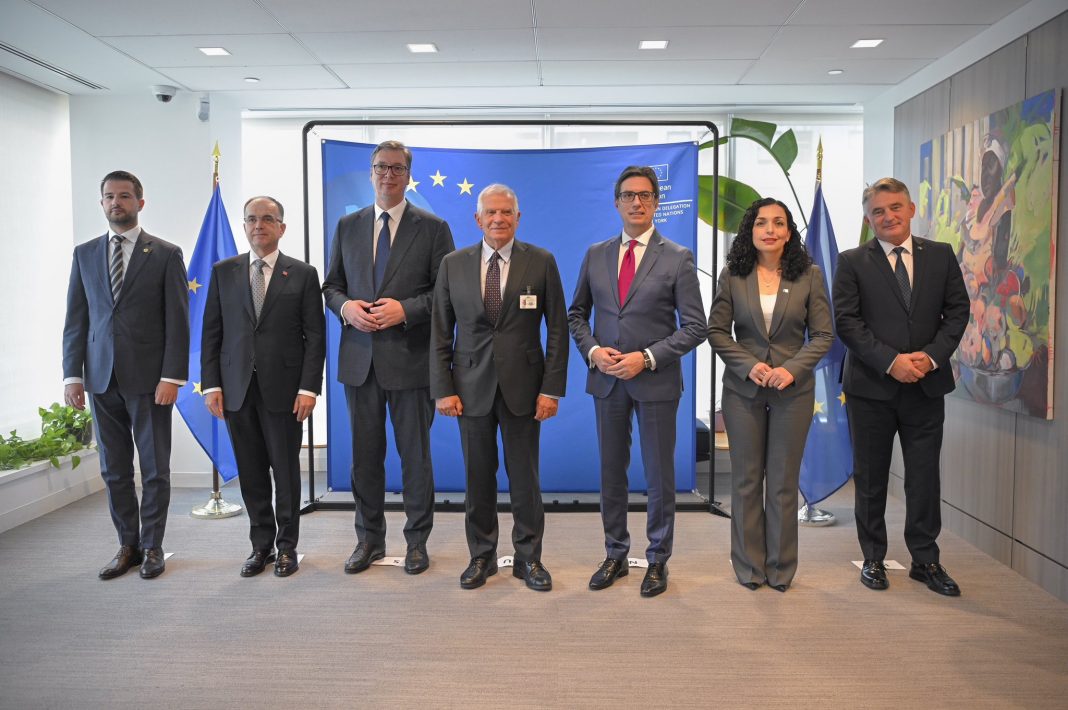
Kosovo’s President Vjosa Osmani has called on the European Union to accelerate the process of granting Kosovo candidate status for EU membership.
These remarks were reportedly made during a traditional luncheon organized by the EU’s Chief Diplomat, Josep Borrell, in New York, coinciding with the United Nations General Assembly.
Serbia’s President Aleksandar Vučić expressed openness to “constructive cooperation in the region aimed at achieving our strategic goal – EU membership” after the meeting.
Since 2003, Western Balkan countries have been promised a European perspective, as outlined during a summit in Thessaloniki. Croatia is the sole country from the region to have successfully joined the EU in 2013.
Membership negotiations have been ongoing for Montenegro and Serbia for several years. In July 2022, Albania and North Macedonia also initiated their negotiations.
Bosnia and Herzegovina attained candidate country status in December of the preceding year, while Kosovo has only entered into a Stabilization and Association Agreement (SAA) with the EU.
Kosovo submitted its application for EU membership in December of the previous year.
Among other concerns, Osmani has voiced her belief that the EU’s punitive measures against Kosovo do not promote dialogue and impact the interests and well-being of Kosovo’s citizens.
These measures were imposed following escalating tensions in the northern region of Kosovo in May, where local Serbian residents protested against the entry of new Albanian leaders into municipal buildings, sometimes leading to violent confrontations.
Osmani emphasized Kosovo’s constructive role in the EU-mediated dialogue with Serbia and its commitment to peace and stability.
She stated, “The EU should reward states that align with EU principles and have undertaken reforms, particularly in the areas of rule of law, the economy, and European standards”.
The most recent round of high-level dialogue in Brussels took place on September 14 but concluded without any significant progress.
Kosovo’s Prime Minister Albin Kurti commented after the meeting that the EU’s mediator in this process, Miroslav Lajčák, appeared to be biased against Kosovo.
He noted that during the meeting, there seemed to be coordination between Serbia’s President Aleksandar Vučić and Lajčák to create an “alternative scenario” where only part of the agreement is implemented.
On the other hand, the EU considered these statements to be unfounded.
Kosovo and Serbia have been engaged in a dialogue mediated by the EU since 2011 to normalize relations. Although the parties have signed numerous agreements, not all of them have been effectively implemented.




