

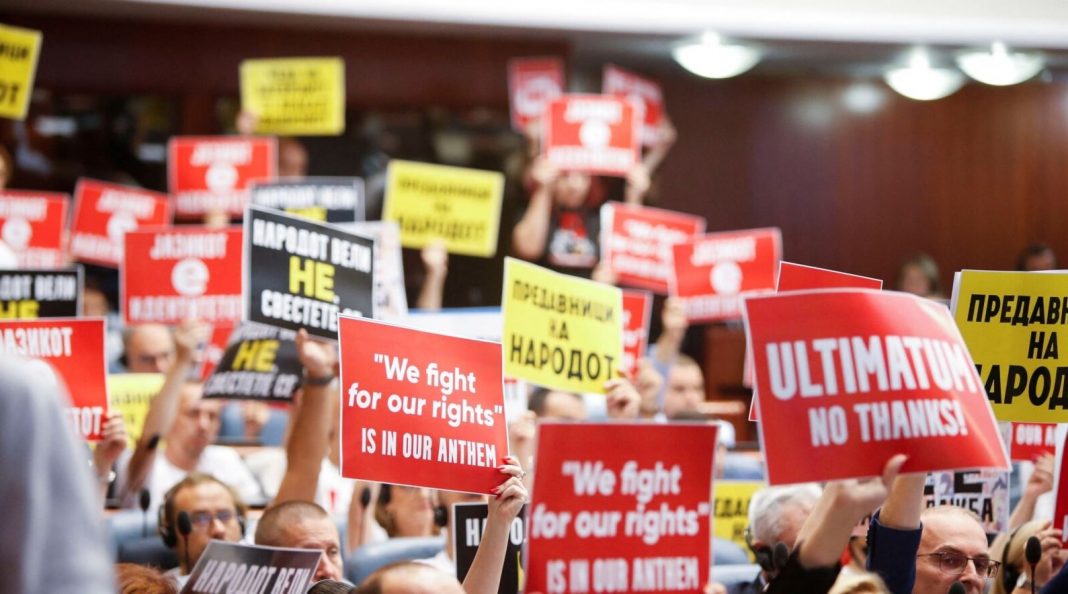
Messages from NATO Secretary General Jens Stoltenberg, as well as other high-ranking international officials, have not swayed VMRO-DPMNE from its opposition stance to constitutional changes.
The changes needed for the inclusion of the Bulgarian minority in its preamble, as a constitutive people, are a key condition for the continuation of North Macedonia’s European integration negotiations.
The decision must be approved before the EU summit in December to give the green light for the start of negotiations on the chapters.
Stoltenberg: Work to lead the country towards the EU
“All political parties have a responsibility to work together and move the country forward. Therefore, I encourage you to be persistent and continuously work to complete your journey into the European family of nations, just as you have worked for NATO membership,” said NATO Chief Stoltenberg before the deputies.
Similar messages were conveyed by other high-ranking European and American officials, drawing attention away from the security and stability risks if the country does not continue on the path of European integration.
Mickoski: Constitutional changes under Bulgarian dictate will not happen
However, despite the opposition’s “unyielding” stance, VMRO-DPMNE, led by Hristijan Mickoski, says constitutional changes can only occur after new parliamentary elections and its victory. Later, it claims to be able to negotiate a more favorable agreement with Bulgaria.
Mickoski claims that the agreement reached based on the so-called “French proposal” harms Macedonian national interests.
“The way these constitutional changes are planned poses a significant risk to our national interests or Macedonia’s position in the progress towards full membership in the European Union. Constitutional changes under Bulgarian dictate will not happen,” Mickoski said.
Kovačevski: VMRO is following Gruevski’s isolationist policy
Despite the opposition’s “entrenched” stance, the ruling parties say they will not “give up” until the last minute, as, according to them, North Macedonia’s integration into the EU has no alternative.
Prime Minister Dimitar Kovačevski, after meeting with NATO Secretary General Jens Stoltenberg, said, “Those who oppose constitutional changes are against the country’s European future”.
“If those who have always been against the country’s integration into NATO and the EU manage to overcome themselves, then at the EU summit in December, we will have a decision to start negotiations with the EU. If we don’t do this, then we will have a replay of the 11 past EU summits when we had no decision for our country. VMRO, with its current leaders, continues with the isolationist policies of Nikola Gruevski,” Kovačevski declared.
The situation for securing two-thirds of the votes in the Parliament is further complicated by the decision of Albanian opposition parties not to support constitutional changes. This decision was made by Albanian parties due to the rejection of their request for changes to include a “new definition for the Albanian language”, which is recognized as the language spoken by over 20% of the population of North Macedonia.
Analysts: Elections have sidelined constitutional changes
Political observers do not expect constitutional changes to be approved by the current parliamentary composition, as all attention is now focused on upcoming parliamentary elections.
Analyst Petar Arsovski says that international pressure will gradually decrease considering the positions of political parties, especially the Macedonian opposition.
“The pressure from the international community will not change, but over time, it will decrease. I am not optimistic that constitutional changes can be made by this parliamentary composition. Now, it seems that all attention is focused on the upcoming elections, so the discussion about constitutional changes is diminishing,” Arsovski says.
He is pessimistic about whether there will be movement even after the elections due to other political circumstances, primarily because of the European Parliament elections in June.
“The overall environment will be less favorable than what we have now for the approval of constitutional changes. In June 2024, we have the European Parliament elections, so on this topic, the debate on constitutional changes cannot turn before September of the following year, but even then, I don’t believe we will have the pressure we have now,” analyst Petar Arsovski says.




