

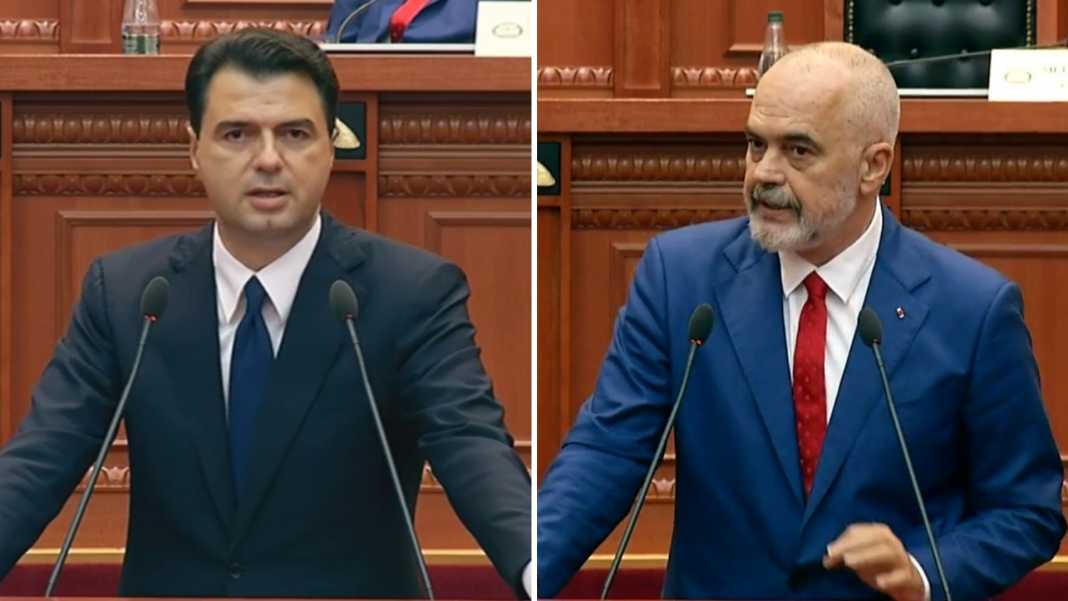
Following an extraordinary session of the UN Security Council on Thursday in New York, United States, where Kosovo Prime Minister Albin Kurti and Serbian President Aleksandar Vučić clashed over the dinar, Albanian Prime Minister Edi Rama took to social media to express frustration at the discussions held.
“It was a pointless session. The UN Security Council is clearly not the venue for anything related to Kosova. As two sovereign countries aspiring for EU membership, Kosova and Serbia should fully concentrate on the EU-facilitated dialogue and focus on reaching agreements on financial circulation, postal service, double taxation, and all other issues benefiting the day-to-day lives of ordinary people, while also securing a peaceful future for the next generations. As we stand by Kosova in deterring any external threats, Albania will continue to emphasize to the Kosova leadership the importance of close coordination with its key allies. Standing firmly and continuously together with them shows a sense of statehood vision and responsibility, while any instance of standing alone on the path to full recognition diminishes the country’s standing in the public realm of international relations,” Rama wrote on X, previously known as Twitter.
It was a pointless session. The UN Security Council is clearly not the venue for anything related to Kosova. As two sovereign countries aspiring for EU membership, Kosova and Serbia should fully concentrate on the EU-facilitated dialogue and focus on reaching agreements on…
— Edi Rama (@ediramaal) February 9, 2024
In response to this comment, the chairman of the Democratic Party, Lulzim Basha, also took to social media to accuse the prime minister of not taking Kosovo’s security seriously.
“Talks like a Westerner, acts like an Easterner. Strategic allies treat Kosovo’s security as a matter of national, regional, European, and Euro-Atlantic security. Only Edi Rama does not consider it as such. Kosovo does not need democracy lessons from an autocrat, but concrete support,” wrote Basha on X.
Flet si perëndimor, vepron si lindor.
Aleatët strategjikë e trajtojnë sigurinë e Kosovës si çështje të sigurisë kombëtare, rajonale, europiane dhe euroatlantike. Vetëm Edi Rama nuk e konsideron të tillë.
Aleatët strategjikë e trajtojnë korrupsionin e politikanëve dhe zyrtarëve…
— Lulzim Basha (@lulzimbasha_al) February 9, 2024
This clash comes a day after the Albanian Parliament rejected Lulzim Basha’s amendment, which envisaged a permanent obligation for Albania to allocate financial resources as military aid to Kosovo.
The amendment in the National Security Strategy submitted by Basha proposes that this active financial contribution of the Republic of Albania to the Republic of Kosovo should be offered with the aim of enhancing its security capacities to prevent any third party from undermining its territorial integrity.
But the debate-free rejection of this bill according to Basha was due to political theater and all the chaos created in the Assembly.
According to Basha, the vote in Parliament could create dangerous precedents, and enemies of Albania could benefit.
This is one of the amendments that Basha has submitted to the Assembly for Kosovo, as just a few days ago, he also submitted an amendment for the reallocation of 50 million euros from the state budget as military aid to the Government of Kosovo.
It is worth mentioning that in the United Nations Security Council, Kosovo was criticized for implementing the regulation of the Central Bank of Kosovo and for neglecting its impact on the Serbian minority in Kosovo. However, it was praised for the transition period it has promised for the implementation of this regulation. Members of the Security Council called for Kosovo and Serbia to commit to dialogue and implement agreements, as well as refrain from unilateral actions that could increase tensions. Serbia was also urged to hold those responsible for the armed attack in Banjska, Zvecan, accountable.
At the UN meeting convened by Serbia, Kosovo Prime Minister Albin Kurti defended the decision of the Central Bank of Kosovo (CBK) to make the euro the only currency for payments, thus prohibiting the use of the dinar. Meanwhile, Serbian President Aleksandar Vučić described this decision as an “attack” on the Serbian population in Kosovo.
Kurti stated that the CBK regulation for cash transactions, which came into force on February 1, does not prohibit the Serbian dinar but makes the euro the sole currency for payments.
He also emphasized that this decision does not prevent the Serbian Government from providing financial support to Serbs in Kosovo.
In Serbian-inhabited areas in Kosovo, the Serbian dinar has been in circulation since the post-war period. The Serbian state pays salaries, pensions, social assistance, and other benefits to Kosovo Serbs through a parallel system.
During the first confrontation between Kurti and Vučić at the UN, the Serbian leader stated that the CBK decision is part of several measures undertaken by Kosovo to, as he put it, attack the Serbian population in Kosovo.
The Kosovo Prime Minister insisted that the decision regarding the dinar is not aimed at harming any group of citizens but, according to him, it protects all citizens of all ethnicities from organized crime, arms trafficking, and money laundering.
According to Kurti, citizens in north Kosovo are daily threatened by criminal groups that accept mainly contraband money from the border with Serbia.
The Serbian President stated that by banning the dinar in Kosovo, the functioning of key institutions for Serbs in Kosovo is directly prevented.
Both Vučić and representatives of Russia and China – Serbia’s allied states – accused Kosovo of enacting the dinar decision and other decisions, such as closing municipalities operating under the Serbian system, as carrying out “ethnic cleansing” against Serbs in Kosovo.
Russia even said that there may be a new outbreak of conflict in the Western Balkans, drawing parallels between the situation of Palestinians in Gaza and Serbs in Kosovo.
“The idea that Kosovo is carrying out an ethnic cleansing campaign or persecution against the Serbian community is a lie,” Kurti responded to these accusations.
During the meeting, various states, such as France, the United Kingdom, Slovenia, and the United States, called on the parties to refrain from unilateral actions that could escalate tensions.




