

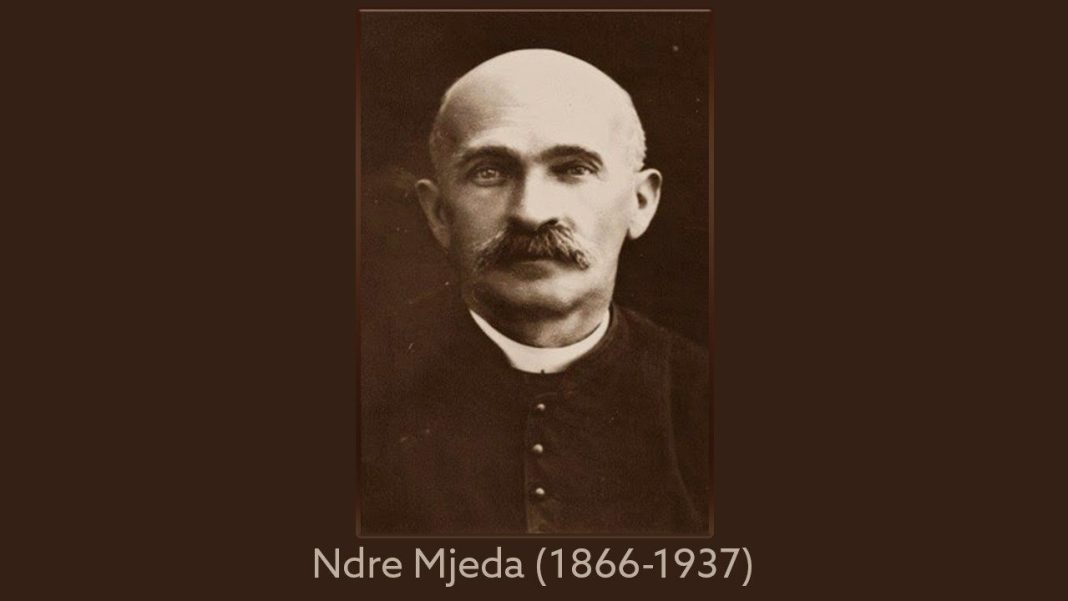
87 years ago, Ndre Mjeda passed away. He was a cleric, patriot, philologist, poet, and prominent activist of Albania’s National Renaissance.
Born on 20 November 1866 in Shkodër, he was a young man with a developed intellect and exceptional talent, which attracted the attention of the Jesuits, who considered making him a priest.
Mjeda continued his religious studies in Spain, Italy, and Poland. In 1883, he studied rhetoric, Latin, and Italian in Croatia. From 1884 until early 1887, he was at a college run by the Gregorian University of Rome, and in 1887 he transferred to another Gregorian college in Cieri.
In 1908, he participated in the Congress of Monastir, alongside At Gjergj Fishta, Luigj Gurakuqi, Hilë Mosi, and Mati Logoreci, as a representative of Shkodër, and supported the Latin alphabet variant. He was elected a member of the Commission for the Drafting of the Unified Albanian Alphabet and a member of the Albanian Literary Commission.
During the peak of the democratic movement, Ndre Mjeda became involved in the political life of the time and was elected deputy. After the political changes in 1924, he withdrew from political life and worked as a simple priest in Kukël. From 1930, he was a teacher of the Albanian language and literature at the Jesuit college in Shkodër, where he also died on 1 August 1937.
Ndre Mjeda is one of the greatest poets in Albanian literature. With an initial romantic and youthful inspiration, he created the poem of personal longing and pain “The Lament of the Nightingale”.
With his understanding of the authentic life of the Albanian world, he created the poem of the Albanian world “The Dream of Life”. Through his search for cultural and historical roots, he created the sound clusters “Lissus, Scodra”.
His poetry marked the transition from the romantic Renaissance literature, mainly focused on national issues, to the literature of Independence, where social issues and realism predominated. A few months before his death, he published the rare and powerful poetic testament, the poem “Freedom”.
He also contributed to the field of linguistics with studies in grammar and lexicology.