

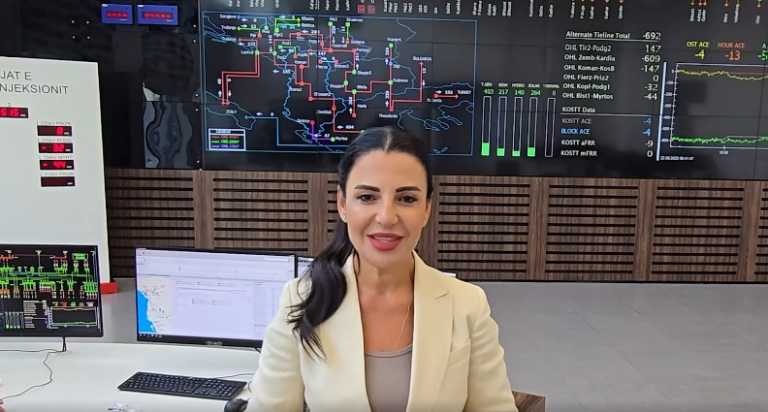
In a press statement from the SCADA hall of the Transmission System Operator, Deputy Prime Minister and Minister of Infrastructure and Energy, Belinda Balluku, gave an overview of the country’s energy situation during the 2025 summer tourist season.
She highlighted the historic increase in electricity consumption, the challenges faced by the grid due to high temperatures and wildfires, and the measures taken to ensure stable supply across the country.
Balluku also emphasized positive results in reducing network losses and outlined government initiatives to strengthen the energy sector, meet growing demand, and lower electricity prices for households.
Full Statement by Belinda Balluku:
“Greetings,
From the SCADA hall of the Transmission System Operator, I am providing a brief overview of the energy situation in the country, electricity consumption during the summer tourist season, and the commitment of all public sector structures to guarantee uninterrupted electricity supply during this critical season for our economy.
Network data shows a steady year-on-year increase in consumption. According to the Distribution Operator, electricity consumption compared to 2024 rose by 2.2% or 41,885 MWh. Compared to 2023, it rose by 10.3% or 184,151 MWh.
If compared with 2019, the year before the pandemic and the energy crisis, June and July 2025 show a monthly consumption increase of 21.5% and 30.7% respectively. This increase alone is equivalent to the entire electricity consumption of household users for April 2025, or about 217,000 MWh.
In terms of daily consumption, the highest consumption day no longer belongs to the winter months but to the summer. On August 13, 2025, consumption reached 27,995 MWh, surpassing December 31, which had historically been the peak day (27,438 MWh in 2024). Average daily consumption in 2025 nationwide is 20,856 MWh, compared to 20,610 MWh in 2024 and 18,593 MWh in 2023. This clearly reflects the country’s steady economic development, particularly in the past two years.
Despite the grid being exposed to record-high demand, electricity supply across the country, including key tourism areas, has continued at the highest standards.
It has also been a challenging season due to wildfires threatening substations and transmission lines. OST and OSHEE teams were on standby at all times, actively engaged in extinguishing fires and protecting our energy assets. I wish to congratulate and thank all those workers who not only kept the network running in fire-affected areas but also directly contributed to extinguishing wildfires across Albania.
Distribution network data continues to show a downward trend in losses, further boosting both the financial and technical performance of energy operators.
A 1.45% drop in technical losses has been recorded, which translates into savings of 21,699 MWh. As we have previously stated, a 1% reduction in losses per year equals about €7 million in financial savings, strengthening the sector’s finances and enabling further reductions in household electricity tariffs, following the 10.5% cut implemented at the beginning of 2025.
However, rising consumption underscores the need to strengthen our capacity across all segments of the energy chain—from production, transmission, and distribution to consumption efficiency.
For this reason, the Ministry of Infrastructure and Energy is pursuing a series of important initiatives. These aim not only to meet growing demand but also to enable access to the regional energy market, while fully protecting consumers, the environment, and our economy from potential fluctuations in international energy markets.
The tourist season now extends beyond August, its traditional peak, and we will continue working with dedication to provide a high-quality and sustainable energy service.
Wishing everyone a good weekend.”





