

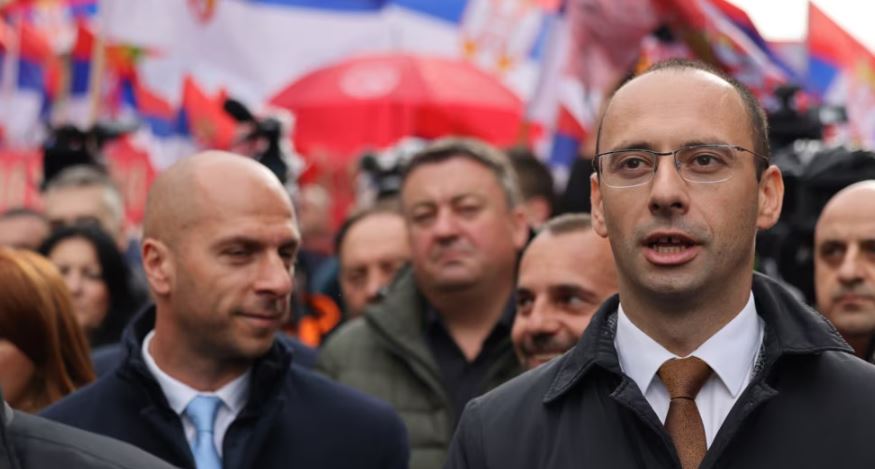
Less than a week after the Kosovo Assembly was fully constituted — with its president and five deputy speakers — the constitutionality of this process has been called into question by the Serb List.
This party, the largest representing Serbs in Kosovo, filed a complaint with the Constitutional Court against the election of the Serb deputy speaker, Nenad Rašić, claiming that constitutional and procedural violations occurred.
In its complaint, the Serb List requested that the court impose a temporary measure to prevent what it called “unconstitutional actions that could cause irreparable damage.”
The deputy speaker representing the Serb community was elected on October 10, with the position given to Nenad Rašić — the only MP from the Party for Freedom, Justice, and Survival.
His name was voted on after none of the Serb List candidates — who hold the majority of seats reserved for the Serb community in the Assembly — managed to secure the required votes.
According to Kosovo’s Constitution, the deputy speaker must come from “among the deputies holding seats reserved or guaranteed for the Serb community.”
Meanwhile, under the Assembly Rules of Procedure, “the candidate for deputy speaker from the Serb community is proposed by a majority of deputies representing that community.”
Rašić was also voted on separately from the deputy speaker representing other non-majority communities — unlike in previous practice — but with the Constitutional Court’s approval.
Nenad Rašić and the Constitutional Challenge
Based on these circumstances, Ehat Miftaraj, Executive Director of the Kosovo Institute for Justice, believes that Rašić’s election may not have been in line with the Constitution.
“I can say that Rašić was not nominated by at least six Serb deputies in the Kosovo Assembly. From this premise, it can be concluded that there were constitutional violations in his election as deputy speaker,” Miftaraj told Radio Free Europe.
He also mentioned the case of Emilija Rexhepi, who was elected deputy speaker representing non-Serb minority communities separately from the Serb candidate — again, contrary to earlier practice.
Although the situation seems clear, Miftaraj is cautious in making predictions.
“The Constitutional Court has surprised us before — it has changed standards and practices. Therefore, at this stage, it’s difficult to predict what the Court’s decision will be,” he said.
Constitutional law professor Mazllum Baraliu also considers the Serb List’s complaint legitimate but views it as damaging to Kosovo’s democratic process, since, as he said, it could lead to a suspension of the Assembly’s work.
“It now depends on the Constitutional Court. I’m convinced it will issue a protective, temporary measure… and the work of the Assembly will be suspended. After that, we’ll see what happens,” he told Radio Free Europe.
Baraliu disagrees with the Constitutional Court’s decision allowing the separate election of minority deputies, saying that the upcoming ruling on the Serb List’s complaint is hard to predict.
“With the kind of mix-ups the Constitutional Court is making with its decisions, anything is possible,” he said.
The constitution of Kosovo’s Assembly was delayed for nearly six months due to political disagreements.
During this process, the Constitutional Court issued three rulings based on party complaints, which set the conditions and deadlines for completing the Assembly’s formation.
Possible Consequences for the New Government
According to Miftaraj, if the Constitutional Court rules in favor of the Serb List, the situation in the Assembly could revert to the circumstances that followed the October 8 ruling.
“This would mean that the Assembly is not yet considered constituted. It would force the Assembly to hold another vote, in line with the Constitution and the Constitutional Court’s rulings, to elect a Serb community deputy speaker proposed by the majority of Serb deputies,” Miftaraj emphasized.
He added that such a decision could also affect the formation of the new government.
“This would nullify the nomination and mandate given by the president to the Vetëvendosje Movement for forming the next government,” he noted.
One day after the Assembly was constituted, President Vjosa Osmani mandated Vetëvendosje leader and acting Prime Minister Albin Kurti to form the new government.
The 15-day deadline for this process began that day and ends on October 26.
Doubts over Rašić’s election had earlier been voiced by other experts as well as representatives of former opposition parties.
“We are practically entering a phase of continuous constitutional violations,” said the chairman of the Social Democratic Initiative, Fatmir Limaj, on the day Rašić was elected deputy speaker.
(Source: Radio Free Europe)




