

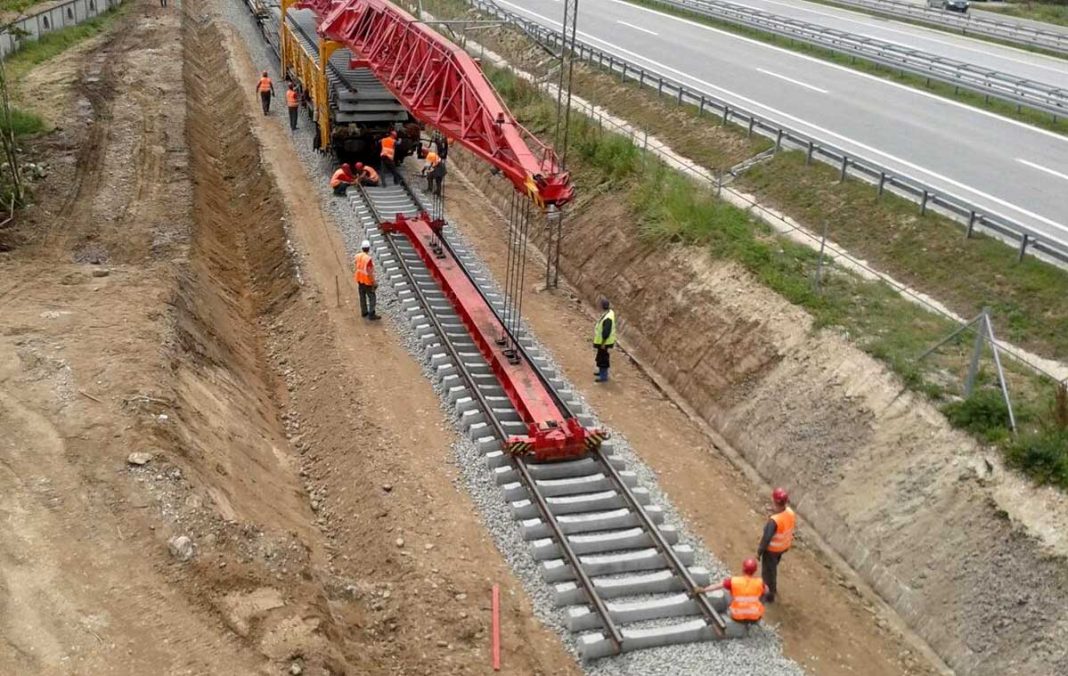
China and Serbia have inked two agreements for road construction amounting to around 4 billion euros (4.2 billion dollars) and signed a contract for the acquisition of five high-speed trains, as reported by the Ministry of Transport.
These contracts, sealed in Beijing, followed a day after the two nations signed a free trade agreement during a forum for the Chinese initiative “Belt and Road”, highlighting Beijing’s efforts to strengthen ties with Western powers.
The road construction agreements, totaling 4 billion euros, will empower Serbia to develop approximately 300 kilometers of new roads and highways, according to an official statement from the ministry.
Transport Minister Goran Vesić expressed, “This is a substantial contribution to the enhancement of road infrastructure”.
He also added, “We have procured five trains for 54 million euros, signifying that we will now have Chinese high-speed trains operating on the Belgrade-Budapest railway”.
Some of these trains are expected to commence operations in early 2025, connecting the capital city of Belgrade with the northern city of Subotica.
Vesić further noted, “When our Hungarian counterparts complete their section of the railway, we will extend our route to Budapest”.
The provided statement lacks specific details regarding project financing, and AFP has sought clarification from Serbian authorities.
Typically, Chinese investments in “Belt and Road” infrastructure projects involve loans, with Chinese companies carrying out the construction. However, several countries have encountered challenges in repaying these debts.
China has been injecting billions of euros into Serbia and neighboring Balkan countries in recent years, aiming to expand its economic influence in Central and Eastern Europe.
In September, Belgrade announced that the Chinese state-owned enterprise Zijin Mining would invest 3.8 billion dollars in the mining complex located in the eastern city of Bor.
As Serbia aspires to join the European Union, it has become a significant recipient of Chinese investments. Belgrade is actively seeking diverse investors amidst the geopolitical competition between East and West for influence in the Balkans.
Approximately one-third of foreign investments in Serbia last year originated from China, totaling 1.4 billion euros.
In 2022, China emerged as Serbia’s second-largest trading partner after Germany, with the bilateral trade volume reaching 6.15 billion dollars.




