

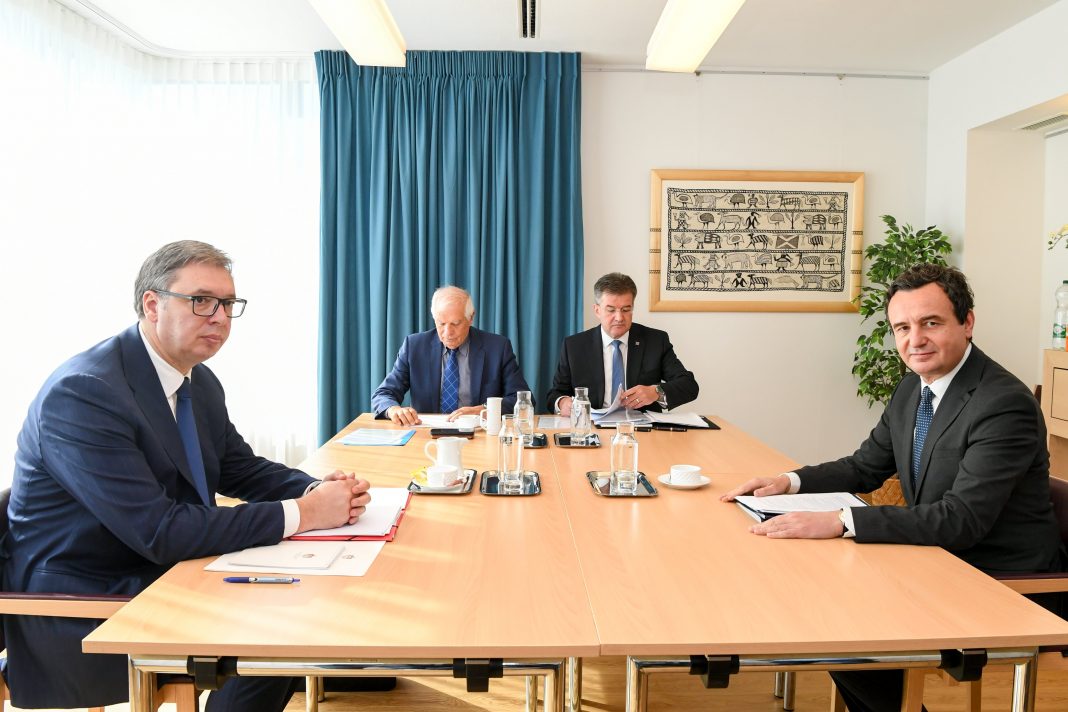
Serbia’s President Aleksandar Vučić stated that talks with Kosovo’s Prime Minister Albin Kurti ended without success “in terms of finding a clear path towards the normalization of relations”.
The two leaders met on Thursday in Brussels for the first time in over four months.
“We all have our proposals; the Albanians have theirs, and we have ours. In the end, we, as Serbia, accepted the EU compromise proposal. Kurti did not want to accept it. The meeting has ended,” Vučić told reporters.
When asked about the EU’s proposal, he mentioned that primarily it was about the Association of Serb-majority Municipalities – “to see if we have a credible process or not”.
“It is clear that Kurti simply avoids the formation of the Association… This is the essence of everything. Serbia does not shirk its obligations,” Vučić said.
Since there is no agreement, such a situation “only leads to bigger problems”, he added.
The Serbian President said that the meeting also discussed the possibility of holding new elections in northern Kosovo, an area predominantly inhabited by Serbs.
He mentioned that if Albanian mayors of municipalities there resign, he “will give everything he has” for the Serbian community to participate in the new electoral process, but he cannot promise on their behalf.
“First and foremost, I am concerned. Second, I am dissatisfied – at least, I am pleased that Serbia has shown its constructiveness, responsibility, and willingness to approach compromise solutions… And third, I am even more concerned about the position of the Serbian people in Kosovo, after everything I have seen and heard today,” Vučić said.
He did not specify further but mentioned that he is, of course, expecting the reaction of the EU.
Kurti and Vučić previously held separate meetings with the mediators of the dialogue, the EU’s Chief of Foreign Policy, Josep Borrell, and the EU’s Special Envoy for the Kosovo-Serbia dialogue, Miroslav Lajčák.
“Today we will see if they are ready to take responsibility,” Borrell wrote on the X platform, formerly known as Twitter.
I am hosting President @predsednikrs Vučić and Prime Minister @albinkurti for a High-Level Meeting of the Dialogue in Brussels.
It is time to start implementing the Agreement on the path to Normalisation in earnest. Today, we will see if they are ready to take responsibility. pic.twitter.com/q8ws2Pqtye
— Josep Borrell Fontelles (@JosepBorrellF) September 14, 2023
The meeting came at a time of heightened tensions in northern Kosovo, where around 50,000 Serbs live and make up the local majority.
The situation there has deteriorated since late May when Serbian groups began protesting against the appointment of Albanian mayors in the offices of municipalities in the north.
These mayors were elected in the extraordinary elections held in April in North Mitrovica, Zvecan, Zubin Potok, and Leposavic, but were boycotted by the local Serbian population.
Protests in the area turned into violent clashes several times, with the most serious incident occurring on May 29 when dozens of soldiers from the NATO mission in Kosovo, KFOR, were injured.
Holding the Kosovo Government responsible for the situation, the European Union has asked it to ease tensions by suspending police operations in the north, relocating municipal mayors to alternative offices, and announcing new elections.
So far, the Kosovo Government has reduced the presence of police units in municipal buildings in the north and expressed readiness to hold new elections.
For this purpose, it has also issued an administrative instruction, but according to election experts, it is unlikely to lead to a new election process.
The U.S. Special Envoy for the Western Balkans, Gabriel Escobar, who has consistently called for de-escalation in the north, said in an interview with Voice of America that the “fastest and easiest way to new elections” would be “if the current Albanian mayors resign”.
However, the Minister of Local Government Administration of Kosovo, Elbert Krasniqi, stated that such action is “a request only from Belgrade”.
Tensions in the north have also made Kosovo subject to punitive measures by both the EU and the U.S., as they have blamed it for not coordinating actions with them.
Kosovo, which declared independence in 2008, and Serbia, which continues to oppose it, have been engaged in talks to normalize relations since 2011.
With the mediation of the EU and the support of the U.S., the negotiations initially began on technical issues before moving to the political level.
The parties have reached dozens of agreements – from free movement to the issue of those missing from the 1998/99 war – but many of them have not been implemented.
The European Union continuously urges both parties to implement everything that has been agreed upon.
Normalization of relations is also a condition for both countries to progress in the process of integration into the European Union.
Kosovo applied for EU membership last year, while Serbia has been a candidate country since 2012.
The President of the European Council, Charles Michel, said last month that the EU could accept new member states by 2030 but that they “should not import conflicts from the past”.




