

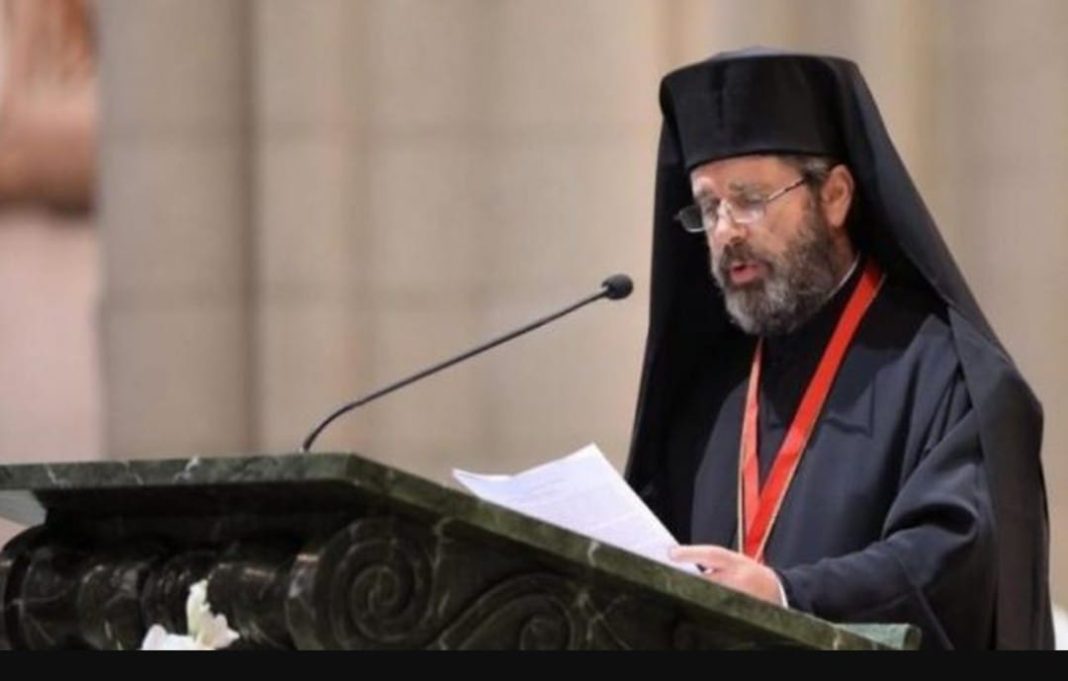
The Metropolitan of Korça, His Grace, Monsignor Joan Pelushi, was present at the international meeting held in Paris, “Immaginare la pace”, organized by the Community of Sant’Egidio, on September 22-24, 2024, as a representative of Albania.
The meeting was attended by the French President Macron, the Mayor of Paris Anne Hidalgo and senior clergy from all faiths around the world.
The full speech of Monsignor Joan Pelushi
The Church has a long tradition of teaching on solidarity with the poor and peace. The main elements that define the Church’s response to poverty, solidarity and peace are love and dignity for every human person, no matter who they are. It is the right of every human being to be treated in accordance with his innate dignity and society should be directed towards this good. The socio-economic structures that keep people in poverty are unjust and require improvement. Those who oppress the poor show contempt for their Creator, but those who are kind to the needy honor Him.
In one of the oldest texts of the Church, the Didakia, Christians were commanded to share with others all they had:
“If you have in common what is eternal, how much more should you have what is transitory.” In his lecture “On love for the poor”, St. Gregory the Theologian begins with a review of various Christian virtues and concludes that above all virtues, we must look at love, as the first and highest of the commandments, since it is the summation of the Law and the prophets, and the most vital part of it he found in love for the poor, as well as in compassion for people. We must constantly remember that the first work of Christ was to preach the gospel to the poor (Lk. 4:18). The Church stands to continue the saving work of Christ and the poor must be the first for that too.
Peace is a combination of justice and solidarity. There can be no peace if there is no justice and there can be no justice if there is no solidarity.
Wars are the result of the violation of people’s rights, the exploitation of individuals or countries, and greed, which always create poverty and conflict. The UN 2030 Agenda for Sustainable Development states: There can be no sustainable development without peace and there can be no peace without sustainable development. Because extreme poverty is both a product of conflict and its cause. It fosters frustration and hopelessness, which are key ingredients in generating violence. History has shown thousands of examples of how war and conflict lead to poverty and destruction, and poverty leads to further conflict, thus creating a vicious circle. The war in Ukraine and Gaza, as well as conflicts in many parts of the world, show us the great damage of war and the suffering and poverty of millions of people.
They are a strong call to all of us to try to stop wars, make peace wherever there is conflict, and stand in solidarity with the poor and needy. By fighting poverty, we reduce the possibility of conflict, and by avoiding conflict, there is more opportunity to ensure peace.
Solidarity reaffirms the idea that people are created as communal beings and are called to live in community with one another, uniting for the common good and preserving the dignity of every human person. We are all brothers and sisters. To be in brotherhood and solidarity with one another is not only to feel pity for others, but to feel their pain and act for the good of others. We need to renew the mindset that thinks in terms of community.




