

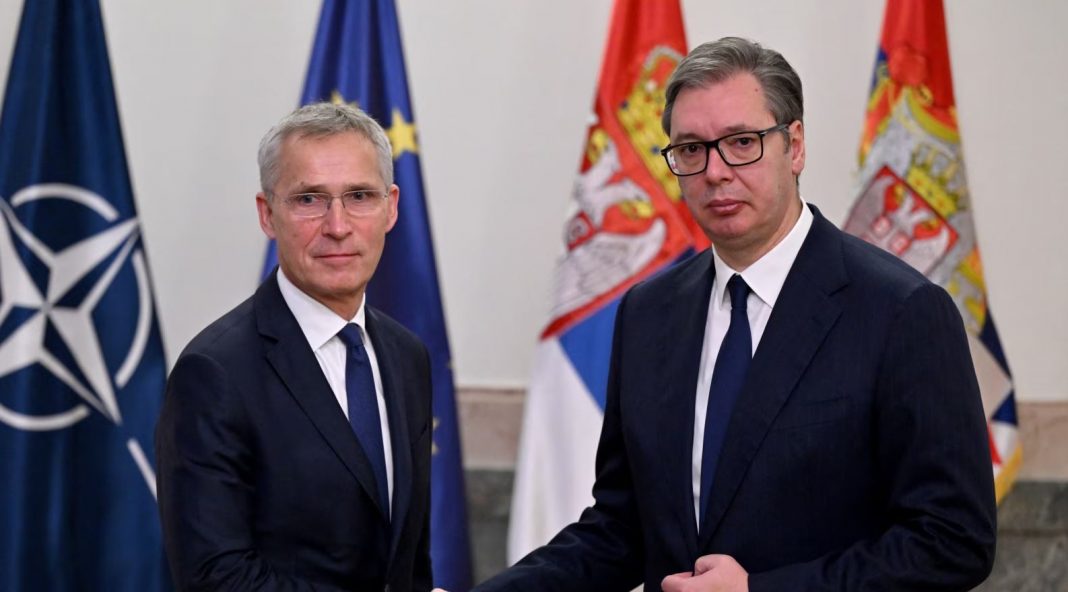
NATO Secretary General Jens Stoltenberg stated on Tuesday in Belgrade that the concentration of Serbian military forces near the border with Kosovo does not contribute to easing the tense situation between the two countries.
“I expect both parties to reduce tensions and refrain from escalating actions,” Stoltenberg said at a press conference with Serbian President Aleksandar Vučić on Tuesday morning.
Stoltenberg arrived in Belgrade after a visit on Monday to Pristina, where he emphasized that the military alliance is considering the possibility of a permanent increase in its military presence in Kosovo following the outbreak of violence in September.
Tensions between Kosovo and Serbia escalated significantly on September 24 when the Kosovo Police were attacked by an armed group of Serbs in the village of Banjska in the north of the country, resulting in the death of soldier Afrim Bunjaku. Three Serbian attackers were killed in the ensuing clashes.
Milan Radojičić, the former deputy leader of the Serb List, the largest Serbian party in Kosovo supported by Belgrade, claimed responsibility for the September 24 attack.
Serbia has deployed troops near the border with Kosovo on several occasions in the past, most recently after the Banjska attack, but withdrew its forces following diplomatic intervention from the West.
Stoltenberg also stated in Belgrade that those responsible for the Banjska attack must face justice.
“We welcome the fact that Serbia is willing to cooperate,” Stoltenberg said at a joint press conference with Vučić.
He added that the attack on KFOR members during the Serbian community’s protest in Zvecan at the end of May was also a topic of discussion with Vučić.
The NATO Secretary General emphasized that he “welcomes and supports the formation of the Association of Serb-majority Municipalities in Kosovo”.
“This would be the key to normalizing relations. I call on Belgrade and Pristina to engage in dialogue under the EU’s auspices; this is the only way to achieve lasting peace and stability,” he said.
Vučić: It is our job to decide where to deploy the army
Responding to the West’s request for Serbia not to gather its army near the Kosovo border, Serbian President Aleksandar Vučić replied that the Serbian army “has never exceeded its rights and competencies”.
“Where and how we deploy the army in accordance with the Constitution of Serbia without endangering anyone, that is our job,” he added.
Regarding the Banjska attack investigation, Vučić said he has a different view of what happened but understands NATO’s and the West’s demands.
“In accordance with local laws and regulations, we will hold accountable those who participated in criminal acts in Banjska,” he added.
Vučić praised Serbia’s cooperation with NATO and the KFOR mission as good and correct.
Stoltenberg’s visit to the region comes amid tensions and warnings of possible conflicts.
A few days before Stoltenberg’s visit to Kosovo, Ukraine warned that Russia is seeking to incite conflict in the Western Balkans.
The European Union has supported Ukrainian President Volodymyr Zelensky’s stance on this issue, while the U.S. State Department told Radio Free Europe that Russia’s malign influence in the Western Balkans hinders the states’ path to Euro-Atlantic integration. The U.S. emphasized that this influence underscores the urgency of Washington’s efforts to counter Russian influence.
Kosovo’s Prime Minister Albin Kurti also spoke on November 19 about Russia’s intention to ignite a crisis in the European Union’s backyard, aiming “to distract NATO”.
Today, Stoltenberg will visit North Macedonia, a NATO member state, where he will meet with state leaders and address the country’s Parliament.
On November 22, the NATO Secretary General will conclude his Balkan tour with a meeting with the leaders of NATO member states from the region. He will meet with Albanian Prime Minister Edi Rama, Croatian President Zoran Milanović, Montenegro’s Prime Minister Milojko Spajić, and Slovenia’s Prime Minister Robert Golob.




