

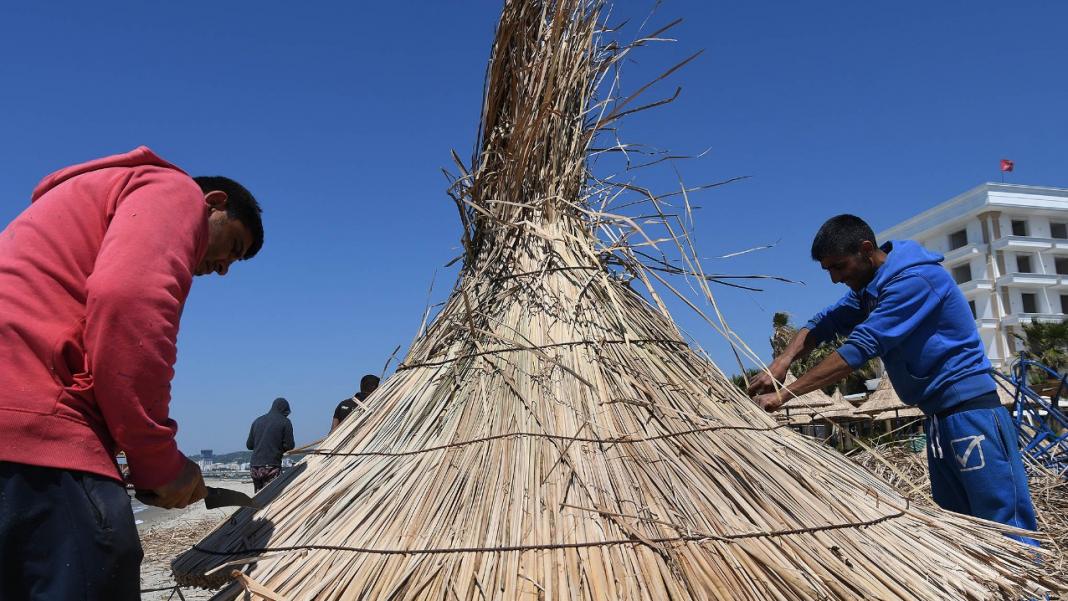
Working with straw is an old tradition of the Roma community. For centuries, the Roma people have worked with straw to sustain their necessities, such as making baskets to hold food, which was later mastered to the needs of the time, and seen as a source of income. But today, this tradition in our country is almost on the brink of extinction.
Vasillaq Ajdini from Gjirokastra has been a craftsman since his early childhood. Today, at 64-years-old he still works with straws mainly for weaving baskets, vases, and other objects. But this is a job that does not provide enough to sustain his family; however, it is the only thing he knows how to do. He tells us that his main challenge is to find raw materials, but even when he does, the problem rests to find a market where he can sell his products.
“I work every day; I try to get some income for my family with the straws. Even though the crafts are beautiful, people tend to prefer plastic. I go out in the streets and try to sell them, but it’s not easy. There is more interest from tourists”.
He says that the main problem is finding the raw material, and this because of river erosions that retrieve gravel for construction companies, they cut off weeping willows that grow beside the rivers. Ajdini addressed the Municipality of Gjirokastra with some paperwork to ask them for a piece of land so that he can grow weeping willows, in order to use its branches to produce his artistic crafts.
“It is my dream to have the possibility to cultivate willows and then have a small workshop where I can employ other Roma people. A small workshop like “Artistikja” from back in the day. We used to do very special and beautiful things. Its former director promised me that if I manage to produce similar crafts, he will guarantee to sell them abroad, there’s demand from Germany”, he said. But his wish remains a hostage of a lack of raw materials.
According to the latest INSTAT data, 28% of the total straw craftsmen are from the Roma community and Egyptian, predominantly in the area of Gjirokastra, Korça, Elbasan, but also in Tirana. This is one of their traditions that risks disappearing because the younger generation has no interest in learning this vocation, exactly because there is no market to sell them, while profits from its sale are not enough.
Pëllumb Mustafaj spoke along the same line. He has been weaving straws for over 40 years.
“I was 20 years old when I started working at the farm, during the Communist regime. After the fall of the regime, the farms closed down and we became unemployed, but my brother and I are carrying on as we’ve been feeding on it. None of my children inherited the vocation, because profits from their sale are too low. They’ve migrated abroad to guarantee a future for themselves and their families”.
Pëllumb also tells us that this period is more promising in terms of demand as he also crafts thatch beach umbrellas. More and more touristic operators are substituting the regular beach umbrellas made of cloth with thatch or straw umbrellas. However, the biggest problem for him remains to be the lack of a stable market, even though up until now he has been able to sell what he crafts, he emphasizes that if he was guaranteed the sale of what he makes, he would definitely be making more.
A study of the organization ‘’Together for life” has shown that the artisans asked regarding the difficulties they face have mainly focused on the state policies in taxation, the lack of a permanent sales market, the lack of raw materials, etc.
“For 91% of artisans, high taxes are the main concern that prevents the progress of the sector of woven products. Low access to funding and financing, because of the high loan interests and the lack of supportive policies from banks and institutions of micro-loans make for yet another main financial barrier. Even though the omission of taxes for creative enterprises in the first 3 years, has been promised on numerous occasions, it hasn’t been kept and the producers of woven products believe that the reduction of taxes for a specific period of time would revive the entire artisanal sector. For 87% of artisans, the lack of a permanent market is one of the main concerns. Over 70% of respondents also express a concern regarding the lack of raw materials, as well as the lack of soft loans or other funds and grants that could support this sector.”- states the report.
Raxhi Rakipi, representative of the Egyptian Youth Movement tells us that the Roma community in Elbasan, Gjirokaster, Berat, Tirana, and other cities make baskets of different sizes, vases, braces for bottles, canisters, wastebaskets, large beach umbrellas for resorts, etc.
“The Egyptian Youth Movement has tried to promote these crafts through its website as well as through mediating the connection of Roma and Egyptian craftsmen with traders. But we know that this isn’t enough and we expect institutions to implement the programs incentivizing employment or self-employment. There should be a market, where these artisans can sell their crafts,” said Rakipi.
Meanwhile, the “Together for Life” organization has posted a number of suggestions for straw artisans regarding how they can survive with this craft and contribute to the conservation of this ancient Roma and Egyptian tradition.
a) The creation of specific markets for artisans in the centers of large cities, as fairs, however often they can be organized, aren’t enough in order to secure permanent employment and to create sufficient and sustainable income.
b) The formalization and regulation of the artisanal market through more lenient fiscal policies
c) Straw artisans should be supported in order to increase their capacity in the field of managing, so they can understand the basics of business, marketing, and intellectual property.
d) The organization of artisan-themed events.
e) More national policies for the increase of hectares planted with white and red weeping willow, which serve as raw material
f) More support in the creation of elite products. More incentives and support through ideas and funds for the creation of artisanal souvenirs, which won’t only raise the values of the tourism sector, but will also provide artisans in these markets with a stable income.
g) The collection, analysis, and processing of data and information regarding the artisanal market in general as well as its sub-sectors.
All of the above would help in the conservation of a beautiful and unique tradition and at the same time, they would help Roma and Egyptian families secure the necessary income.
The Poznan Declaration, signed by Balkan leaders, outlines one of the objectives in order to increase the employment of the Roma people to 25%, from the current 16.5%.
The Regional Cooperation Council emphasizes that “The most efficient way to significantly increase the rate of employment of the Roma is recognizing undeclared labor in which they are engaged, without lowering the family’s income. In order to do that, it is necessary to intervene in labor legislation, taxes, and social assistance in order to assure that there are special registries for these employers which enable them to maintain social assistance rights and be excluded, or at least pay a symbolic fee until their economic capacities are sufficient to get regular employment”.




