

The political tensions regarding the dialogue between Kosovo and Serbia, the lack of understanding of the specific position and needs of the Serbian community by the Albanian majority, as well as the high level of nationalism, are some of the factors that deepen inter-ethnic divisions in Kosovo.
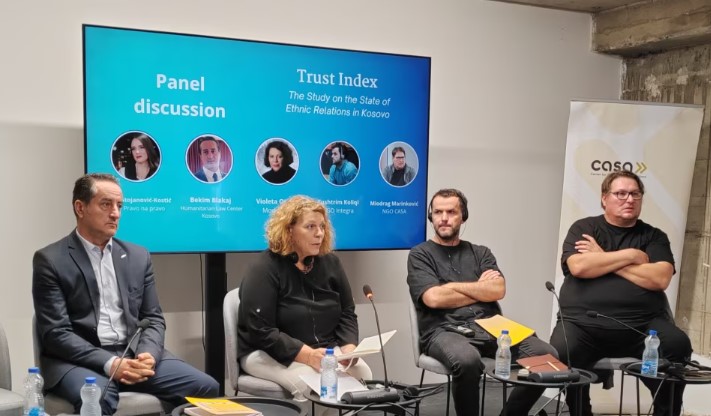
These are the main findings of the Study on the state of ethnic relations in Kosovo – the Trust Index, which was carried out by the Barabar Center. This center was founded by the non-governmental organizations Integra from Pristina and the Center for Affirmative Social Action from North Mitrovica with the aim of promoting a multi-ethnic and multilingual Kosovo, dialogue, tolerance and trust building.
The research for the study on the state of ethnic relations was carried out from the end of March to the middle of April 2024, where 500 respondents participated, of which 302 were Albanians and 192 were Serbs.
About 57 respondents from the Serbian community and about 52 from the Albanian community think that Kosovo Albanians and Serbs will never be able to trust each other again, while over 69 percent of respondents from the Serbian community and over 64 percent from the Albanian community, estimate that it is important to achieve reconciliation, so that future generations can live better.
The results of the Study on ethnic relations were presented on September 24 in Pristina, on the anniversary of the attack in Banjska in Zveçan, when a group of armed Serbs killed a Kosovo policeman.
During the exchange of fire that followed, three more Serbian attackers were killed. This attack is preceded by an ongoing crisis in the north of Kosovo as a result of the exit of Serbs from the institutions of Kosovo, due to the decision of the Government of Kosovo to convert license plates issued by Serbia to those of Kosovo.
In the question how to find a solution?”, 71 percent of respondents from the Serbian community and 62 percent from the Albanian community said that the promotion of peace and tolerance by politicians of all communities would help achieve peace and tolerance in Kosovo.
Also, public narratives and hate speech in the public space were mentioned as one of the main factors that promote mistrust between ethnic communities in Kosovo.
Radio Free Europe (REL) reported on July 9 that there is a negative narrative when it comes to the coexistence of Serbs and Albanians, after which the Minister for Communities and Returns, Nenad Rasić, raised this issue at the meeting of the Government of Kosovo. He emphasized that coexistence should be a completely normal phenomenon in a multiethnic society.
The civil sector, on the other hand, emphasized that cooperation between Serbs and Albanians in Kosovo mainly takes place “behind the scenes” due to the rhetoric used by politicians. At the conclusion of the Study on the state of ethnic relations in Kosovo, it is said that the respondents from both communities have shown skepticism towards mutual relations, but at the same time they have also shown some optimism and interest in their improvement.
“The high percentage of negative attitudes indicates a deep-rooted mistrust, but a significant number of undecided respondents indicates that there is room for potential change,” said Boban Simic from the non-governmental organization Center for Affirmative Social Action, writes REL.
The Albanian and Serbian communities in Kosovo have been deeply divided since the last war in 1998/99, when around 13,000 people – mostly Albanians – were killed. Also, close to 1,600 others are considered missing.
Meanwhile, since 2011, Kosovo and Serbia have been holding a dialogue under the mediation of the European Union, a process aimed at normalizing relations between the two countries.




