

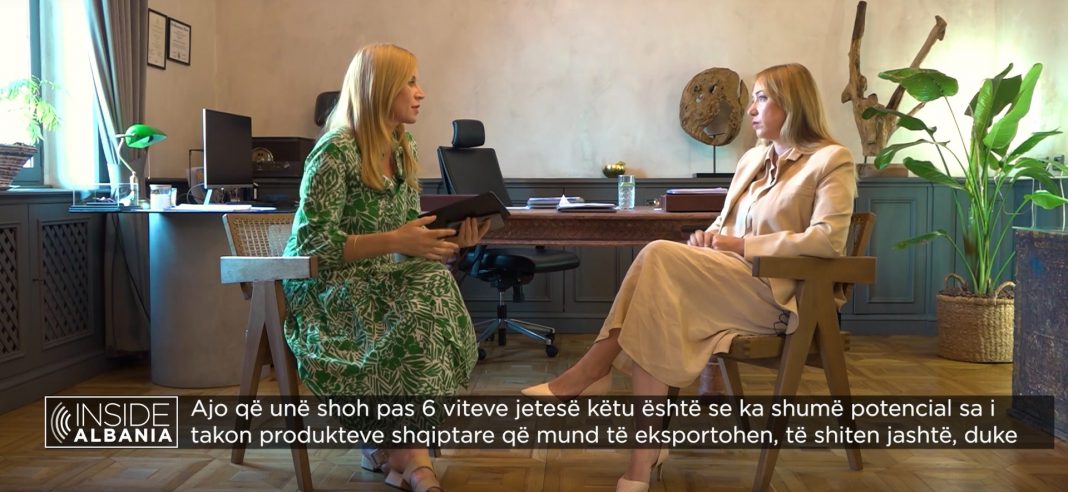
In an exclusive interview with Euronews Albania, Frida Krifca, the Minister of Agriculture for Albania, shed light on the challenges facing the agricultural sector in the country.
Krifca’s experience in working closely with farmers and understanding their needs has shaped her approach to tackling issues such as rural-urban migration, attracting young talent to the sector, and promoting formality within the industry. Additionally, she discussed the importance of aligning agricultural practices with European Union (EU) standards and the strategies being implemented to facilitate market integration.
Migration, both internal and external, poses significant challenges to Albania’s agricultural sector. Krifca emphasized that this phenomenon is not unique to Albania but affects the region and other European countries as well.
“In a recent statistical report of Eurostat that I was reading, around 45% of the space in EU is actually considered rural territory, and only about 21% of the population lives there. You see countries such as Croatia suffering a lot within the European Union, or Bulgaria suffering a lot where they’re losing roughly between three to 3.5% each year, while other rural areas such as the islands of Greece, are having a spike,” she told Inside Albania host Alice Taylor.
To counteract the loss of interest in rural areas, Albania has focused on agritourism. By supporting and financing over 100 agritourism initiatives, the government aims to diversify farm activities and attract young people to the sector. The combination of traditional farming practices and alternative income streams has proven appealing to the younger generation.
“We have linked the possibility of maintaining people in the rural areas and young people, especially in rural areas with the diversification of the farms. Ever since 2018, we introduced a policy of agritourism. We have seen that this has been quite an attraction for the young people as well to deal with different kinds of works that are happening in the farm,” Krifca said.
Informality is another hurdle for Albania’s agricultural sector. Many farmers lack proper documentation for their land, hindering their ability to register with tax authorities and access digital services. To address this issue, the Ministry of Agriculture has made significant progress in identifying farmers through a unique identification number (NIPT). Educating farmers about the benefits of having an NIPT, such as eligibility for support policies and subsidy schemes, has helped increase the number of registered farmers from 12,000 to approximately 94,000.
“When I started working as previous director of the vetting agency, we had roughly around 12,000 farmers identified with this number, it was very little so the progress in four or five years has been tremendous in also educating the farmers that if you are a holder of such an NIPT number, you are able to benefit from the policies of support from the subsidy schemes,” she said.
As Albania progresses towards EU accession, aligning agricultural practices with EU standards is crucial. Krifca highlighted two parallel plans for European integration: regulatory alignment and compliance within the sector.
“Regulatory alignment involves working with regulators and agencies under the Ministry of Agriculture to ensure legislation is in line with EU requirements. Simultaneously, the entire agricultural sector must gradually adapt to these regulations. Investments in agriculture, food processing, and the entire value chain are essential for the sector’s growth and successful market integration. With the EU accession process, there are a lot of challenges that lie ahead in terms of aligning what farmers are doing, and what needs to be done in order to enter the European market,” the minister explained, adding that progress is consistent and ongoing.
Krifca acknowledged Albania’s immense potential for exporting various agricultural products: olive oil, honey, herbs, and other locally produced goods have a market abroad if properly branded and marketed and can be sold for 50% more than the regular price.
Encouraging cooperation among farmers through joint applications for financial support has proven effective in fostering communication, planning, and negotiation power. This approach helps farmers collectively address challenges and secure better prices for their produce and inputs, Krifca explained.
You can watch the Minister’s interview to Inside Albania in the link below.




