

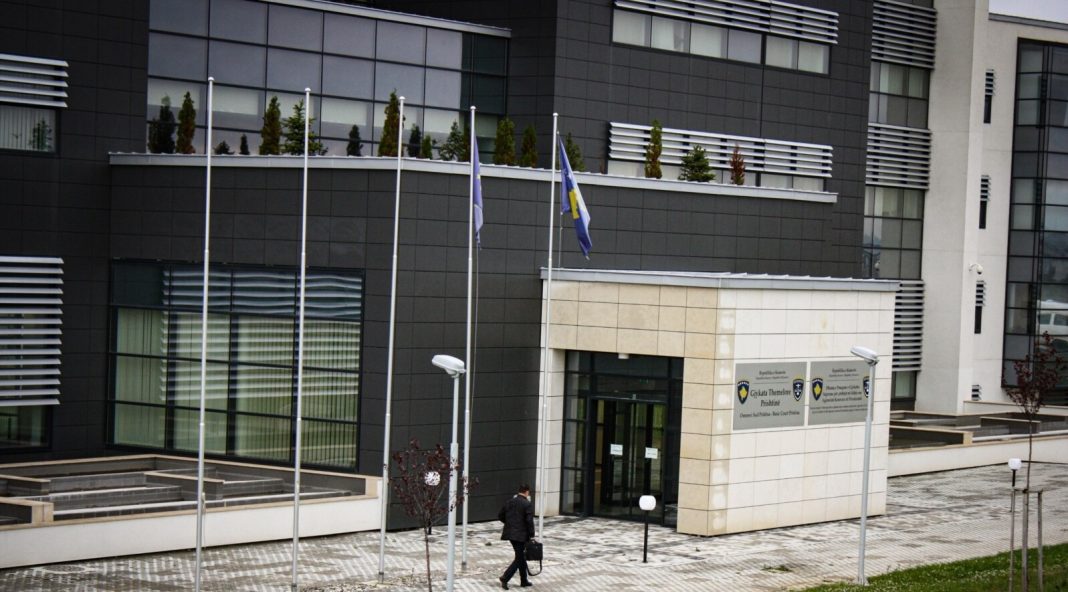
In Kosovo, there is no political will to refrain from interfering in the judiciary, and the country still needs to work on combating corruption.
This was stated in the Corruption Perceptions Index report for 2023, compiled by the international organization Transparency International.
Like last year, Kosovo scored 41 points.
The index ranks 180 countries and territories worldwide annually based on the perceived level of corruption in the public sector. It uses a scoring methodology from zero to 100 points, where zero indicates a highly corrupt country, while 100 denotes a clean one.
In the section on Kosovo, the report states that despite continuous efforts, key reforms for the independence of the judiciary system, such as the establishment of the vetting process and the adoption of new legislation to strengthen integrity within the Prosecutorial Council, are progressing very slowly.
“Worse still, the continuous interference of the Government in judicial matters, illustrated by the dismissal of the chief of the Kosovo Police Special Unit, along with the majority deputies’ interference in the parliamentary investigation of a major corruption case, suggests there is no political will to relinquish control and strengthen independent oversight,” the report said.
Vetting process
The vetting process has been promised by the Government of Prime Minister Albin Kurti in the four-year program.
However, it is still in the initial phase.
This process involves the re-evaluation of prosecutors and judges, enhancing their professionalism, fighting corruption, and preventing politicians or other elements from influencing justice.
The concept document for vetting has also been assessed by the Venice Commission.
According to the commission, effective vetting, in Kosovo’s case, requires a combination of various measures that would have a positive impact on the integrity and efficiency of the justice system.
As a first step, verification of high-level personnel in the judiciary and prosecution has been recommended.
Constitutional amendments for vetting at higher levels have been drafted by an ad-hoc commission of the Kosovo Assembly, supported by the Ministry of Justice.
Later, in March 2023, the President of the Kosovo Assembly, Glauk Konjufca, had sent some amendments to the Constitutional Court for review to determine if they are in line with the Constitution.
The Constitutional Court has not yet issued its opinion on this matter, although, according to the law, this group must provide an assessment within six months of receiving the request.
According to the report of the United Nations Development Programme (UNDP) and the United States Agency for International Development (USAID) Public Pulse, published this year, only 29 percent of citizens are satisfied with the work of the justice system in Kosovo.
Regional countries
From the countries in the region, Albania, North Macedonia, Montenegro, and Bosnia and Herzegovina have made slight progress. Serbia remains stagnant.
Albania
Albania is rated 37 points – one more than last year.
Although the improvement in the situation has been noted, especially in the investigation and prosecution of high-level corruption, progress in Albania is said to depend on strengthening criminal justice legislation and ensuring effective oversight of the executive branch.
The report has referenced the work of the Special Structure against Corruption and Organized Crime (SPAK), which was established in December 2019 to investigate corruption at high levels and organized crime.
The United States has stated its support for SPAK’s work and judicial reform in Albania.
“The decision to create a new ministry responsible for anti-corruption activities means there are expectations for effective integrity mechanisms. However, this cannot be achieved if Parliament does not have greater autonomy, and if civil society organizations and the media cannot perform their oversight role without interference from the authorities,” the report said.
Adea Pirdeni was appointed at the head of the new ministry in Albania for Administration and Anti-Corruption, while she has been Deputy Minister of Justice until now.
North Macedonia
North Macedonia is ranked on the list of countries where weak justice enables the flourishing of corruption.
This country has made slight progress, with 42 points – two more than last year – but, according to the report, progress has been backtracked following changes made to the Criminal Code.
“The decision to reduce penalties for abuse of official duties for personal gain and the shortened deadlines for initiating legal proceedings for suspected corruption cases are in favor of corrupt individuals, as about 200 cases will be time-barred, including those against former high-level officials. Politically motivated appointments and dismissals of court officials raise concerns about the judiciary’s ability to effectively fight corruption,” the report said.
Changes to the Criminal Code were approved in September of last year.
The government has justified these changes with the need to harmonize the Criminal Code with European practices, but also to abandon points of legislation, which, according to the Government, still relied on the practices of the former Yugoslav system.
For legal experts in Skopje, the changes have been scandalous and “in favor of protecting crime”.
Montenegro
Montenegro – with 46 points, one more than the previous year – has been mentioned as an example of how the early capture of the state can have long-term consequences for institutions.
“After three decades of one party in power came to an end in 2020, many felt encouraged to report past corruption. However, the slow progress in processing these cases and the struggle to rebuild a functional judiciary show how deep the capture has been from the previous regime and how the justice system has been destroyed by organized crime,” as a reference to the governance of Milo Đukanović.
According to the report, to be successful, the coalition government led by the Movement Europe Now must prioritize the fight against corruption and organized crime.
The new government of Montenegro was elected in October 2023, headed by Prime Minister Milojko Spajić.
The Europe Now center coalition won the early parliamentary elections held in June.
Serbia
With 36 points – the same as the previous period – Serbia is said to be experiencing a decline in democracy, with “its autocratic Government using special laws to limit transparency in large-scale projects”.
There, contracts with inflated prices and poor-quality construction in several projects, which are expected to be finalized with public funds totaling 1 billion euros, have been mentioned.
Another problematic issue is electoral fraud in the recent elections in Serbia, from which the ruling party, the Serbian Progressive Party (SNS), and its allies are said to have benefited.
“This institution of justice, captured by politics, is failing to protect the public interest at crucial times, reducing the state’s ability to end corruption”.
Parliamentary, local, and regional elections were held in Serbia in December 2023.
This electoral process has been described as unfair by international observers.
However, Serbian President Aleksandar Vučić and his allies have said the elections were fair.
The opposition rejects the election results and has protested several times in Belgrade.
Bosnia and Herzegovina
In the section on Bosnia and Herzegovina – with 35 points, one more than the previous period – it is said that complex governance and the judicial structure leave room for the concentration of power in major ethnic-based parties.
“Their dominance in all branches of government contributes to systematic corruption and undermines the functioning of the state, so citizens lose trust in institutions”.
For many, this negative trend is said to have worsened due to efforts by the political elite to silence oversight.
World in trouble with corruption
Overall, the report mentions that the majority of countries have made little or no progress in combating corruption in the public sector.
Denmark is at the top of the list, with 90 points, as highly effective in the fight against corruption, while Somalia is at the bottom with 11 points.
The average points of countries remain unchanged – at 43 points – for the 12th consecutive year, and over two-thirds of states have more than 50 points.
According to the report, this indicates serious problems with corruption.




