

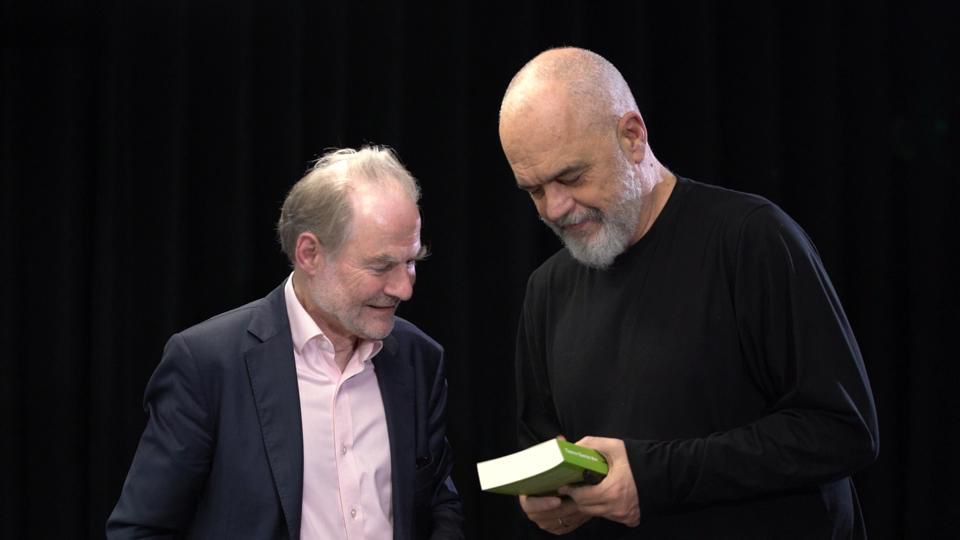
Historian, author, and acclaimed British journalist Timothy Garton Ash made an appearance on Albanian Prime Minister Edi Rama’s podcast “Flasim” this Saturday.
During his conversation with Prime Minister Rama, Timothy Garton Ash highlighted the significant advantage of being both a journalist and a historian simultaneously. According to him, “both roles share a fundamental quest for the truth”.
“Both our roles are about seeking the truth, although we approach it differently. Conflicts arise when one begins to think – I refer to it as ‘the Kissinger rite’ – that they are a decision-maker, striving to act as a government and shape government policies, rather than pursuing our primary duty, which is to search for the truth and present it as it is, by telling the truth to those in power. I have always believed that this is the essence of what I have done,” he expressed.
Garton Ash characterized Brexit as the “greatest political defeat in his lifetime”.
“My whole life has revolved around Europe; I am an English European, so Britain’s separation from Europe is a tragedy for Britain, but I also think for the European Union and the future of Europe. However, I do not think that Brexit has severed the British strand that you described. I think it is still there,” he added.
According to the historian, the mistake made by Tony Blair was his belief that unlimited openness was possible.
“Opening of society, opening of finances, opening of the economy, opening of immigration without any reaction! Because, in fact, there was a reaction. And the slogan of the Brexit supporters, which gave them the victory, was ‘Take back control’. What is happening now in Germany is that German leaders are talking about ‘Kontrollverlust’ (loss of control). So, I think all our societies need that feeling that things are under control, that immigration is being managed. So, I think this was a mistake of Blair’s years, which we paid dearly for. But the fact that we are now trying to get it under control, like all other European countries, does not mean it is the end of our cultural diversity; it is beyond that,” he said.
Discussing the future of the European Union, the British historian stated: “If a new generation of Europeans were mobilized, not only to protect what we have achieved, which is the best Europe we have ever had, but also to expand and improve it, which is entirely possible, after 10 years, we could look back and have a Union of 35 states and have succeeded in protecting what we have, the free way of life in Europe. It is possible, but it is in our hands”.
According to him, “this should happen without any single country as a hegemon”.




