

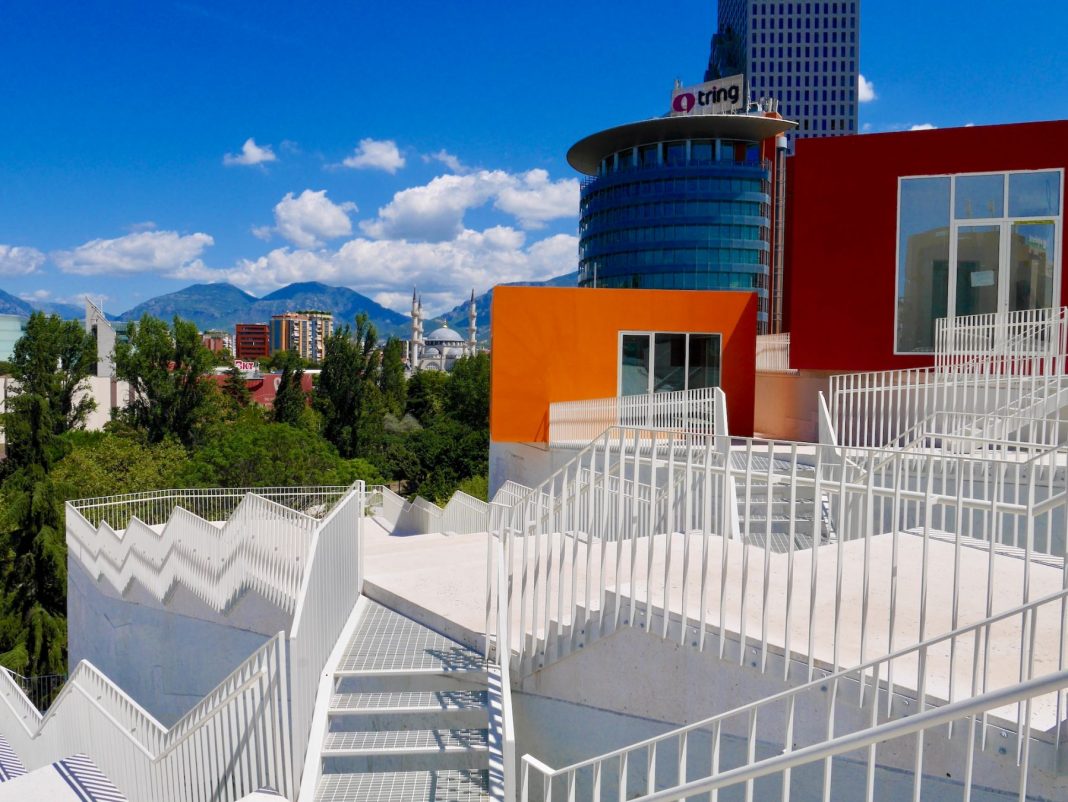
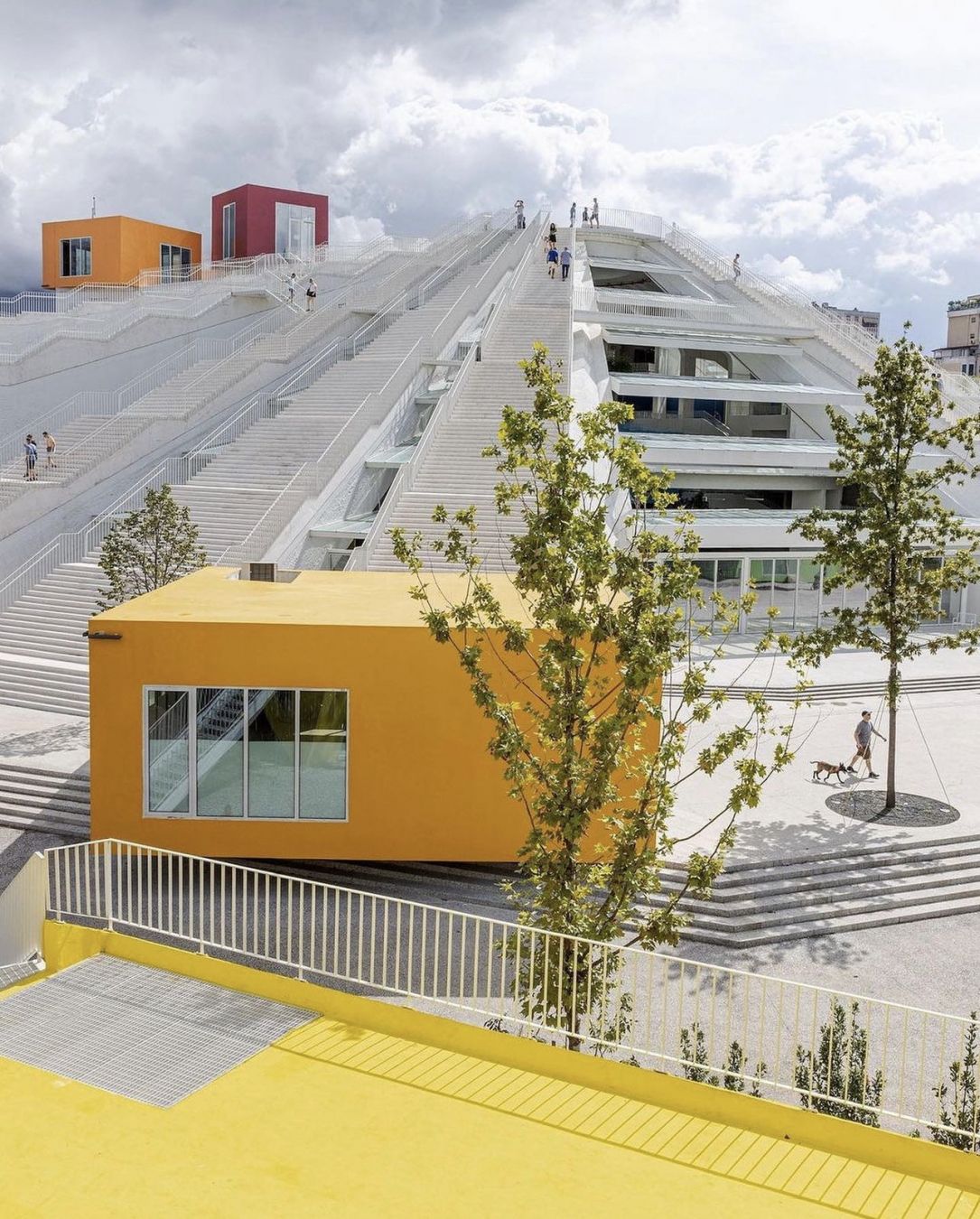
Fourteen steep white staircases scattered across the structure lead to the top of the Pyramid of Tirana. A relic from the communist era (it was a celebratory mausoleum for Enver Hoxha, built in 1988 on the initiative of the dictator’s daughter and son-in-law), after four years of work, it has finally reopened its doors to the public and is set to become the largest multifunctional hub in Eastern Europe. It was born thanks to an investment from the Albanian-American Development Foundation (AADF) and the Municipality of Tirana, designed by the famous Dutch architectural firm MVRDV. The firm has expertly renovated the dilapidated complex and its outdoor spaces: the Pyramid, while retaining its original basic structure, is now a transparent building dominated by white and light, with large windows, iron elements, colorful cubes, trees, and greenery all around.
Tirana is the new capital to discover
“Its halls will host start-ups, offices, events, and a TUMO center to provide young Albanian and regional students with access to digital skills that can give them future employment. Similar centers are already operational in Yerevan, Paris, Berlin, Los Angeles, Zurich, and Lyon, but Tirana’s is the first space for creative technologies in all of the Balkans,” says Ketrina Jarazi, the director of the Department of Tourism of the Municipality of Tirana, as we walk around the structure. As I walk, I realize how much the city has changed in recent years, many new buildings, yes, but also renovated areas, openings, high gastronomy restaurants, events every week, and many tourists: Tirana now has all the right cards to become the new destination for a different kind of weekend. “This year the number of visitors has been very high for a small country like ours, surrounded by giants like Italy, Croatia, Greece, and Turkey: a total of 8.2 million tourists (according to data from INSTAT, the Albanian National Institute of Statistics), including many Italians, have crossed the Albanian borders and visited Tirana from the beginning of the year until now,” she concludes, seemingly reading my thoughts.
What to do in Tirana
In recent years, the winds have shifted, and it’s quite evident. Low-cost airlines now connect the Albanian capital to major European airports, and starting from November, Ryanair will also fly to Tirana from Bologna, Milan, Rome, Catania, Treviso, and many other cities across the old continent. The events calendar is continuously evolving: this summer, Tirana hosted artists of the caliber of Enrique Iglesias, Ricky Martin, and Placido Domingo, while the TIFF International Film Festival and the Tirana European Youth Film Festival drew actors and directors from all over the Balkans and Europe. But the year isn’t over yet: on October 16-17, the Kosmos Festival brings local and international classical music artists to the city, on October 22, there’s the Marathon, from November 15 to 19, the Book Fair is an opportunity to meet Albanian authors, many of whom are also translated into Italian. On November 29, the White Night brings music, dancing, and fun to the streets of “Blloku”, the nightlife district. And then there’s the Christmas market, which gathers artisans, wineries, and gastronomic stands in festive Piazza Scanderbeg, from December to the beginning of the new year.
Visiting museums
From the grand square, the heart of the city, to BunkArt2, it’s just a short walk. It’s a museum dedicated to the victims of the communist regime, housed in an atomic bunker beneath the Ministry of the Interior, right in the city center. A younger sibling of BunkArt1 on the outskirts of the capital, which is also inside a bunker (seven floors below ground level) with rooms, halls, chambers, and a theater. These two are unmissable stops to delve into Albania’s not-so-distant history. However, the real gem is the House of Leaves, winner of the 2020 Museum Prize from the Council of Europe, located in the former headquarters of “Sigurimi”, the Albanian secret police during Hoxha’s time. Among bugs, archives, and various devices, the museum tells the story and commemorates the psychological violence, human rights violations, and control perpetrated against citizens during the harsh years of the communist regime.
Tirana with a view
At the end of the day, the streets of the city fill up with people. The Grand Park, at the edge of “Blloku”, attracts families, athletes, elderly couples on a stroll, and groups of friends meeting up. Walking here is always a pleasure, and the impression is that you are never alone but part of a large community. At sunset, however, make another visit to the Pyramid, climb to the top to admire the city from above during the most beautiful hour of the day. While trying to keep vertigo at bay, it’s worth the climb. It may not be like a view of Rome or Paris, but the Albanian capital is my home away from home, and for me, it’s unexpectedly beautiful, original, and unique every time. In one word? Tirana.
You can read the original article here.




