

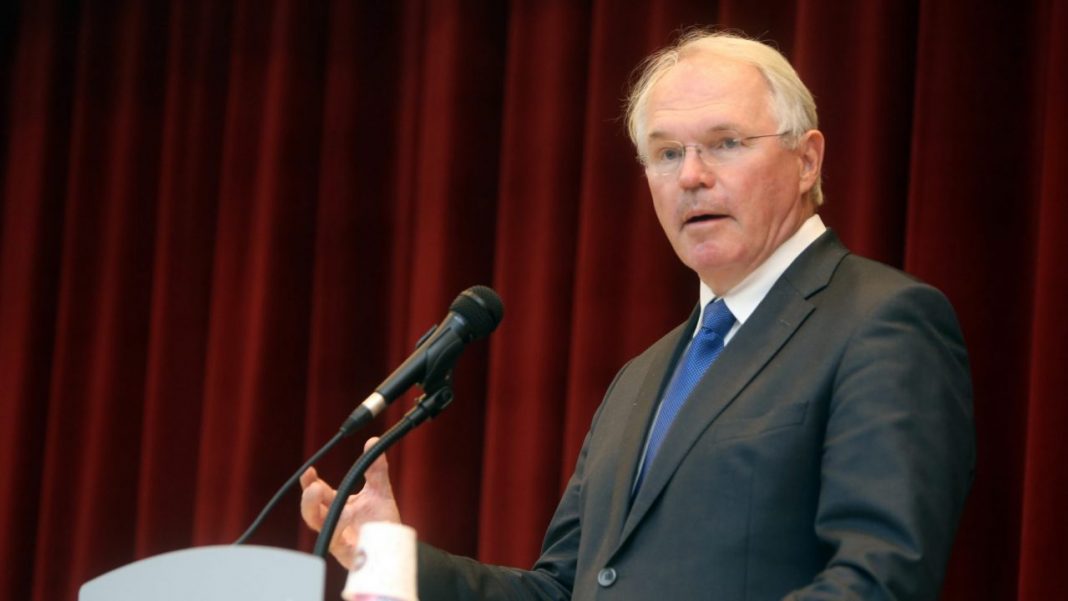
The United States Ambassador to Belgrade, Christopher Hill, and the European Union Ambassador to Belgrade, Emanuele Giaufret, held a meeting on Thursday in southern Serbia with the Serbian Minister of Defense, Miloš Vučević, and the Chief of the General Staff of the Armed Forces of Serbia, General Milan Mojsilović.
The U.S. Embassy in Belgrade confirmed this meeting, which was convened at the request of Serbian military and government officials, with the purpose of “allowing Hill and Giaufret to gain further insight into the situation near the Serbia-Kosovo border”.
This visit by Hill and Giaufret to Serbian military facilities comes approximately ten days after an armed group of Serbs attacked the Kosovo Police in the village of Banjska, within the municipality of Zvecan, on September 24. This attack resulted in the tragic death of officer Afrim Bunjaku, with three Serbian attackers also losing their lives during the ensuing clashes at the village’s monastery.
Furthermore, this meeting occurred shortly after the United States and the European Union expressed concerns about Serbia’s troop movements near the Kosovo border and called for their withdrawal.
Earlier reports in Serbian media had suggested that the American diplomat initially arrived at the Serbian Army’s “Stefan Nemanja” barracks in Raška by helicopter and later visited the “Rifat Burdžević Tršo” barracks in Novi Pazar.
Both of these barracks are located in close proximity to the Serbia-Kosovo border.
The Serbian Ministry of Defense stated that the two foreign diplomats were “guests of Deputy Prime Minister and Defense Minister Miloš Vučević and Chief of the General Staff of the Armed Forces of Serbia, General Milan Mojsilović, during a brief visit to some units of the Armed Forces of Serbia in the wider Novi Pazar area”.
The Ministry further reported that during their visit, the U.S. and EU ambassadors had the opportunity to confirm that the units of the Armed Forces of Serbia in the region were solely engaged in their regular duties.
While Serbia has denied any involvement in the attack, responsibility for it was claimed by Milan Radojičić, the former deputy chairman of the Serb List, the largest political party representing Serbs in Kosovo, which has official support from Belgrade. Radojičić was questioned and subsequently released by Serbian authorities on October 4.
Following criticism from the United States and the European Union, Serbia began to withdraw some of its forces from the border area.
Serbian President Aleksandar Vučić, in an interview with CNN on October 2, disputed reports of an increased number of troops in the south, stating that the reports “were not entirely accurate” and asserting that a year ago, the Serbian army had 14,000 soldiers stationed on the Kosovo border, whereas today, there are “only 4,400”.