

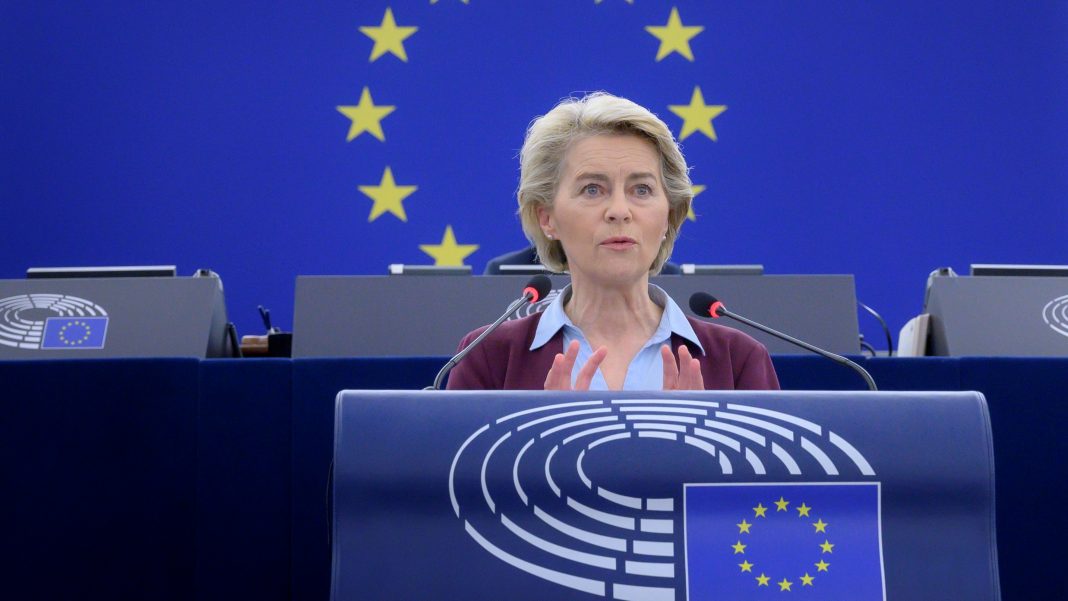
The President of the European Commission Ursula von der Leyen called on Kosovo and Serbia to implement the guideline for de-escalating the situation in northern Kosovo.
“There is a very clear and committed plan for de-escalation, a guideline that both parties worked on earlier this year. This is absolutely crucial to move forward in a peaceful manner. And it is clear that both parties must fulfill what they agreed upon,” von der Leyen said before the start of the second day of the NATO Summit in Lithuania.
On 11 July, the European Union confirmed that Kosovo had agreed to reduce police presence in and around municipal buildings in Zvecan, Leposavic, and Zubin Potok – predominantly Serbian-populated municipalities in northern Kosovo – and that Kosovo would support holding new elections in four northern municipalities as part of efforts to de-escalate the situation.
The agreement was reached during an informal meeting in Bratislava between the EU’s Special Representative for the dialogue between Kosovo and Serbia Miroslav Lajčák, and Kosovo’s Deputy Prime Minister Besnik Bislimi.
The Government of Kosovo stated that all steps “will be finalized within a two-week period”.
Furthermore, Kosovo and the EU have also agreed to undertake other steps.
Regarding the meeting between the negotiators of Kosovo and Serbia, it will reportedly take place next week.
The European Union had presented several requests to reduce tensions in the north, which began at the end of May after newly elected Albanian mayors in Zvecan, Leposavic, and Zubin Potok entered municipal buildings under the escort of the Kosovo Police.
Kosovo has continuously demanded the implementation of the Agreement towards the normalization of relations, reached in Brussels on 27 February. The parties also reached an Annex for the implementation of this agreement in Ohrid on 18 March.
The document, consisting of 11 points, does not include mutual recognition, which Kosovo insists on, but requires Kosovo and Serbia to accept each other’s documents and symbols, including passports, diplomats, and license plates.
The document calls on the parties to implement all agreements reached so far in the dialogue on the normalization of relations, including the one on the establishment of the Association of Serb-majority municipalities in Kosovo, which the Government in Pristina has rejected so far, arguing that it could jeopardize the functionality of the state.




