
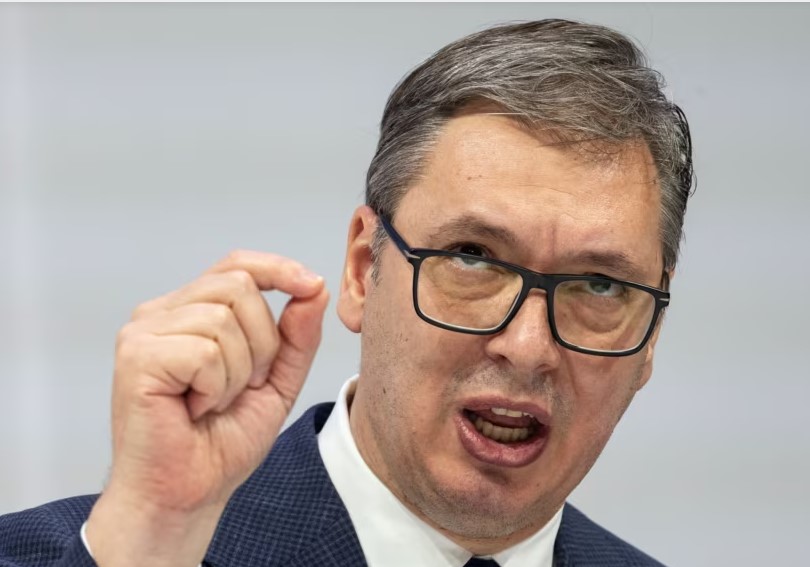
The Serbian President, Aleksandar Vučić, said on Friday, speaking about the banned dinar in Kosovo, that Serbia is being asked to “sell” the Serbian bank, Kursimora e Posta, to Raiffeisen bank or any other bank.
In a televised speech before the people in Belgrade, he did not give any other details about this, but insisted that Serbia “cannot and will not accept the removal of the dinar” from use in Kosovo.
The use of the dinar for cash payments in Kosovo was banned on February 1, when the Central Bank of Kosovo implemented a new regulation that designated the euro as the country’s sole official currency.
This issue, apart from angering Serbia, also provoked disagreements between the Government of Kosovo and the international community, since the Serbian community in Kosovo, for years, receives payments in dinars from the budget of Serbia.
Since the post-war, Kosovo Serbs have received payments in dinars from the Serbian state through the branch of the Post Office in Kosovo, which is one of the largest Serbian banks.
The chief negotiators of Kosovo and Serbia met twice in Brussels this month to discuss the dinar issue, but differences between them remain large and the European Union announced a new meeting in April.
Serbian chief negotiator Petar Petkovic said this week that the Serbian side will try to keep Serbia’s bank operating in Kosovo so that Serbs can receive salaries, pensions and other aid.
For the Council of Europe Vučić warned that Serbia will take a “serious decision” for the Council of Europe, if this European organization accepts Kosovo as a member.
“We will continue to talk about Kosovo, we will also make decisions for the Council of Europe”, he said.
“I think that Serbia’s reaction should be strong, serious and responsible,” said Vučić without explaining what his country’s decision will be if Kosovo becomes the newest member of the Council of Europe in the coming months.
Despite the vote against Serbia and two other countries, the Committee on Politics and Democracy of the Council of Europe approved on Wednesday the report of the rapporteur for Kosovo, Dora Bakoyannis, who recommended that it fulfills the conditions to become a full member of Council of Europe.
The Parliamentary Assembly is expected to vote on Kosovo’s membership in April, and if it gives the green light, then the Council of Europe’s Council of Ministers must give the final say in May.
Serbia voted against and intends to continue opposing Kosovo’s membership in this organization, although it is required not to oppose the neighboring country’s membership in any international organization in accordance with the Basic Agreement that the parties reached in the EU-mediated dialogue in February 2023.
The EU says the Framework Agreement is legally binding on Kosovo and Serbia.