

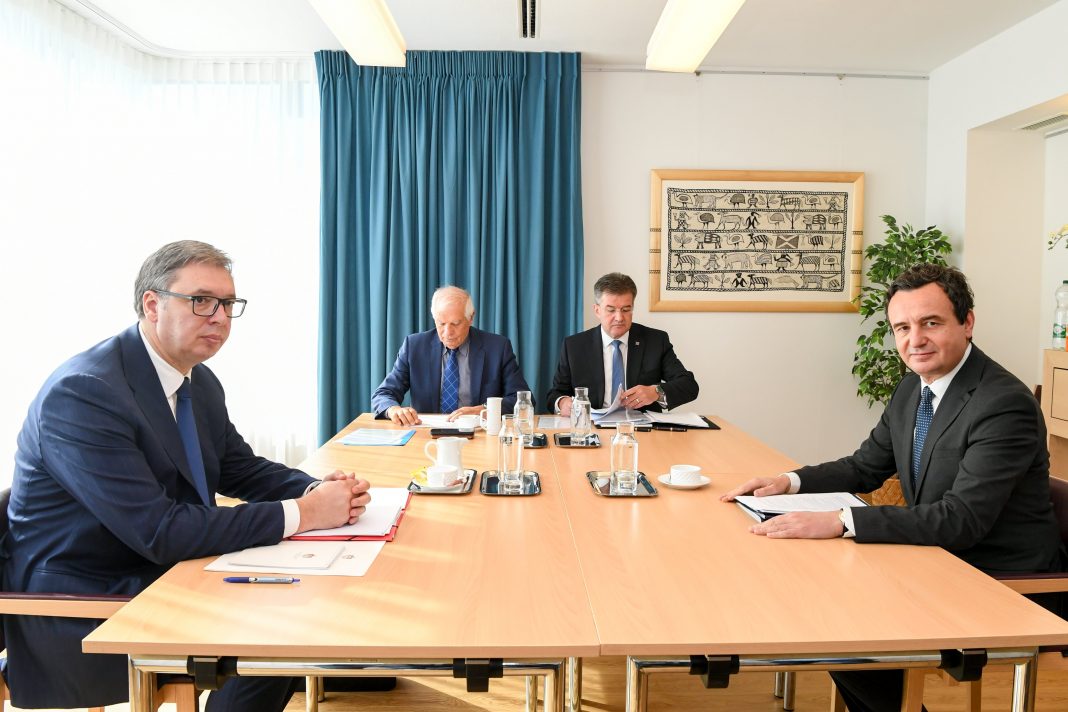
The President of Serbia, Aleksandar Vučić, has expressed anticipation of “renewed pressure” from Western nations regarding his country’s negotiations with Kosovo.
Vučić remarked that the Western powers have largely aligned with the actions of Kosovo’s Prime Minister Albin Kurti. He emphasized that the issue of establishing the Association of Serb-majority municipalities is of utmost importance, citing that the agreement for its formation was signed a decade and a half ago, and Serbia strongly advocates for its implementation. Vučić made these remarks during an interview with Pink Television.
Following a meeting on September 14 between Vučić and Kurti, held as part of the dialogue aimed at normalizing relations, the European Union announced its intention to consult with member states and the United States to determine the next steps, given the lack of progress in the negotiations.
The EU expressed concern that Kosovo had rejected a proposal from the European bloc regarding the implementation of the Agreement on normalizing relations, an accord reached earlier in the year between Pristina and Belgrade. Kurti characterized this proposal as a “condition”.
President Vučić has announced the possibility of advancing the scheduled elections in Serbia, which is a demand put forth by the opposition. He suggested that the elections could take place on March 4, 2024, or possibly a week earlier than the originally planned date of December 31.
Vučić stated his readiness to hold elections in March, in accordance with the suggestions made. Notably, on September 11, representatives of the Serbian opposition, who have organized the “Serbia Against Violence” protests, submitted a request to President Vučić, urging him to call for early parliamentary elections and elections in Belgrade before the end of 2023.
The request for early elections was submitted by various political entities, including the Democratic Party, the Ecological Uprising, the Green Front, as well as parliamentary groups like the Movement of the People of Serbia and the Direction for Europe.
In early September, opposition MPs declared their intent to “block” the legislative proceedings in Serbia until their demand for elections was met, following months of protests triggered by two major incidents of violence in the country.
Regarding the leadership of the Security and Information Agency (BIA), President Vučić clarified that although he may have considered replacing the current Director, Aleksandar Vulin, such a decision is not imminent.
Vučić addressed speculations in the media suggesting that Vulin’s tenure might be short-lived, asserting that these claims have extended Vulin’s current mandate.
He added that while he may have contemplated a change in leadership, it is not something that can be executed immediately.
Furthermore, President Vučić dismissed the notion that Marko Đurić, Serbia’s current ambassador to the United States, would assume the leadership of the BIA.
On July 11, the United States imposed sanctions on Aleksandar Vulin, accusing him of involvement in drug trafficking and connections to Russia. President Vučić took responsibility for these sanctions, because “I have not imposed sanctions against Russia”.
U.S. Ambassador to Belgrade Christopher Hill subsequently stated on August 22 that the United States disagrees with Serbian authorities regarding sanctions against Vulin. He noted concerns about Vulin’s pro-Russian stance but highlighted the overall positive relations between the U.S. and Serbia.




