

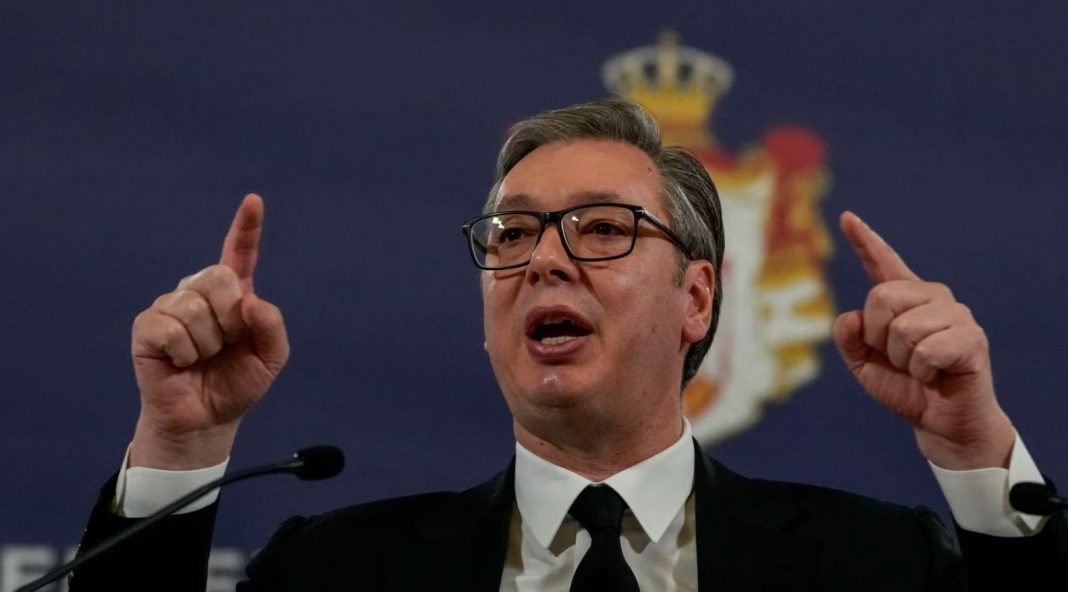
Serbian President Aleksandar Vučić has stated that Kosovo’s authorities’ decision to abolish the Serbian dinar is an attack on all agreements signed since 1999.
“In each of those acts, Serbia has the right to finance specific activities, healthcare, education, pensions,” Vučić said on Friday at a press conference.
“Unfortunately, Albin Kurti made that decision with his initiative, with the following intention: ethnic cleansing of the Serbian people from the territory of Kosovo and Metohija,” Vučić said, referring to Kosovo’s prime minister.
On February 1, a new regulation of the Central Bank of Kosovo came into force in Kosovo, stipulating that the euro is the only currency with which cash payments can be made.
The decision came into force despite calls from the international community to postpone the implementation deadline.
Kosovo’s Deputy Prime Minister Besnik Bislimi pledged to ensure a smooth transition.
In Serb-majority municipalities in Kosovo, the Serbian dinar has been in circulation since the post-war period.
The Serbian state pays salaries, pensions, social benefits, and other benefits to Serbs in Kosovo through a parallel system.
The Law on Local Power Finance in Kosovo allows for financial aid from Serbia.
The Serbian state has allocated 139 million euros for Serbs in Kosovo for 2024 – about 11 million more than in 2023.
At the press conference, Vučić said he would do everything to ensure that Serbs in Kosovo receive their incomes again.
The Serbian President said that by noon on Friday, more than 5 million euros had been allocated to Serbs in Kosovo for various benefits.
He announced that Serbia would seek a solution on how to send money to Serbs in Kosovo.
Speaking of the funds allocated by Serbia, Vučić revealed that his country has 31,831 employees in Kosovo, 29,115 pensioners – of whom 4,700 receive pensions in cash – and 31,586 social assistance recipients.
Vučić warned that next Monday, Serbia would continue to send dinars to Kosovo through a “licensed and authorized carrier, the British company Henderson, in accordance with the laws”.
The National Bank of Serbia has been sending dinars to a vault in the municipality of Leposavic in north Kosovo for years, and they are then transported by the international company Henderson.
Some blame the Kosovo Customs for allowing such a practice, as the Central Bank of Kosovo is the only authorized institution for the import and export of euros and other currencies in Kosovo.
“The National Bank of Serbia will not negotiate with the Central Bank of Kosovo”
Kosovo authorities hope for an agreement between the Central Bank of Kosovo and the National Bank of Serbia to reach an agreement on payments for Serbs in Kosovo.
However, Vučić has dismissed this possibility.
“We will find a solution. If necessary, we will find private banks that will be licensed anyway, we will find a solution to give our people the money”.
According to him, the National Bank of Serbia will abide by the law, and Serbia will provide information on the final decision on this issue, but “the priority will be the transport and sending of money to Kosovo”.
Among other things, Vučić has warned that Serbia will seek an urgent session at the United Nations Security Council on Monday, February 5.
Why was the regulation passed precisely now?
Central Bank of Kosovo Director Ahmet Ismaili mentioned financial integrity as the main reason for implementing the regulation.
According to him, the decision protects Kosovo “from counterfeit money, financing of terrorism, protects it from the use of non-original currencies”.
Others mention tax evasion in the absence of control over the dinar.
What should Serbs do now?
Serbian citizens in Kosovo will need to open accounts in commercial banks licensed by the Central Bank of Kosovo.
The Serbian state can send them money in dinars, but they must be converted to euros along the way.




