

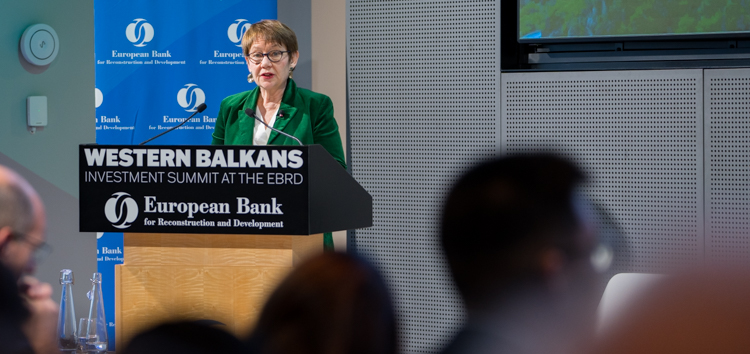
The Western Balkans Investment Summit 2024, organized by the European Bank for Reconstruction and Development (EBRD), is taking place in London today.
At this event, government leaders from the six countries of the region are present. During the summit opening, EBRD President Odile Renaud-Basso emphasized that although the region has made significant progress over the past decade, there still exists a significant gap between the region and the European Union.
“According to a new EBRD study on convergence with EU living standards, it may take between 40 and 70 years, or even more, to close this gap. This finding critically underscores the need to combine public funds with private capital to accelerate convergence. Thus, the EBRD has collaborated with international financial institutions and the European Commission to find ways to involve private capital in key regional infrastructure projects, through PPPs or attracting private investments in the energy sector,” stated Renaud-Basso.
She emphasized that it is time to recognize the true economic forces and potential of the Western Balkan countries.
She also expressed EBRD’s readiness to closely cooperate with the European Commission and the governments of the region in implementing the EU Growth Plan for the Western Balkans, seeing it as an opportunity to bring necessary investments and reforms.
Renaud-Basso also highlighted the great potential of investors in the region, mentioning favorable corporate tax regimes, competitive labor forces, and clear prospects for integration into the European Union. She added that people in the region are well-educated, highly qualified, and many of them are talented entrepreneurs.
In conclusion, she added that the region should focus on three key priorities.
Firstly, it is necessary for Western Balkan countries to accelerate their green agenda. Increased investments in renewable energy, as well as in electricity networks and energy efficiency, will help increase the region’s resilience to future energy challenges and economic competitiveness.
Secondly, improving public governance standards should be a priority, including reforming state-owned enterprises, fighting corruption, and using digital technology.
Thirdly, expanding trade and investment spaces is essential. Deeper integration into global value chains will be key to increasing competitiveness and innovation.
As the largest international financing organization in the region, the EBRD has invested over 18 billion euros in the region, with a record figure of 1.63 billion euros just last year.




