

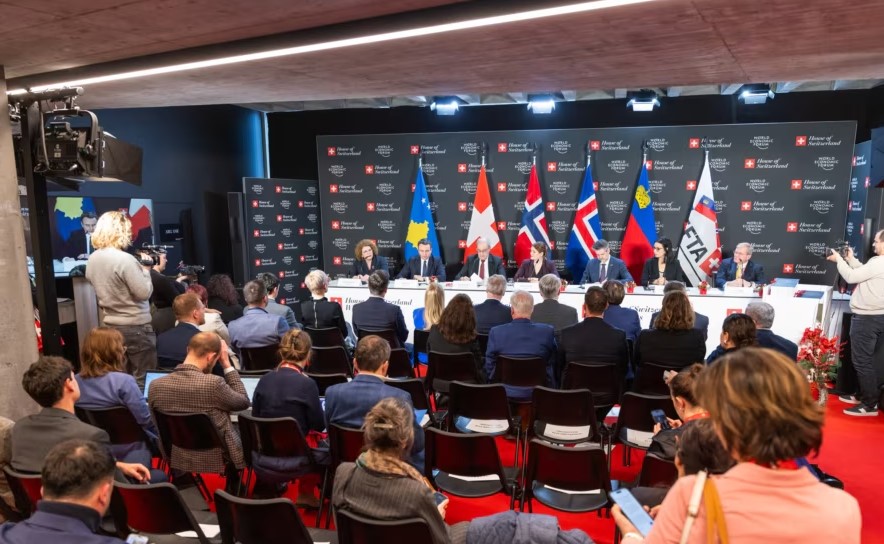
On January 22, Kosovo signed an agreement with the European Free Trade Association (EFTA) after negotiations lasting over two and a half years. Who are the members of this association, how will Kosovar producers benefit from the free trade agreement, and what are the advantages for them? Ekrem Idrizi provides the details.
If a Kosovar local producer previously had to pay an additional 10% customs duty to export goods to a country with a large diaspora, like Switzerland, now they will no longer have to pay extra – in fact, they won’t pay any customs duties at all.
This has been made possible through a newly signed agreement between Kosovo and the European Free Trade Association (EFTA), which includes Switzerland, Iceland, Liechtenstein, and Norway.
The removal of tariffs is one of the advantages Kosovar companies that export or plan to export to EFTA member countries will enjoy. Kosovo signed this Free Trade Agreement with EFTA on January 22, less than three years after initiating negotiations with the organization.
The agreement offers numerous opportunities, including those for importing and exporting goods. Consumers and businesses can benefit from lower prices, while local companies can more easily sell their products in foreign markets.
The agreement allows companies in the contracting countries similar or better access than competitors from third-party countries, according to EFTA.
The president of Kosovo’s Chamber of Commerce, Lulzim Rafuna, told Radio Free Europe/Radio Liberty that this agreement means a lot for Kosovo.
“Such agreements for a small market like Kosovo must have strategic objectives because they facilitate foreign investment. Any investor coming to Kosovo to produce and export goods to EFTA countries will benefit,” says Rafuna.
Kosovo’s Prime Minister, Albin Kurti, expressed confidence after signing the agreement in Davos, Switzerland, stating that it “will bring benefits for businesses, industries, and citizens of all [contracting] countries.”
Who Benefits Most from This Agreement?
The agreement between Kosovo and EFTA covers areas such as trade in goods and services, intellectual property rights, trade facilitation, sustainable trade development, and legal and horizontal provisions.
According to Rafuna, local producers will benefit the most from this agreement because they will be able to export all products originating in Kosovo to these countries without needing to pay customs duties. The same applies to goods entering Kosovo from these countries.
“We have a large diaspora in Switzerland, and thanks to this agreement, they will benefit by bringing Kosovar products into the Swiss market. Likewise, their products or those of their partners will enter the Kosovar market without customs duties,” says Rafuna.
What Is the Trade Balance Between Kosovo and EFTA?
Bilateral trade between Kosovo and EFTA began in 2008, following Kosovo’s declaration of independence.
Since then, trade has seen continuous growth, reaching its highest value in 2023: €176 million, according to data from EFTA’s website.
In 2023, Kosovo exported goods worth €76 million to EFTA countries, while importing products worth €99 million from them.
The average import growth rate over the past five years was 20.4%, while the export growth rate was 26.6% during the same period.
Trade between Kosovo and Switzerland in 2023 reached a value of €141 million. Kosovo exported goods worth €75 million to Switzerland while importing goods worth €66 million from it. Trade data with Switzerland includes Liechtenstein, as these two countries share a common customs system, according to EFTA.
Kosovo primarily exports goods to EFTA countries, including furniture, plastics, iron and steel, and wooden products. It imports cars, pharmaceutical products, tobacco, and machinery from these countries. Adapted from REL




