

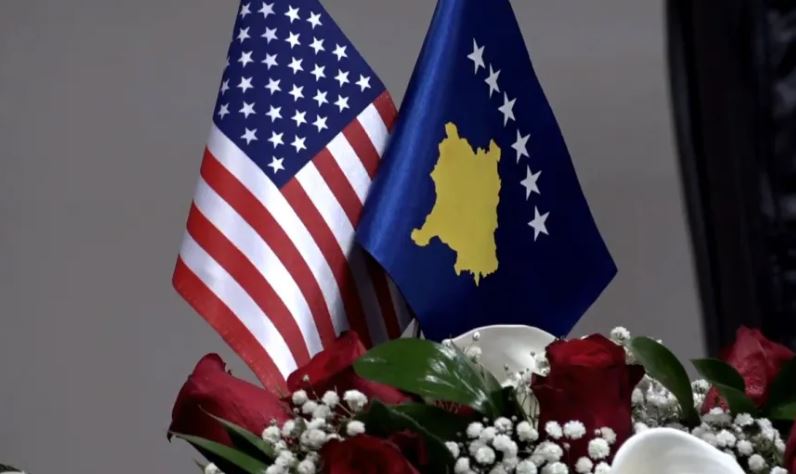
The United States’ decision to suspend the strategic dialogue with Kosovo is being viewed as a concerning development for the country. Senior officials from the Democratic Party of Kosovo are accusing acting Prime Minister Albin Kurti of seriously jeopardizing Kosovo’s alliance with the United States.
According to them, relations between Kosovo and the U.S. have deteriorated since Kurti came to power. Meanwhile, professors of international relations also consider Washington’s decision as negative for the country, calling on acting Prime Minister Kurti to change his approach so that the strategic dialogue with the U.S. can resume, KosovaPress reports.
The U.S. Embassy in Pristina announced on Friday that it had suspended the planned strategic dialogue with Kosovo due to concerns over the actions of the acting government.
The U.S. reaction comes at a time when Kurti has openly criticized the Constitutional Court over the formation of the Assembly, while the acting government has shut down some parallel Serbian structures in Kosovo, prompting a response from the European Union on Saturday.
Kurti has remained silent since Friday’s U.S. decision, but his spokesperson, Përparim Kryeziu, stated that the Republic of Kosovo is the U.S.’s most serious partner for stability, security, and peace in the region. He emphasized that all actions of the acting government are in line with the country’s laws and Constitution.
On Monday, the U.S. Embassy in Kosovo told the media that it wants to move forward with the acting government, but stressed that a committed partner is needed—one that understands the importance of avoiding destabilizing actions.
The Secretary-General of the Democratic Party of Kosovo, Vlora Çitaku, told KosovaPress that Friday, when the U.S. suspension was announced, marked “the darkest day in Kosovo’s recent political history since the declaration of independence.”
According to her, acting Prime Minister Kurti is undermining the alliance with the U.S., one that Hashim Thaçi and Kosovo’s leadership in 1999 had built during wartime through bridges of cooperation with Washington.
“It was the darkest day in Kosovo’s recent political history—perhaps the darkest day since the declaration of independence. Everything we have achieved over the last 26 years—liberation, independence, state-building, consolidation of Kosovo’s international subjectivity—was the product of close coordination between Kosovo and its allies. Imagine this: Hashim Thaçi and the leadership of that time managed to build bridges of cooperation and forge alliances with the U.S., NATO, and the EU, under occupation and in wartime. Meanwhile, Albin Kurti, from the comfort of the prime minister’s office, is seriously endangering those achievements. Since this ruling group came to power, we have seen a steady deterioration in relations with the U.S. It has now been over five years since any senior official from Kosovo has set foot in the Oval Office of the White House. This has never happened before,” she said.
Meanwhile, Afrim Hoti, a professor of international relations, told KosovaPress that the U.S. decision is a strong signal to Kurti that he must change his approach toward allies. He explained in detail what the strategic dialogue with the U.S. entails and the range of issues it covers.
However, Hoti emphasized that suspending the dialogue does not immediately mean a break in bilateral relations.
“First of all, if a platform for strategic dialogue is offered, it means that the state in question either has or continues to cultivate close relations with the United States. At the core of such relations are the universal civilizational values we all recognize: human rights, respect for minorities, the promotion of democracy, adherence to the fundamental norms upon which democracy rests today. Such a platform is not normally offered to states with authoritarian regimes, that disregard the rule of law or violate human rights. The U.S. government’s action—its suspension—thankfully does not mean an immediate break in relations, because it is well known that Kosovo, regardless of who is in power today or tomorrow, has cultivated excellent relations with the United States. If these relations are currently suspended, it is a powerful signal, a clear alarm to local authorities—specifically to acting Prime Minister Kurti—that his political discourse must change immediately. It seems we are already seeing certain deviations that require corrective actions, and this dialogue must not only continue but also deepen further,” he said.
KosovaPress contacted officials from the ruling Vetëvendosje Movement on Monday, but they did not respond.
Following Washington’s decision, President Vjosa Osmani also expressed regret over the suspension.
The strategic dialogue is a process through which the U.S. State Department engages with various countries worldwide to advance bilateral relations. It involves high-level discussions either in Washington or in the partner country, covering a wide range of topics such as defense, security, the environment, energy, and economic cooperation.
In recent years, the U.S. has conducted strategic dialogues with countries including France, the United Kingdom, Romania, Austria, Poland, Slovenia, Moldova, Greece, North Macedonia, Qatar, Oman, Bahrain, and Egypt.