

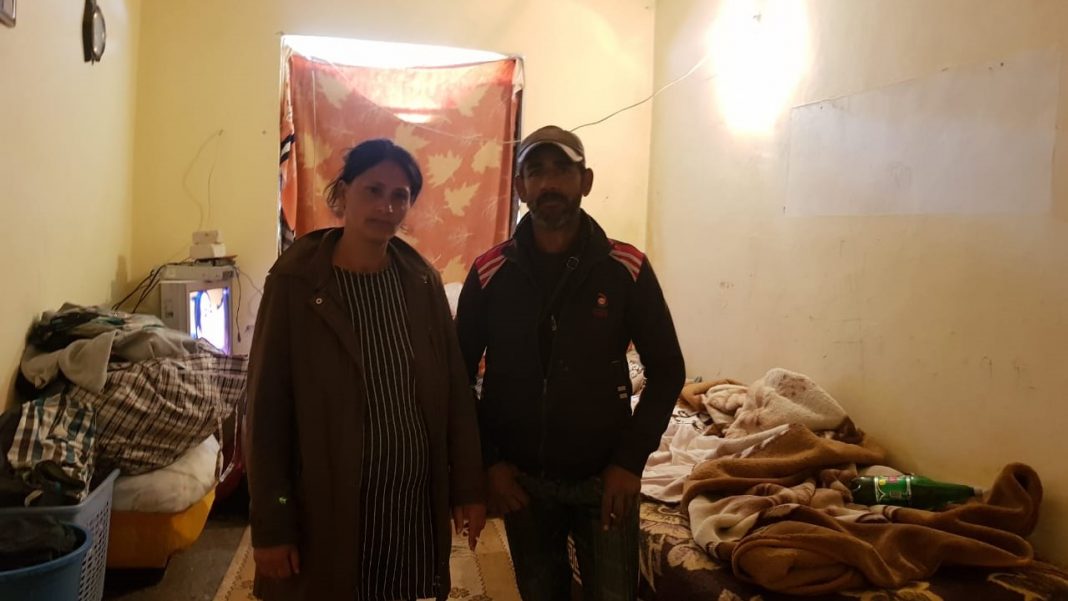
We found Flutura Abazi at the same place we met her 4 months ago. In the dorm building of the former communality of the 4th administrative unit of Tirana; an object risking collapse at any given moment because of the damages caused by the 2019 earthquake.
The object was deemed “uninhabitable” by the municipal council, a few days after the earthquake. The 90 families that were living in this building were advised to make an application to profit from the Reconstruction projects.
But, Flutura Abazi, a member of the Roma community and a mother of two, hasn’t profited from any of these programs. Since November 26th, 2019, she lives wherever she can, at times in her former rented apartment, at other times with her relatives. She secured food for herself, her children, and her disabled husband, from the “Gonxhe Bojaxhi” community center, but when night falls, she doesn’t have a roof over her head.
She tells us how during this electoral campaign, representatives from various political parties have reached to her asking for her at the general elections, but they have never found the time, all these years, to show any interest whatsoever in her or to help her find shelter.
We went to the municipality of Tirana, in order to find out if Flutura Abazi has benefited from any projects of Reconstruction and the answer was that she hasn’t applied for any of the programs, neither for the rental bonus, nor the reconstruction of her home.
We received the same answer from the Ministry of Reconstruction: “Flutura Abazi hasn’t applied for housing after the earthquake”.
They also told us that all the other citizens that used to live in this building have applied and benefited from the Reconstruction scheme and are currently on the rent bonuses roll (they’ve been accommodated in rented apartments, paid for by the municipality).
In addition, they also clarified that the building will be demolished and after its reconstruction, all those that have applied will return and continue living there.
After the earthquake, institutions had declared that all those who weren’t able to apply would be assisted by specific groups.
But what happened? Why has Flutura not been able to apply? In order to find out more about this, we went to the municipality division nr. 4. The administrator, Liri Qoshi explained to us that the issue is very complex.
“One day after the earthquake, we contacted all the residents of the dorms of the former-Communality and we have assisted everyone in the application process, but Flutura Abazi wasn’t there”.
Flutura admits that she hasn’t been contacted by any of the teams on the ground and that together with her family, she had gone to a close relative, after the earthquake. But she also says, that later, her relatives helped her go to local government offices, but they have all told her that she doesn’t profit from the housing scheme for those suffering damages from the earthquake.
And this is exactly where the “complexity” of Flutura’s case lies.
The building, where she has lived for years, has been privatized following a decision of the Council of Ministers. According to the decision dating in 2019, all the homeless people that lived in the rooms of this object became property owners.
The National Building Body was delegated to deal with this process. Since that time, the beneficiaries made privatization contracts with this legal body and some of them gave these apartments out for rent.
Until recent years, this relationship between the landlord and tenant hasn’t been regulated by the law. Therefore, everyone that had an apartment for rent, could rent it out to whoever through a “vocal agreement”, without the need for any official written documents.
In 2015, the government undertook a decision, according to which, whoever gives an apartment out for rent, should do this through a notarized contract, on the basis of which they would also be taxed. In order to avoid this tax, many landlords wouldn’t sign a contract with their tenants.
This was exactly the case, for Flutura.
No one knows who the apartment’s owner is; she has rented it out from a citizen, who says that he is only looking after the apartment that was earlier entrusted to him by someone else, who had also been a tenant there.
In other words, Flutura doesn’t have any contracts with the Building Body, as she hasn’t benefited from the process of privatization, and she doesn’t have a rent contract because the person that gave her the apartment, has simply profited the rent from her but hasn’t accepted to write a contract so that he wouldn’t pay tax.
In the midst of this idleness stands Flutura and her family. Without any documentation, nor a shelter, and a myriad of unsolved problems.
The situation comes as a result of dysfunctional laws and institutions because the least she could have is a rental contract, but she doesn’t have that either, and not because of her fault!
On the other hand, institutions claim that she can’t be a part of any of the schemes of the reconstruction process without proper documentation in order to make an application.
What for these institutions is a matter of paperwork, for Flutura is a matter of life.
Having shelter is one of the fundamental rights of human beings. What could a possible solution be for her?
The administrator of Tirana’s fourth unit, Liri Qoshi, says that in the case she’d have a contract for her rent, institutions would immediately include her in one of the shelter schemes, which are paid for by the state.
But in order to get to that point, there is the need to find someone who can rent a flat to Flutura.
Suela Hoxha, a Roma human rights activist, tells us that this is really hard due to discrimination towards members of the Roma community.
In spite of all the problems we addressed Flutura’s case to Social Services at the Municipality of Tirana and they pledged to do everything at their disposal to secure an accommodation for Flutura.




