

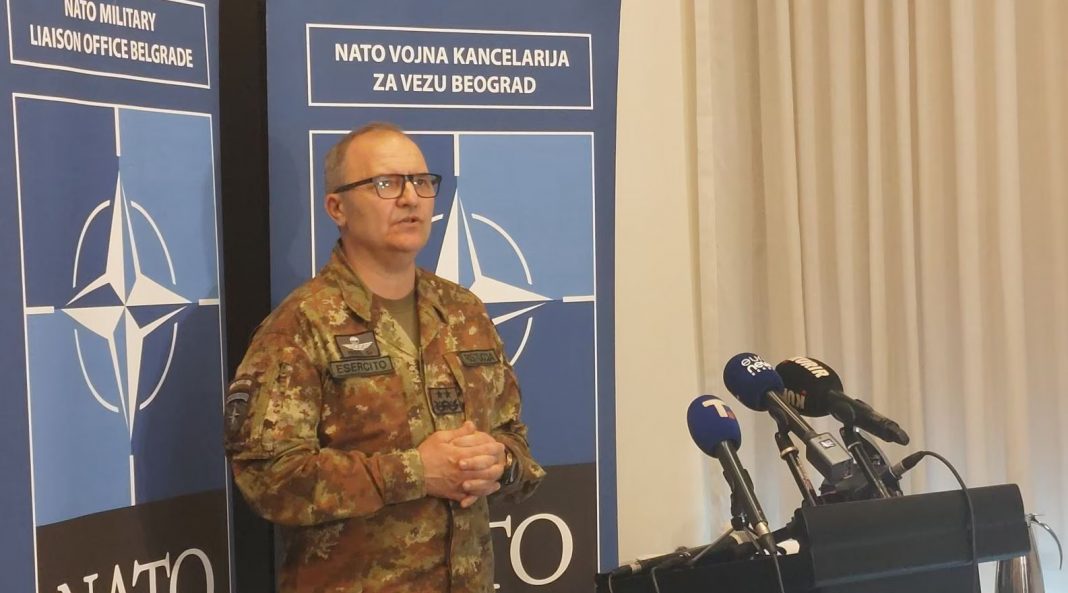
The Commander of NATO’s mission in Kosovo, KFOR, Angelo Ristuccia, emphasized on Tuesday that any matters related to security in Kosovo should be carried out in coordination with the KFOR mission.
During a press conference held in Belgrade, Ristuccia responded to questions from reporters regarding whether KFOR’s approval should be sought when deploying special units of the Kosovo Police in the northern regions.
NATO Secretary-General Jens Stoltenberg, following a meeting with Kosovo’s President Vjosa Osmani on September 7 pointed out that Kosovo had committed a decade ago not to engage the Kosovo Security Force in the north without prior consultation and approval from the KFOR commander.
“In accordance with Pristina’s commitments in 2013, any deployment of the Kosovo Security Force in the north necessitates negotiations with KFOR. We anticipate consultations for any actions involving the special units of the Kosovo Police that could impact security,” Stoltenberg stated at that time.
Ristuccia assessed the security situation in Kosovo as “highly unstable” and cautioned that the situation could deteriorate rapidly.
He acknowledged that events that posed security threats had been followed by substantial military and diplomatic efforts to create a more peaceful and balanced environment.
“These events only underscore the importance of political solutions, which can yield long-term peace and stability in the region. Numerous incidents, particularly those on May 29, underscore the necessity for political solutions. That’s why NATO and KFOR offer full support for the dialogue mediated by the United States and the European Union,” he asserted.
He stressed that a constructive approach from both parties was essential to establish the necessary conditions for lasting security in Kosovo and the broader region, benefiting everyone, including future generations.
The situation in northern Kosovo, primarily inhabited by Serbs, became tense at the end of May when local Serbian groups protested against the entry of new Albanian leaders into municipal buildings.
The extraordinary elections in April in the north were boycotted by local Serbs.
At times, the situation in the north has escalated into violence.
The most critical incident occurred on May 29 when numerous KFOR soldiers were injured.
Kosovo authorities are currently conducting investigations to ascertain responsibility for the violence.
The escalation of the situation has been strongly condemned by officials in the European Union, which is mediating the dialogue between Kosovo and Serbia with the goal of normalizing relations.
The violence has also garnered condemnation from the United States, prompting KFOR to decide on an increased presence in Kosovo.
Regarding the investigations into the attacks on KFOR soldiers, Ristuccia stated that he does not possess any new information but is aware that investigations are ongoing.
He expressed hope that authorities in Serbia are also conducting investigations into individuals who have returned to that country.
Ristuccia expects that those responsible for the attacks on KFOR soldiers will face swift legal action on both sides.
Among other points, the KFOR commander reiterated that the mission remains dedicated to ensuring a secure environment for all residents of Kosovo.
The KFOR mission has been actively engaged in Kosovo since 1999, in line with the mandate of the United Nations.





