

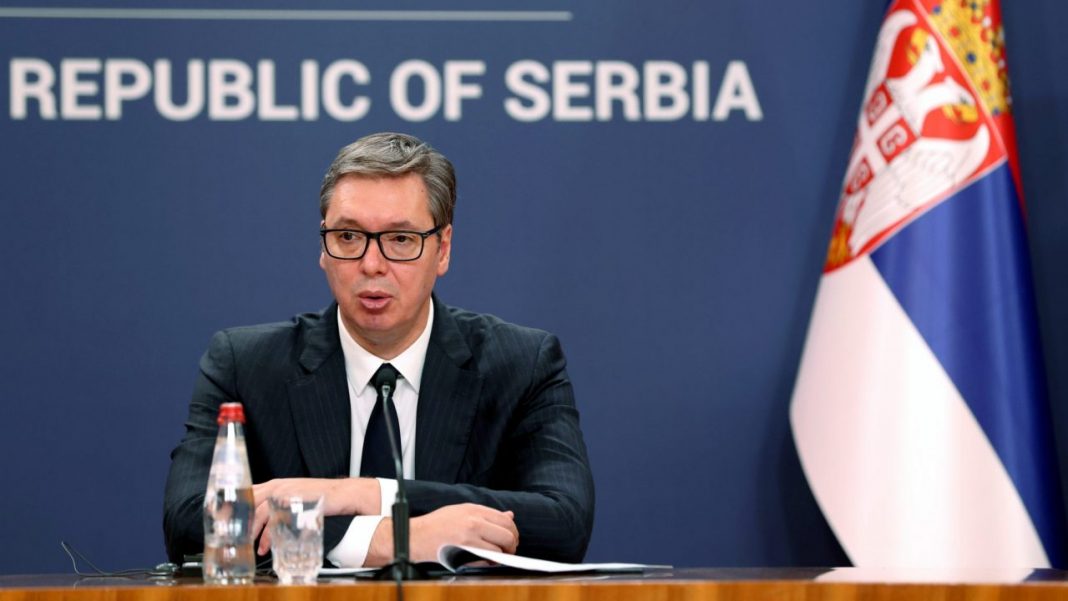
Serbia’s President Aleksandar Vučić has urged the ambassadors of the QUINT states and the head of the European Union delegation to take steps to ensure that KFOR addresses all security matters in northern Kosovo, a region predominantly populated by Serbs.
The QUINT states comprise the United States, the United Kingdom, Italy, Germany, and France.
Following a crucial meeting in Belgrade on September 26, Vučić shared his thoughts on Instagram, highlighting the challenging circumstances Serbia currently faces.
He also raised concerns about Kosovo Police refusing the involvement of the EU mission in Kosovo for the Rule of Law (EULEX) in the operations conducted in northern Kosovo, though he did not provide specific details regarding this assertion.
In Kosovo, the initial response to security issues is the responsibility of the Kosovo Police, followed by EULEX and ultimately NATO’s peacekeeping mission in Kosovo, KFOR.
On September 25, Vučić held discussions with the Russian ambassador to Serbia, Aleksandar Bocan-Harchenko, during which he reportedly presented “the demands of the Serbian side”. However, the specific content of these demands was not disclosed.
Serbia has declined to join the EU’s sanctions against Russia, primarily due to Russia’s support for Serbia in its Kosovo-related policies and the ongoing situation in Ukraine.
On September 24, an armed group attacked Kosovo Police officers while they were attempting to remove roadblocks in the village of Banjska in Zvecan. This encounter resulted in the death of police officer Afrim Bunjaku and injuries to several others.
The armed group sought refuge in Banjska Monastery, where they engaged in confrontations with Kosovo Police officers. Authorities have reported that three attackers were killed during these clashes, with six others being taken into custody.
Kosovo authorities have accused Milan Radoičić, the vice president of the Serb List, the largest political party representing Serbs in Kosovo, of orchestrating and participating in the attack.
On September 26, Kosovo’s Minister of Internal Affairs Xhelal Sveçla released a drone-recorded video that purportedly showed Radoičić armed in Banjska.
The Serb List, a political party with backing from Belgrade, as well as Serbian institutions, have yet to respond to Kosovo’s allegations concerning Radoičić’s alleged involvement.
Kosovo holds Serbia responsible for the attack, while official Belgrade points to Kosovo Serbs as the culprits.