

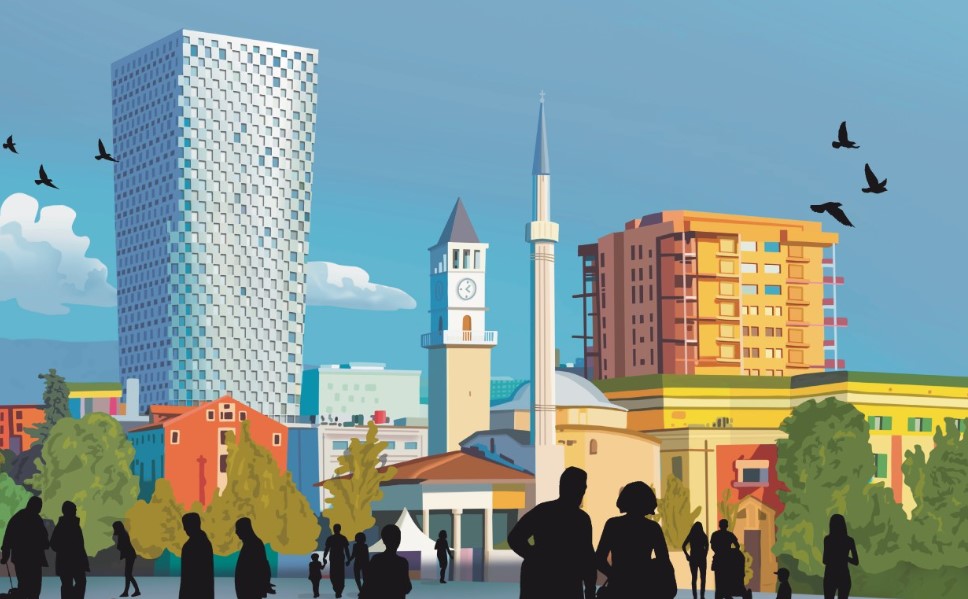
If you come to Tirana, the capital of Albania, you can not only expect a warm welcome, but night life and lots of fun at economical prices. This is the panorama described by Joey Tyson in “The Times”.
He writes that Tirana is not an average European city. It was opened, as Tyson says, in the 1990s.
“Prior to this, the Albanian capital was completely cut off from the outside world, ruled by the despotic communist dictator Enver Hoxha,” continues Tyson.
Full article:
Tirana is not your average European city. For a start it’s only been open to visitors since the 1990s. Before that the Albanian capital was all but cut off from the outside world, ruled over by the despotic communist dictator Enver Hoxha.
Since those dark days ended Tirana has been making up for lost time. Futuristic new skyscrapers pierce the skyline, joining minarets and rejuvenated monuments. Abandoned areas have been recast as art, shopping and nightlife districts. The history is still there, told in unflinching museums and derelict bunkers, but the people are looking forward, and it’s those people — the friendliest you’re likely to find in any big European city — that make Tirana worth a visit. The city spent decades with no one to welcome. Now its arms are wide open.
What to do
- Standing in the middle of the city, Tirana’s infamous Pyramid is the perfect place to start. For decades this bizarre structure stood abandoned; it was built as a monument and museum to Hoxha following his death in 1985 but ransacked after the fall of communism five years later. As of 2023 it has been renovated as an IT centre for young people. From the summit 360-degree views reveal the city’s evolving skyline
- The vast Skanderbeg Square is named after Gjergj Kastrioti, aka “Skanderbeg”, the national hero who led a revolt against the Ottoman Empire in the 15th century, and his statue shares the square with some of Tirana’s most important buildings. Peek inside the meticulously restored 18th-century Et’hem Bey Mosque, one of the few remnants of Tirana’s Ottoman past, and catch a performance at the National Theatre of Opera and Ballet. Or, for something more casual, head to Tulla Nouvelle, a hip bar on the opera house roof that plays live music from Thursdays to Sundays.
- Tirana wears its troubled past proudly. Nowhere tells its traumatic story better than the twin museums Bunk’Art 1 and Bunk’Art. The latter is a network of tunnels off Skanderbeg Square that once connected to Albania’s Ministry of Internal Affairs, while the former, a mega bunker on the edge of the city, was initially created to house Hoxha in the event of a chemical attack. Intense and claustrophobic, the tunnels are a powerful metaphor for the regime’s stranglehold on Albania, and document the rise and fall of the communist government through first-hand testimony, original objects and incredible black-and-white footage. It’s not pretty, but it’s essential to understand the immense hardships Tirana has overcome.
- For light relief, join the locals for a passeggiata around the lake in the sprawling grounds of the Parku I Madh (Grand Park of Tirana). Hidden among the shaded pines, cafés serve light bites and pizza with Aperol spritz, fresh juices and coffee. During the summer an outdoor cinema pops up here too.
The coolest neighbourhood
Blloku used to be a no-go area for Tirana’s average citizens. The political elite lived here in luxury behind armed guards and Hoxha’s mansion still stands, curiously empty and unused (there’s still a great debate about what to do with it).
Since the 1990s, however, what was once a symbol of the city’s misery has re-emerged as a thriving area for nightlife and creativity. Revelry has replaced repression, with open-air bars, cosmopolitan restaurants and cafés lining the streets.




