


While the country has experienced notable economic growth in recent years, the incomes of Albanian families are insufficient to sustain a standard of living comparable to other European countries, even within the region.
In addition to being low, incomes are further impacted by high prices.
Eurostat has released an indicator for the equivalent disposable income per family member. This indicator reflects the total income of a household after taxes, available for spending or savings, and it’s divided by the number of family members adjusted to adults.
This indicator is measured based on the purchasing power parity (PPP) standard, which theoretically means that one PPP can purchase the same amount of goods and services in any country.
In 2020, the most recent year for which income data is available, Albania had a median income indicator of 4,358, which is the lowest in Europe (data for Kosovo and Bosnia and Herzegovina is unavailable). The median indicator implies that half of the population has more than 4,358 PPP, while the other half has less.
When compared to the European median for the same year (17,926 PPP), a member of an Albanian family has only 24% of that income at their disposal. As a result, the purchasing power of an Albanian family is four times lower than the European average.
Despite nominal incomes being 32% of the European average, the indicator drops to 23% when considering purchasing power. This is mainly due to the fact that prices in most sectors are similar to those in EU countries (especially in supermarkets), while incomes are considerably lower.
In comparison to countries like Germany, for example, the purchasing power in Albania is 5.5 times lower, while with Italy it’s 4 times lower, and with Greece, it’s 2.3 times lower.
Following Albania, the second-lowest for median disposable income are North Macedonia (5,988 PPP), Turkey (6,210 PPP), Montenegro (6,328 PPP), and Serbia (6,968 PPP).
In Europe, in 2022, the average equivalent disposable income in the EU was 18,706 purchasing power standards (PPS) per inhabitant, which increased from 18,011 PPS recorded in 2021.
At the national level, the EU countries with the highest average disposable incomes in 2022 were Luxembourg (33,214 PPS), the Netherlands (25,437 PPS), Austria (25,119 PPS), Belgium (24,142 PPS), Denmark (23,244 PPS), and Germany (23,197 PPS).
On the contrary, Bulgaria (9,671 PPS), Slovakia (9,826 PPS), Romania (10,033 PPS), Hungary (10,217 PPS), and Greece (10,841 PPS) reported the lowest values.
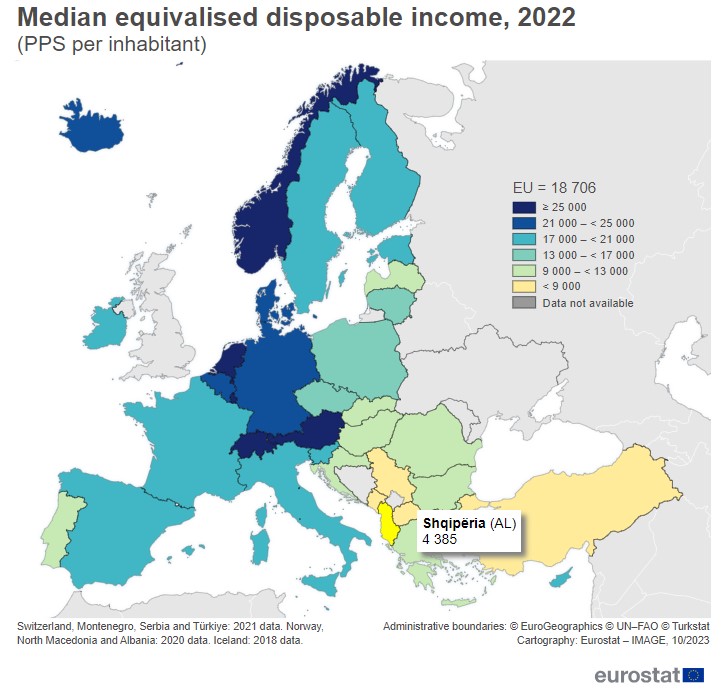
Average equivalent disposable incomes expressed in PPS are based on income distribution, family size, and composition. The PPS unit takes into account variations in price levels to ensure data comparability between countries.
To reflect changes in the size and composition of a family, the total (net) family income is divided by the number of “equivalent adults” using a standard scale: the modified OECD scale.
This scale assigns a weight to all family members (and then adds them up to reach the equal size of the family):
1.0 for the first adult;
0.5 for the second person and each subsequent one aged 14 and above;
0.3 for each child under 14 years old.
Finally, the resulting figure is called equivalent disposable income and is attributed equally to each family member.