

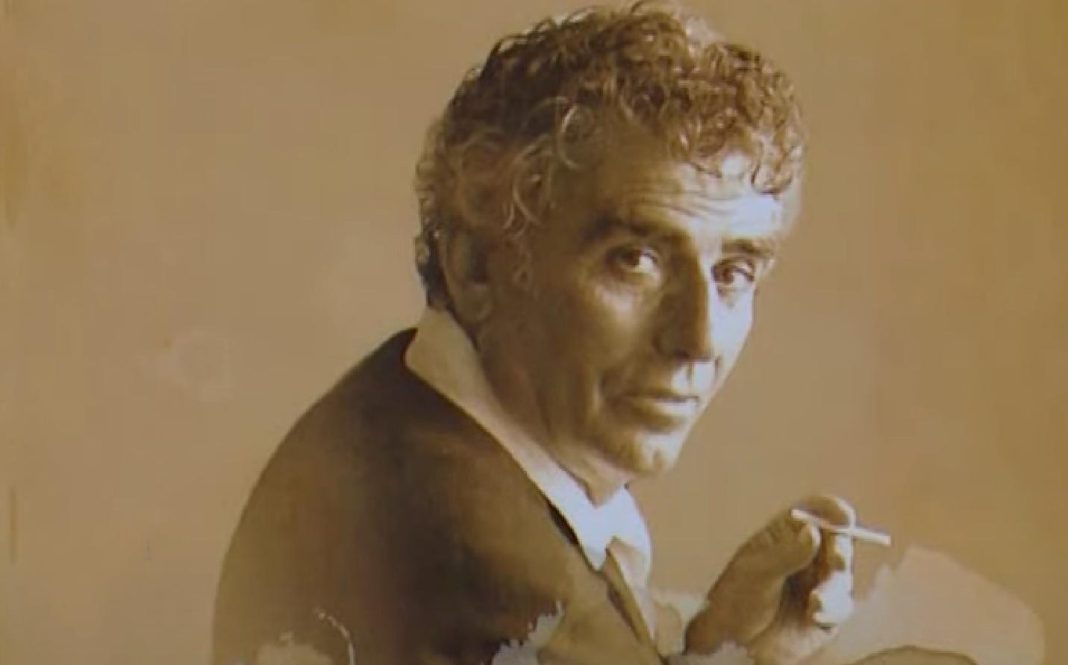
Petro Marko was born in Dhërmi on November 25, 1913, and died in Tirana on December 27, 1991.
He was an Albanian teacher, publicist, journalist, interbrigadist, and writer. Born to his parents Marko and Zoica, Petro Marko was raised by his grandmother, Mama Mille. His father had accumulated wealth through the citrus trade, but left him at a young age after falling ill during his internment by the Italians on the Tyrrhenian islands.
After completing primary school in his hometown in 1924, he went on to attend the Commercial School in Vlorë, graduating in 1932. Among others, the school’s director was the educator and scholar Kolë Kamsi, while Ernest Koliqi was one of his teachers. Many Italian teachers also taught there, one of whom introduced students to Marx’s Manifesto.
After finishing school, he spent a long period moving around Tirana in search of work, until one day he met Hilë Mosi, then Minister of Education, who appointed him as a teacher in Dhërmi. He was later transferred to Dhuvjan in Dropull. During this time, he remained in constant contact with the left-wing press through Greek newspapers provided to him by Asim Vokshi. Following a misunderstanding, a pretext was found to accuse Petro of distributing communist literature to students—an unfounded accusation.
He was forced to leave for Greece for the first time. He stayed in Corfu, where he came into contact with local political emigrants led by Dr. Omer Nishani. He then moved to Athens, where his brother Dhimitri (Mimo) lived, having left the Himara region as a child. There, Petro Marko enrolled in the Faculty of Literature, where he clashed with the rector, who considered it shameful that Petro, as a Himariot, was teaching the Albanian language. Petro replied, “Shame on you for still living in Byzantine times!”, a remark that led to his expulsion. Through his brother’s employer, he later found the opportunity to enroll in a non-state school, in the Faculty of Economics and Politics. He considered going to the Soviet Union, where Sejfulla Maleshova, Ali Kelmendi, and Tajar Zavalani were at the time, but this option fell through.
He returned after the establishment of Mehdi Bey’s liberal government in the summer of 1935. The Fier Uprising was planned but failed at its outset; Riza Cerova was killed by the troops of Hamit Matjani, and the remaining participants fled from Vlorë to Corfu. Petro returned in November after Branko Merxhani and Ismet Toto invited him on the occasion of launching a newspaper (Koha e Re) as a government organ. The newspaper was closed after a bold article on the workers of Kuçovë, which Ethem Toto, then Minister of the Interior, viewed as reactionary and communist. Petro moved from one newspaper to another (Illyria, etc.), and in 1936 co-founded the magazine ABC with Branko Merxhani, Dhimitër Godelli, Zavalani, and Migjeni. The magazine was shut down after its second issue; he was interned in Porto Palermo for two weeks and then in Llogara, and released following the intervention of Merxhani and I. Toto.
He collaborated with Përpjekja Shqiptare by Branko Merxhani, which Merxhani intended as a counterpoint to Hylli i Dritës. However, Petro left after Merxhani wrote the article Why I Am Not a Marxist, under pressure from censorship. After openly expressing his pro-proletariat views in another newspaper, he drew the ire of Musa Juka, who attempted reconciliation by offering him the post of deputy prefect in Himara. Petro promised to accept after going to Athens to take several exams, seeing beyond this proposal.
He met Migjeni before departing in 1937, and upon arriving in Athens boarded a ship to Marseille. The ship traveled around the Mediterranean (Izmir, Jaffa, Alexandria, Tripoli). In Marseille, he found Llazar Fundo and Ali Kelmendi in Paris. He received directives from a Serbian “comrade” known by the alias “Robert” and was appointed leader of a group of 113 individuals sent to Albacete, the headquarters of the International Brigades. He joined volunteers of the Garibaldi Brigade in Spain and went to Quintanar de la República. He participated in the Congress of Anti-Fascist Writers in Valencia, attended by figures such as Ernest Hemingway and Pablo Neruda. He moved through Extremadura, Aragon, Gondez, and then returned to France, where in Paris and Grenoble—funded by the International Red Aid—he was tasked with agitation among university youth, bearing the identity and charisma of an interbrigadist.
He entered Italy toward the end of 1939. After more than a thousand days, he returned to Albania following instructions from the Comintern to send communists back to their home countries, legally or otherwise. He returned to Dhërmi and sought reconciliation of blood feuds with the villages of Dukat. In Vlorë, he began drafting anti-fascist leaflets in Albanian and Italian. He was imprisoned in Vlorë and Tirana in May 1940; after March 1942, he was sent to Italy, Palermo, and Ustica. Following the liberation of southern Italy by Anglo-American Allied forces, he broke out of prison with other detainees and reached liberated Italian zones. In 1944, he was arrested by the Germans but escaped thanks to his former high school teacher Ernest Koliqi, and returned to Albania the same year.
At the end of the Anti-Fascist War in 1944, he returned to Albania, organizing the return of nearly 300 other Albanians at a time when Albanians were left without any organizational structure. He was in Shkodër, at the home of Nush Topalli, when the city was raided by Serbian troops. In Retë dhe gurët, he cites N. Spirun, who told him that Albania had sufficient material resources not only for itself but for many years, enabling Albanian traders under Italian and later German occupation, as the occupiers needed supplies.
After returning to liberated Albania, he was invited to head the newspaper Bashkimi in Tirana from 1945 to 1947. Following a surprise inspection, writings deemed outside the party line were found (he later wrote that Hysni Kapo saved him from execution), and he was released on May 15, 1950. In 1957, he worked as a teacher at the “8 Nëntori” technical school. In 1973, he was stripped of the right to publish. In 1975, his son Jamarbër was imprisoned. His novel Çuka e shtegtarit (1980) was written as an act of self-criticism directed by the Party, but it was not accepted or published. This was solely because he could not reconcile himself, from the earliest days of the regime, with the onset of dictatorship—especially when he attempted to resist dictates imposed on Albania from abroad, mainly from Belgrade.
Petro Marko died on December 27, 1991, and was buried according to his wishes, without ceremony. In 2003, the President of Albania, Alfred Moisiu, decorated Petro Marko with the Order “Honor of the Nation.”
Works
He began writing poetry and short prose while still a student in Vlorë. Minister of Education Mosi once told him: “Write poetry. Poetry is the most human expression of thought and heart.” He wrote Një natë e dy agime, the poems Nase Labi, Horizonti në kuletë, Parada e të uriturve, and the novels Kodashi, Rrugëve të luftës, Nisja pa mbarim, Bija e kapitenit, among others, during his time in Italy.
In Albanian culture and literature, Petro Marko stands as a major figure with an unwavering spirit and mind in the face of every storm. Those who knew him personally felt a profound belief in humanity and goodness radiating from within him. Such spiritual stature enabled him to confront death face to face, something he experienced many times throughout his life. Each time he rose again to fight evil with the same strength of belief and radiance of goodness.
Readers sense this in novels such as Hasta la Vista (1959) and Qyteti i Fundit (1960), where his life journey, artistically assimilated, is deeply present. In the 1970s, he wrote Një emër në katër rrugë, while the harsh period of his life on the island of Ustica was immortalized in Nata e Ustikës. The appearance of Petro Marko with his first two novels marked a true turning point in the history of the Albanian novel—not merely a culmination of experience, but a break from an unnaturally grafted literary tradition, opening the narrative toward new visions, creative universes, and thematic spectra.
Beyond their innovative spirit, these works stood out for their superior artistic articulation. All of Petro Marko’s works were embraced and sought after by readers. The strongest pages of his prose reflect the triumph of love and humanism. After all the hell through which humans pass in his narratives, they remain undefeated by the world’s cruelties. This inner core radiates through his characters and through Petro Marko himself, both as a man and as a writer.
There is no comparable example in Albanian literature where the human being and the creator are so intertwined—Petro Marko the man and Petro Marko the writer. Through his novels, he became one of the most distinguished personalities of Albanian culture, introducing genuine innovations into literary tradition. His work radiates an innate belief in love and humanism, despite his lifetime of persecution and suffering.
In 2000, his wife Safo and daughter Amantia published Retë dhe gurët – Interview with Oneself, an autobiographical work in which the elderly Petro Marko questions a younger version of himself—a manuscript he had long wished to see published.
Selected Titles
Hasta la Vista (1958)
Qyteti i Fundit (1960)
Një emër në katër rrugë
Ara në mal – novel
Nata e Ustikës (1989)
Shpella e piratëve – novel
Autobiographical Works
Horizont – novel
Fantazma dhe plani 3+4
Çuka e shtegtarit
Një natë dhe dy agime
Stina e armëve – novel
Halimi – novel
Tregime – short stories
Gazetari, mbreti e uria – novel
Retë dhe gurët (2000)
Ultimatumi (2002)
Selected Stories (2003)
Honors
Master of Work – 1998
Golden Pen – 2000
Honorary Citizen of Vlorë – 2002
Order “Honor of the Nation” – 2003




