

In his post, Rama criticized the language used by some commenters, describing it as offensive and lacking substance. He argued that such rhetoric harms public debate on important issues and stressed that “street language” should not dominate public discussions.
“A few words first for the revolutionaries who come here and to the social media pages of anyone who thinks differently from them. Since they cannot put together four sentences to form a coherent concept, they compensate for that emptiness with shouting phrases filled with insults and one-syllable slogans.
Leave genuine environmentalists to their work and their right to protest. Leave true defenders and lovers of nature to their work and their right to protest. Leave concerned citizens to exercise their right as well. But certainly leave the flamingos in peace too, and do not turn their feathers brown with the mud of street language,” Rama wrote.
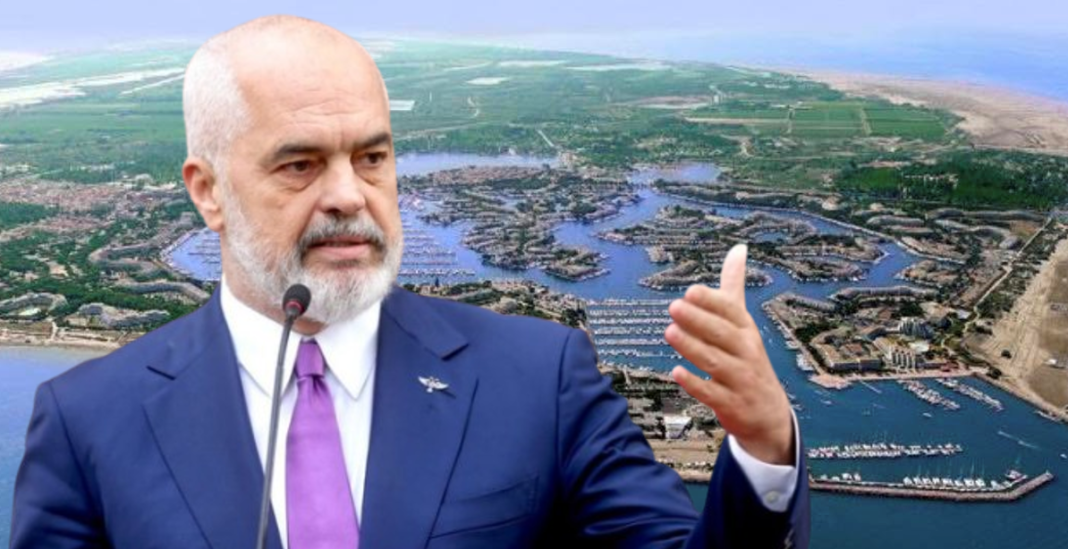
In the second part of his statement, Rama cited the Camargue region in France as an example of how nature and economic activity can coexist through tourism and sustainable land use.
According to him, this model demonstrates that environmental protection and economic development can go hand in hand when natural areas are properly managed.
“When wetlands, lagoons, and protected areas are discussed, there is often an impression that the only way to protect them is to isolate them from economic life.
But Camargue in France tells a completely different story.
Located in the Rhône River delta, Camargue is one of Europe’s most important wetlands. It is an extraordinary landscape of lagoons, marshes, coastal dunes, salt flats, pink flamingos, the famous white Camargue horses, and hundreds of bird species.
It is a paradise of biodiversity, but at the same time an economic engine.
Today, Camargue is an international destination featuring boutique hotels, restaurants, marinas, nature tourism, horseback riding, birdwatching, traditional salt production, and a local economy that thrives precisely because of the landscape it has preserved.
France did not protect Camargue by keeping civilization away from it.
It protected it by making it valuable to its civilization.
By understanding that nature is not necessarily the enemy of development. In fact, sometimes nature itself is development.
That is why the flamingos are still there.
The lagoons are still there.
Biodiversity is still there.
Therefore, the question is not whether nature and the economy can coexist.
The question is whether we have the vision to turn nature into an economic asset.
Because when the landscape becomes part of the economic model, people are no longer indifferent to it, nor are they inclined to destroy or pollute it.
They have an interest in protecting it.
And that is the true lesson of Camargue: it did not choose between nature and development; it found a way for both to succeed together,” Rama wrote.




