

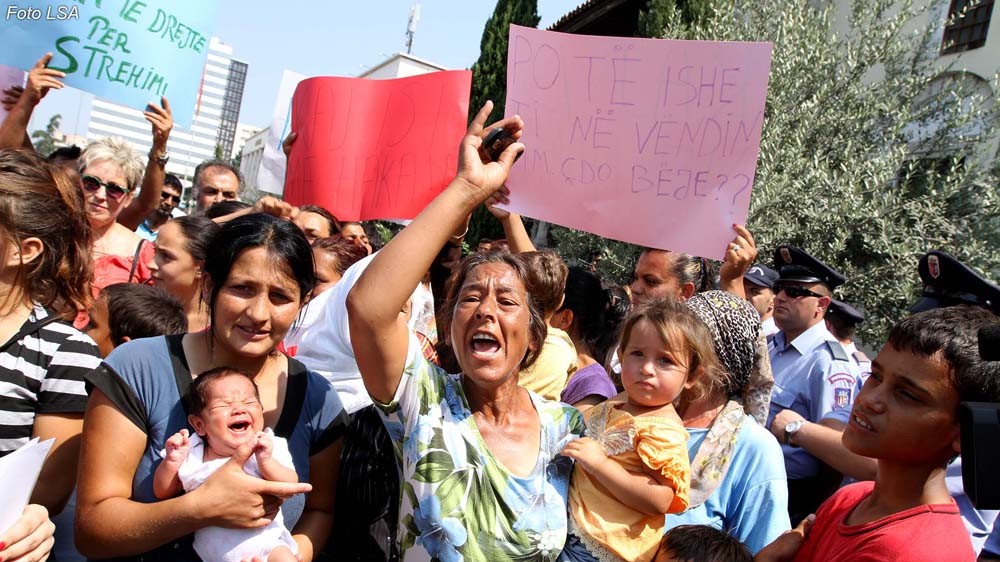
She had worked all year round to save money to buy books, school supplies, a backpack and proper school attire to send her son to school, but she couldn’t because he wasn’t registered in the civil registry. This is the story of a 29-year old mother from the Roma community, who wished to remain anonymous, but accepted to share with us her story. Working in the informal economy, she was able to fulfill her duty as a mother, but despite her efforts, her son lost the school year, because he did not have a birth certificate. Her son had to be registered at “Hasan Vogli” school in Tirana, but the lack of documentation did not make it possible. Meanwhile official sources at the Education Ministry, inform us that in such cases, the school directory notifies the district education directorate and thereafter the Ministry gives the instructions on how to enable the registration proccess.
The only official data on the number of people belonging to the Roma and Egyptian community are those that come from the last census, conducted in 2011, according to which 8,301 people belonging to the Roma community and 3,368 belonging to the Egyptian community are currently registered and live in our country, which makes up for a total of 11,669 people belonging to these communities. However, it is estimated that the number is much higher, rounding up to 115,000, or 4% of the total population of Albania.
As per the Family Code, birth registration in the Republic of Albania is closely linked to the establishment of maternity and paternity and a court procedure is required in the case of children born out of wedlock. In order to avoid opening complex court procedures, some families choose not to register their children until pending family disputes have been resolved. Some cases involve adults who cannot be registered because of the denial of or confusion over maternity/paternity. With the revision of the Law on Civil Registration, which entered into force in October 2018, the legal framework now regulates such issues. However, there is a need to finalise pending cases and ensure monitoring of its implementation, especially implementation of the large set of instructions drafted and entering into force in 2019.[1]
Another category affected by the risk of statelessness is Albanian migrants who gave birth to their children abroad but could not complete the registration of their birth. This population is entitled to Albanian nationality by law, but the need for court interventions and/or other administrative follow-up prevents them from being registered. Several categories of returnee children are at risk of statelessness in the Republic of Albania. These include children not registered in birth registries and children of undetermined citizenship. The vast majority of these children belong to the Roma community, which lives in deep poverty and social exclusion and experiences discriminatory treatment in almost every area of life.
The General Directorate of Civil Status did not respond to Euronews Albania’s inquiry as regards the number of representatives of the Roma and Egyptian communities in Albania.
Ola Tare, head of the Treja center, says that in addition to not having an exact figure, there are also contradictions in the figures among institutions.
The TREA Center was established in 2017 and its mission is the empowerment of poor and vulnerable families in seeking and achieving their rights by undertaking acts and initiatives that facilitate their access in various services and rights, with the scope of improving their lives, educational level, shelter, health and position in their society.
“Currently we have no exact figure on the number of the Roma and Egyptian people at a national lever. There have been continuous efforts, but we still remain stuck between perceptions and facts. The number is higher than what data from the census of year 2011 show. There are even contradictions between institutions.”
According to the most recent population data gathered through the 2011 census and compiled by the Albanian Institute of Statistics (INSTAT), 7,443 persons were classified as stateless in the Republic of Albania. There is no further data available regarding the demographics of these individuals, except for the gender distribution based on 2011 census: 3,874 men and 3,569 women. It must be emphasised that there is no official data on the number of persons of unknown nationality or at risk of statelessness who are, for example children or minorities or any other special categories.
The most accurate figures currently available were collected by Tirana Legal Aid Society TLAS as part of a mapping exercise conducted jointly with United Nations High Commissioner for Refugees UNHCR and published in May 2018. In total 1,031 persons at risk of statelessness were identified through this mapping exercise. The reported number of 7,443 stateless persons from the 2011 census is thought to have been reduced significantly through the provision of legal access to registration support provided by TLAS and the support provided over the intervening years by international organisations such as the UNHCR.
This reduction in the number is indicated by the TLAS – UNHCR mapping report that confirmed the number of persons at risk of statelessness as 1,031, which is significantly lower than the number reported earlier in the census. This is pertinent to Roma statelessness in the Republic of Albania, where the main cause and risk of statelessness is the lack of civil documentation and the inheritance of statelessness. As the Roma Belong Report found , these causes have a disproportionate effect on Roma because of their vulnerability and marginalisation as well the increased likelihood that the authorities will question their right to citizenship. The 2011 census identified the estimated number of Roma and Egyptian communities as 8,300 Roma and 3,368 Egyptians; however, these communities strongly contest these estimates and consider the respective figures to be much higher.
According to Ms. Tare there are several reasons why people belonging to the Roma and Egyptian communities do not register for identification. The first being the lack of an accurate mapping of the areas in which these minorities live. The Second is the lack of a simple language when completing the questionnaire. And the third reason is: avoiding questions asked by the interviewer and finally the lack of self-declaration of these people as part of these two minorities.
According to TLAS and the Rodmaps the reasons are: The majority of people at risk of statelessness in the Republic of Albania are persons who in theory should have access to nationality but in practice are unable to confirm their nationality because of the various obstacles to their registration in the birth register. This applies to Roma and Egyptian communities in particular because of their social and economic marginalisation, but it also affects Albanian returnees whose children were born abroad. Many of them were in irregular residence after the collapse of the communist regime in 1991 and did not register the birth of their children. From 2008, following the economic crisis in Italy and Greece, many undocumented persons returned or were deported to Albania and are currently investigating the possibility of late birth registration in Albania.
There is no mechanism to determine statelessness and therefore it is not possible to identify such cases under this status. Because of the lack of a systematic or individual method for their classification, stateless persons face obstacles when attempting to attain lawful residence in the Republic of Albania. Moreover, the fact that these persons are essentially ‘legally invisible’ and the methodological constraints such as census data that is based on self-identification makes it extremely difficult to gather reliable data.
Discrimination, institutional antigypsyism, structural inequalities and bureaucratic systems are shown to be root causes as well as the lack of awareness, social and economic vulnerability continue to hinder the Roma and Egyptian communities and their ability to obtain the required documentation for registration. In 2019, approximately 60 per cent of the TLAS caseload consisted of persons from the Roma and Egyptian communities.
Experts also suggest that Albania must guarantee that all maternity hospitals and other hospitals fulfil their obligations regarding registration of births and must report them accurately and systematically, by cooperating with Local Government Units and Civil Registry Offices and count the cases when a child is born to an unregistered mother.
In an interview for Euronews Albania, Ina Kokëdhima, expert of social inclusion and gender equality in the Albanian Ministry of Health and Social Protection said that Albania has no data regarding people that have not registered their identity in the civil registry.
However, this problem seems to be coming to an end after the decision of the council of ministers on a baby bonus for new births. The decision of the council of ministers stipulates that an employee of the civil registry must stay in hospital services to register new births. In these cases it is difficult to register the babies, as the institutions are not informed and no mechanism works to make this process possible, even in such particular circumstances. “Giving a baby bonus has had a positive effect as it has enabled maximum registration of new births in the Republic of Albania and had definitely minimized the number of unregistered births. This is due to the immediate financial aid provided in accordance to the DCM, which all Albanian citizens benefit from, for all births inside and outside the country,” she explains.
Kokëdhima adds that the establishment of specific structures for the registration of the children belonging to the Roma and Egyptian communities is not perceived as something that can be created as it could lead to discrimination between Roma and non-Roma children.
Special attention should be paid to children born outside maternity hospitals. No child should be subject to such chasms and remain unregistered, as the birth registration is the main gateway to have access to all social services and civil rights and a good deal of these children belong to the Roma and Egyptian communities.