
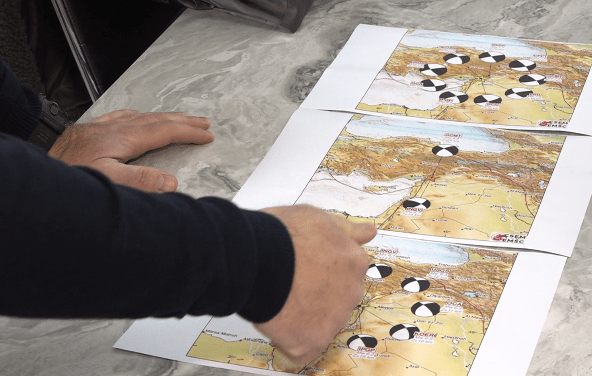
Turkey continues to be hit by other earthquakes, considered strong. Although earthquakes can not be predicted, seismologists argue that the collision of giant plates will still generate high-magnitude tremors.
“We are at one of the most important tectonic junctions in the Mediterranean, where giant tectonic plates such as those of Arabia and Africa collide with each other. Earthquakes in Turkey continue to be of high intensity, mainly in terms of their energy and not their frequency, they continue to remain with high magnitudes and this shows that we still have a very large accumulated energy”, he emphasized.
“And in this collision of giant tectonic plates, the entire region is involved, where Albania is no exception. We are seeing that there are other newly activated areas that have moderate earthquakes, so that shows that the whole region has already been loaded in tectonic terms, but because of this very large movement that is happening from the earthquake in Turkey an equilibrium is being established by expressing itself with seismic activity. Even Albania is no exception to the energy that is transferred along these lines, currently we have the southern part of Albania that has several earthquakes, so their speed has increased, but we are still in the area of microearthquakes. The February 6 earthquake in Turkey was 7.8 on the Richter scale and caused tens of thousands of victims.