

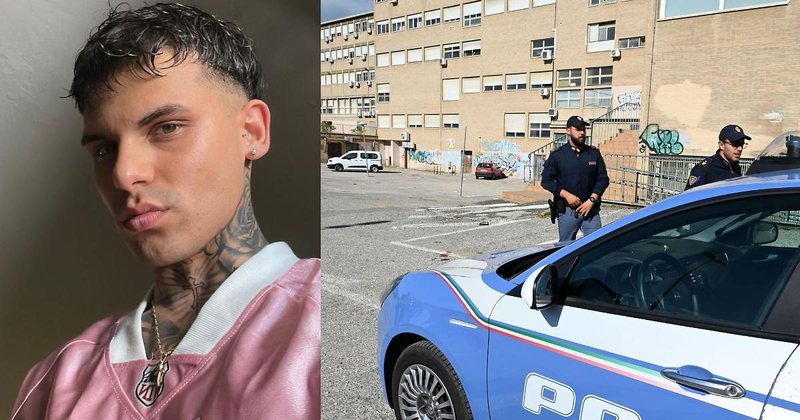
The objects and emotions that once made up the family world of Hekuran Cumani, a 23-year-old Albanian who was killed by a knife wound to the throat in the courtyard of a university in Perugia, remain untouched — silent — waiting for a return that will never come.
His life was cut short by a stabbing at the end of a night out at a university club — a senseless act of violence against a young man everyone describes as “sweet, calm, and sociable.”
Hekuran was in Perugia, in Fabriano, together with his brother and a group of friends. Something happened at the club — perhaps a look, an unintentional bump, or a girl he tried to flirt with who was already in a relationship. It didn’t take much to spark a brawl with another group of young men, second-generation Italians (of Tunisian and Moroccan origin) from the Ponte San Giovanni neighborhood of Perugia.
The fight was noticed by the club’s security staff, who immediately separated the two sides. It seemed to have ended, but as the night drew to a close and people began to leave the venue, tensions flared again in the square, and the two groups clashed physically once more.
Then came the shocking tragedy. A car stopped nearby, and a young man — apparently Tunisian — got out holding two knives, one long and one short. These weapons could never have entered the club, which had metal detectors. He was likely called by friends for help, or he went to his parked car knowing he would find the knives there.
According to witnesses, the young man brandished the knives at his rivals, then stabbed Hekuran’s brother in the thigh. Hekuran rushed to help his brother and received the fatal blow.
This is the reconstruction of events provided by police, coordinated by Deputy Prosecutor Gemma Miliani. The version is not supported by security camera footage — those in the club were of little use, and the parking lot cameras were not functioning — but it is corroborated by testimonies from the victim’s friends and other young people involved, all of whom were questioned at the police station throughout Saturday. These accounts have led investigators on the right track to capture the suspected killer. The search for the weapon used in the crime is still ongoing.
People who were at the club that night confirmed that the incident began inside, where the group of African-origin youths allegedly provoked others. Several witnesses described them as “known for their provocative and threatening behavior.”
“They were going around starting fights inside the club, even with people who had nothing to do with them. I saw it happen several times that evening,” one girl testified.
According to many regular visitors of the club, such behavior was not unusual, as several of the youths were recognized from previous parties.
The first altercation between Hekuran, his friends, and the group broke out in the club’s parking lot around 4 a.m. as they were leaving. Private security intervened and seemed to calm things down.
“I saw the first fight, which initially looked like it had been settled,” said a young man who had met Hekuran that night — so much so that he decided to leave.
Peace, however, was short-lived. Minutes later, the situation escalated again.
“It was just a matter of minutes before someone came running, crying and shouting that a boy had been stabbed,” a witness told TGR Umbria.
When emergency services arrived, there was nothing they could do for the 23-year-old. Other young people later wrote on social media that the atmosphere that night had already felt tense.
“My friend and I were there last night. Honestly, we felt so uncomfortable that we left after less than two hours,” a girl wrote on Instagram.
Another university student complained about the club’s lack of security.
⸻
Grief
Hekuran’s parents, Elca and Astrit, arrived at the Perugia police station devastated. Supported by her husband, the mother whispered:
“They killed my son. He was the best of them all. He never hurt anyone.”
Beside them sat their younger son, Samuele, who was injured in the same attack, in a wheelchair. His father, Astrit, his voice trembling, said:
“I said goodbye just after midnight, and around 5 a.m. they told me he was dead.”
Hekuran, of Albanian origin, was born and raised in Fabriano, where he attended school. He later enrolled at the Panzini Institute of Hotel Management in Senigallia and had been working for six years as a seasonal waiter at the Hotel Riviera — the same place where his older brother, Denis, works as head chef.
“We are in shock. He was a wonderful young man,” said staff members at the restaurant.
Reserved and balanced, he loved fitness, tattoos, and his family. Recently, his brother Denis had given him great joy — a newborn niece or nephew — and Hekuran had just bought a house in San Donato.
A friend wrote on social media:
“His life, a flower that bloomed too soon, has left behind a fragrance of memories and a pain that will never fade — a void that can never be filled, a presence missed every day, every hour, every moment.
His memory reminds us that life is a precious, fragile, and fleeting gift, to be lived with intensity, passion, and love.
Those of us who knew him share in his parents’ sorrow and remember his smile, his energy, and his kindness.
We know that his short life was still a beautiful gift — one that made us smile, cry, and love — and that his memory will stay with us forever.
Rest in peace, Hekuran Cumani. May the earth be light upon you.”




