

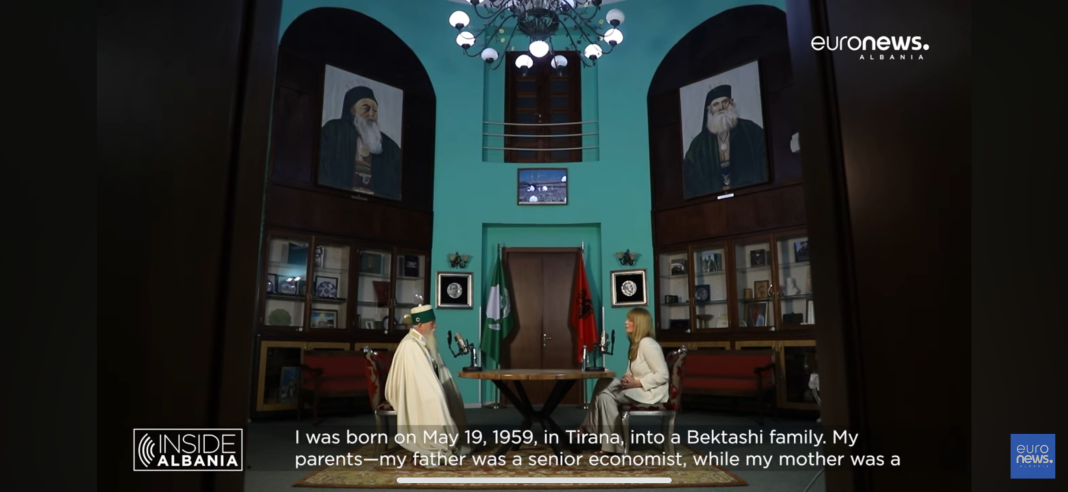
This week on Inside Albania, host Alice Taylor sat down for an exclusive interview with Baba Mondi, who spoke about faith and the idea of establishing a Bektashi state.
Full interview:
I was born on May 19, 1959, in Tirana, into a Bektashi family. My parents—my father was a senior economist, while my mother was a worker—always inspired us with faith, because we are also descendants of Dede Ahmet, who was the World Grandfather (Kryegjyshi Botëror) from 1948 to 1958. Later, he was interned in Mallakastër, and even after religion was banned in Albania, we maintained our relationship with him. He would come to our house even during the communist era. My father, Dede Reshati, served from the fall of the regime until Dede Ahmet passed away on July 10, 1980. I was born then and grew up during these moments and with this spirit.
Also, my mother, who had been married to my father for five years, was unable to conceive a child. So, she prayed to Dede Ahmet to give her a child and nine months later, I was born. After Dede Ahmet was moved from Tirana and interned in Drizar, Mallakastër, we were raised as his spiritual children. In our house, we had a clock that said “World Leader of the Bektashis, Ahmet Myftar Dede.” I once asked my mother, “Who is he?” and she told me. From time to time, we would visit him until the time we finished elementary school.
In 1974, my mother wanted me to pursue higher education, but since we were four children, if I went, the other three would not be able to go to school. So they sent me to military school so that another one of the children could pursue higher education. Before I left for school, my mother asked Dede Ahmet, “Should Mondi go to school or not? Because they will insult the faith, and they will do this and that.” And he said, “Let him go, because we’ll need him later.” So I went, completed military school, and started working.
During this time, I maintained a relationship with Dede Ahmet, with Dervish Reshati, as we used to call him.
Then in 1989, I told Dede Reshati that I was tired of the military and that I wanted to work with in a more honest and faithful profession. There was much suffering and persecution at that time as I was not in Tirana, I was stationed at the border with Macedonia. And I told him, “Either open the borders so we can leave or open the tekkes.” And he told me, “Hold on for one more year,” and I waited. In 1990, the process of democratisation began, and from that time until today, I have not left this path. As a spiritual person, as a Dervish, as a Baba, and as a Kryegjysh—I’ve undertaken all the roles that belong to a Dervish. I’ve done all kinds of work here in the tekke. I was by Dede Reshati’s side at all times.
This is an old property, which used to be a retirement home, and it was in ruins—we rebuilt and restored it, including the sanctuary. So everything you see here has been tirelessly maintained by me, until 1994 when we started dealing with property issues, which still haven’t been resolved.
Despite all the effort and sacrifices, we have not reached a consensus with the government to complete the process of returning and compensating the properties from the Albanian state. So, during all this time, I have been in the service of the Bektashis. In every tekke we have gone to, we have renovated and rebuilt them together with Dede Reshati, who put Bektashism back on track by ordaining Dervishes and Babas and reopening their tekkes across Albania. As it is known, Bektashism once had 116 tekkes and 1001 türbes (shrines). Now we are also finalizing the book The Geographical Distribution of Bektashis in Albania.
The state, through its censuses, has always acted politically and has always underreported the number of Bektashis in Albania. As is well known, from central Albania and downwards, the majority of the population was Bektashi. But there were also Bektashis in the north, although we were fought by the Bushati family of Shkodra. That is why all this activity of the Bektashis should not be denied in Albania. That is also why we do this—to show both the world and Albanians that the Bektashis have played a key role in Albania. It has been a bridge between East and West. As Pope John Paul II said, if it weren’t for the Bektashis, there would be no Albania.
So, the great role of the Bektashis in Albania, but also in the world, has been peaceful and peace-loving; they have always been for the resolution of conflicts. They have even helped create some states, and also in Turkey and in Egypt.
So, everywhere, they have been a factor for peace and continue to be such a factor. Bektashism has not been heard around the world because the World Headquarters has been in Tirana since 1967 at a time when religion was banned. Starting from 1945, religion was not allowed and this has greatly harmed us Bektashis, because Catholics have Rome or Istanbul, others have the Islamic Conference of Saudi Arabia, or in Iran. So they have not had it as difficult as we Bektashis have.
If you look at history, since the time of the Great Sultan, Bektashis have been persecuted because the leader of the Bektashis, the Kryegjysh (World Leader) at that time, told Sultan Mahmud that he should not create a harem, that he must marry one woman because religion has morals, and he was destroying morality. And so, the Sultan eliminated him. The second persecution was under Sultan Mahmud the Magnificent, who killed 2 million Bektashis because he believed that we were corrupting the Islamic faith.
Thus, nearly 2 million were exterminated. They planned to kill 4 million, but the Sultan’s mother said to him: “What do you have against the Bektashis? I declare it haram for you to spill their blood.” And out of spite, he destroyed 2 million gravestones. Because our gravestones carry a symbol, and he erased those symbols. This is a massacre unheard of in the world.
Furthermore, later in 1914 in Albania, Haxhi Qamili, a representative of the empire, along with the Greeks, persecuted the entire south of Albania. They didn’t destroy a single church or mosque—only the Bektashi tekkes. So all this persecution continued with Atatürk as well, who closed 300 tekkes in Turkey. That’s how the centre was forced to come to Tirana. And in 1929, during the Third Congress, it was decided that the headquarters would be in Albania. It was initially placed in Turan, Korça, and later, by order of King Zog, it came to Tirana, where he decreed it as the World Headquarters.
Then communism came and repeated the same pattern. From 1945, persecution began again. Seventy Babas and Dervishes were killed by the communist regime, plus many were interned and persecuted. All of this—in these few minutes I speak—if you read and research, you’ll see how much the Bektashi Babas have suffered for truth, for peace, for goodness, and for love. All our tekkes have always been generous—they helped the poor, they housed people who had no economic means. Land was given to farmers to work so they could earn their daily bread through hard work. So all this goodness of the Tekke has also been met with persecution.
Bektashism is a faith that, first and foremost, respects the human being. The human being is the highest value. As Naim Frashëri writes in his works: do good for God, for people, and for your homeland. As it’s well known, Bektashis have no enemies—they see all people, regardless of religion, region, colour, race, or politics, as brothers and sisters. That is why, while we are making progress, the more conservative side, as it is known and seen, attacks us. And yet, we live and work with sweat and peace in this world.
But the idea of a Bektashi state—does it face more criticism from friends or enemies?
From enemies—because our friends support us, since we are not a divisive factor, we are peace-loving. But when we say “NGO,” what can an NGO do in the world without legal status, without diplomatic status when facing states? Because when you are a state, there are international conventions between states, there are various relations. So, by being recognized by the UN, by being recognized by the EU, we will then have other kinds of challenges and we will face them as equals among other states.
We are asking for the rights of the Bektashis, who all over the world, in the Middle East and Far East, are—how shall I put it—secret, due to persecution, such as in Iran, but also in Turkey, where we have 25 million who still don’t have their rights, where the tekkes have not been reopened. So this is an unprecedented struggle by this community, which has always been peace-loving. And by facing states—state to state—we will then seek our rights. The world will help us obtain our rights, because political Islam throughout the Middle East has not respected the Bektashis.
But the Muslim Community of Albania, I mean, has reacted quite strongly, saying: “Why them, and not us?” Then there are also people who say that Albania is a secular state. Why should we be divided in this way?
The Muslim Community has signed it, the Orthodox Community has also signed the agreement I made with them—that Bektashism should have a World Headquarters, that it should receive global status. They signed it. But it’s the conservative faction within Sunni Islam that opposes this—not all Muslims. Because the Muslims we know—we’ve had very good relations with them and will continue to do so. Albania is not about division, but it will give value to this community. We do not cover women—we educate them. We have made progress; we are progressive, and that is why the conservatives do not want religion [in this form]. So that’s why—we are not at war with anyone. We fight for ourselves, to be peace-loving, kind-hearted, to educate people, so that there is knowledge and not ignorance. Because, as is known, the three main enemies of humanity are ignorance, poverty, and individual egoism. The Muslim Community will see how the Bektashis will act and what we will accomplish in the future—always being a factor of peace.
I also have a few more questions about the Bektashi state, but first I want to ask you: what has been the most difficult part of your life so far as a Baba? And what has been the most beautiful moment?
My whole life has been difficult, from childhood up to this point. First of all, I was five years old when we had to stand in line under communism—we stood in line to get dairy, milk, and everything else. That’s how everyone lived, but I was the first child. Then I went into the army, to the Skenderbej military school, and even there, life wasn’t luxurious—it was all sacrifice. The same goes for university, and later for work—you had to be prepared to face the difficulties that came your way. I have felt happy when I became a spiritual member of the Bektashis, when I became a Dervish, then a Baba, and finally the Kryegjysh (World Leader) of my community. These have been joyful moments. But there have also been moments of great sacrifice. God has never thrown away my efforts, he has always honored it. For example, the event of Charlie Hebdo, when we went to Paris and all the religious communities marched together, showing France that it is possible to live with love, peace, and kindness—that was a powerful moment. The same goes for meetings with the Popes—with Pope Francis, Benedict, and also the new Pope—where we delivered messages of love and peace to one another. Pope Francis, in particular, has shown great kindness toward me, with the way he welcomed me—he broke all protocol, simply out of the goodness he had toward me, and I toward him. These are unforgettable moments. We’ve shown that we are always a factor of peace—both they and we—throughout the world.
I have one more question. You have been a spiritual person your entire life, but during communism, all religions were illegal. It must have been very painful for you to keep that inside and not be able to practice it.
Of course, when we were young children, we didn’t have a clear perception of what communism really was or why it had banned religion. But during school, through studying and understanding how the communist system functioned, and through the persecution we endured, we came to understand that faith is something personal, it is not collective. You cannot remove God from people’s hearts. Nevertheless, despite the regime’s harsh fight against religion, the situation Albania is in today is still marked by the consequences of that persecution. The communist system destroyed families, destroyed property, eliminated people of intelligence—those strong bloodlines that uphold a nation. It destroyed everything. It destroyed religion, property, the military—everything. And even today, we suffer the consequences of that, both as a community, as the World Bektashi Headquarters, but also as an Albanian people. Such was that system. Even so, during communism, Dede Ahmeti and Dervish Reshati kept this light alive. They kept it burning even into the 1980s. Then the transition came—from Dede Ahmeti, it continued with Reshati, who kept the light burning until 1990. Eventually, activity resumed, tekkes started to reopen, and the few Babas that remained—there were about five at the time—were here: Dede Reshati, Baba Bajram Mahmutaj, Baba Selimi, Baba Sherifi, Baba Tekiu. They were alive at the time. They came together and reopened Bektashism in Albania. I have been serving here since the very beginning, from the very first days—providing food for the Babas who lived here with me: Baba Reshati, Dede Reshati, Baba Bajram Mahmutaj, and Baba Selimi. After six months, they each took on their own roles, and the revival of Bektashism and the tekkes across Albania continued from there.
Now, let’s return to the Bektashi state. Where do things currently stand? What concrete steps have been taken toward the creation of this sovereign state within Albania?
Aside from what the Prime Minister of Albania spoke about at the UN, they are continuing the process—it is in their hands now to move it forward. We have been informed that this will happen, and we have many of our representatives who are working in cooperation with working groups to deliver a verdict and a decree on what will be done. Whether it will be a state or a mini-state—it will be an official decision. We don’t know yet. They are the ones who will decide what will be done with Bektashism in Albania. They will look at the most reasonable solution so that there are no violations of the constitution or contradictions with the law. So only the Prime Minister and the initiative group for this matter know exactly how it will proceed.
And what about the news of a Bektashi State – was this a surprise for you?
Yes, it was a miracle for us. Because we have been asking for 30 years to have our rights. As I said before, as an NGO, you cannot go up against powerful states where Bektashis exist. Nevertheless, as the World Bektashi Headquarters, we have won our rights in North Macedonia, and also in Strasbourg. In North Macedonia, we have obtained equal status as a community alongside all the others there.
When there was no World Headquarters—not even during the empire—there was no such structure, but when states began to form, then Bektashi communities were created in Albania, North Macedonia, Kosovo, and Greece. But now, there needs to be a connection, because they do not yet have that.
Being an NGO means you don’t have legal or diplomatic power, so this was a surprise for us. Because it was announced at the United Nations, it presented to the world what Bektashism is, what role it plays, what role Albanians have had—starting with the King during World War II who protected people. The same goes for Mother Teresa, and the same goes for what Bektashism has given to Albania—values of peace, which are fundamental.
We don’t believe in communism, we don’t believe in violence—we may be killed, but we do not kill; we may be conquered, but we do not conquer others. That is the mission of the Bektashis. Wherever they are, they create love, peace, kindness, support—everything.
But this Bektashi state has a political element to it, since it involves governance, decision-making, and the will to lead. Some might say: do you have any political ambitions, or is this purely a religious initiative?
This has nothing to do with politics. Let’s take an example—let’s say it becomes a state. That state will have rules, it will have a constitution, it will have something specific that aligns with Albania’s legal framework. We are not going to place ourselves above the laws of Albania.
We will not have an army, we will not have police. Why would we need that now? Everything has become simpler, even with artificial intelligence—so we will continue to be who we are, you understand? There will just be something different from a diplomatic and legal standpoint, so that we can engage on that level. There’s nothing particularly unusual about it.
The World Headquarters already exists, but it doesn’t yet have its own political or diplomatic jurisdiction. And we’ve never been involved in politics.
One more question. What kind of funding would be needed for the Bektashi state? Would it require financial support, and where would that come from? Some people have said, “Ah, this is Turkish influence, maybe they’ll get money from there or elsewhere.” How do you respond to these public concerns?
We are the only religious community that does not receive any financial aid from abroad—we live off our own properties, let that be clear. We have properties all over the world, but we have not been able to take possession of them. That’s why the fight is for every religious community to have its own property rights.
In North Macedonia, for example, we have 1,200 hectares in Tetovo that belong to the Tekke. If they don’t return the properties, then they must be compensated. So, a way must be found to return the properties of the Bektashis, wherever they are.
You don’t need any money from anyone!
Until today—still—over 30 years, no one has helped us, except for the Albanian state, which gave a donation of 2 million euros for this Odeon that we built here. The great Odeon, that’s it!
There has been a lot of debate around the creation of this state. If it ever reaches a point where it truly divides the Albanian people, would you be willing to give up the idea of establishing a Bektashi State?
For us Bektashis? It doesn’t harm us, nor the state. In fact, it would be a help. It would help the Albanian state to reform as it should. The Bektashis have never been… it’s just what those who don’t like us say… these are just words. So we won’t be upset, and even if some get jealous—there’s no reason for jealousy. As Imam Ali says: when someone does good, don’t be jealous—do the same as them.
So we’ve never been like that. If you read history over the past 800 years—as I’ve said before—we’ve been persecuted, violated, everything has been done to us. Take just my life—five years that I lived in North Macedonia—I was persecuted, burned, there were even attempts to physically eliminate me, yet here I am. Because I will die only when God wills it, but I won that right in Macedonia.
So, without struggle, without effort, without sacrifice—nothing is achieved in this world. Even to put food on the table, you must work for it. People will talk—they may say whatever they want. They have even insulted prophets—prophets who weren’t sent by us but by God. They’ve insulted different personalities who work for peace and justice.
We will not focus on the world—we will focus on ourselves. And by focusing on ourselves, we won’t have time to get distracted. With the world, we’ll move forward.
Do you have another message for the people who say: “No, we don’t want it, it’s corrupt or has bad intentions?”
We must understand one thing—that every step forward always comes with problems, because conservatives do not accept something new. That’s why these things happen—we are aware of them, but we should not be afraid of what they say. Time will reveal the truth—who we are—and time has already shown who we are.
All the saints have been killed, persecuted, poisoned—but humanity has continued, mysticism has moved forward. We are a path—we are not… Even if we are a state, we still have our own rules. We do not consume what is forbidden, we do not exploit others—we work ourselves and help feed others.
That’s why the Albanian people have no reason to abandon this beautiful country and go elsewhere. We must all work together to rebuild it, just as our ancestors did. As our ancestors lived to preserve the nation that we and others enjoy today. Without effort and sacrifice, none of this can happen.
This is true all over the world—even America, which is what it is today, was built with effort, blood, and sweat. The same goes for Europe, for the East—everything was built through struggle. The truth has always been attacked. If people don’t like it, that’s their issue—we will continue to live our path. Regardless of who insults, threatens, or slanders us—we have no issue with them, only with ourselves.
There are no enemies—they are created by people themselves, from race, from poverty, from egoism. That’s why effort and sacrifice are needed from people. During fasting, we read a book—a book that describes the sufferings of the prophets, from Adam to Muhammad, and from Muhammad to the martyrdom of Imam Hussein and the 72 martyrs. So even for faith, people have suffered—they have been persecuted, killed, poisoned. But humanity has followed in their footsteps because they set the example.
We follow the footsteps of the scholars—Leonardo da Vinci, Michelangelo, Beethoven, great writers like Jules Verne—all those who gave to humanity, they are remembered. So we too will follow in their footsteps—with effort, with sacrifice, with love, with peace, and without egoism.
That is my message to all people: people should focus on themselves, not on the world.
Now, the announcement was made in January. Since then, have you received any threats? Have there been any problems? Have you been forced to increase security?
Yes, but we are not afraid. Why should we be afraid? We have surrendered ourselves to God—there’s no need for fear. I have two young men who serve here with me, that’s it.
Look, I say this: when you are an honest person, a hard worker, no one bothers you. If you harm others, they will harm you—but we don’t harm anyone. We mind our own work. Even if we are attacked, we will not retaliate.
If I have the possibility not to stray from my path—from my justice and my truth—then that’s what matters.
How are you connecting with the younger generation? Today, young people are drawn to social media, many want to leave Albania… they’re focused on appearance, on music… and I’m curious to know how you are engaging with them today to preserve faith among the people.
As the Prophet Muhammad said: When you feel troubled, turn to good places. And so, when people feel troubled, they come to me. And with wisdom, love, and kindness, I show them what they should do—how they should live their lives. Whether they’re married or not, whether they’re young—whoever comes, I help them find belief in themselves.
As God says: I created man in My own image. So you are God’s presence on Earth—how can you fear hardships? There is a verse in the Qur’an that says: Neither the heavens nor the earth can contain Me, but the heart of a faithful believer can. If you carry God with you, why should you be afraid?
That’s why we guide them—to be strong, to face difficulties. As I said earlier, what you read—we read it publicly, to show people how they should act in difficult moments. I give advice, of course, I give blessings, prayers. Because people come here to release negative energy, and to absorb positive energy—that’s what this is about.
That’s why the Prophet said: Turn to good places. They release energy here through positivity, to help them cope with the challenges of this temporary world. Even though we say that technology should be used for good—not for harm—for kindness.
That’s why we also pray to God that people follow the path of God. And as the Qur’an says: Whoever knows themselves, knows God. They must get to know themselves—because many do not know who they are. The holy books are what guide us to the truth—whether it’s the Torah, the Psalms, the Gospel, or the Qur’an.
But I still feel that today, from my perception, young people are not interested in history, culture, or religion. And this is a problem—not just in Albania, but abroad as well. The Catholic Church faces the same issue, as does the Church of England in the UK. They’re struggling to bring people back into churches, into places of worship.
It’s not the youth’s fault—we, the leaders, are to blame. There is no bad people, only bad leadership. Because leadership often uses “Divide and Rule.” Religion unites people—it doesn’t divide them. Division comes from interests. We have no interest in harming anyone, in killing—we want people to be good, to walk with God, to do good deeds, not to be criminals, not to be thieves. That is what faith is about.
We must look at faith seriously, and religious leaders must look inward and lead by personal example. This is important, because—as both Christ and Muhammad say—when a person has no spiritual guidance, their guide becomes the devil. Because your ego—when you don’t have spiritual leadership—won’t even let you give alms.
Let me ask you something: do you have spiritual guidance?
Yes! I was raised in a family without spiritual guidance—my father is a psychologist and my mother is a teacher. But I do have it. I’m Christian.
Spiritual guidance is a priest, or a baba, or an orthodox cleric—it doesn’t matter which. What matters is that you have one, because they don’t let you go astray.
I believe there is only one God.
Yes, God is one, but He has left behind certain things. My sister, God doesn’t appear to you every night on television or in your dreams. God has sent His people—He has sent His leaders, His books. We follow those. Because ego won’t let a person move forward—anyone.
That’s why I say: you choose your own spiritual guide. In Bektashism, the number of people doesn’t matter—what matters is that those who come have quality. We say three times: don’t come, don’t come, because this is a hard path. But if someone insists and says “I want to come”—we say: “Welcome, but don’t turn back and don’t betray.”
Humanity must have rules—just like the universe has rules. Leaders are the ones who move humanity forward—both political and religious. And those who are good, God sees them more than those who do evil. So every person will go before God—with both their good and bad deeds.
I have one more question about the Bektashi state. Have you had any discussions or dialogue with the European Union or the United Nations?
I am registered with the European Union—I go there for the issues I deal with today. They have specific departments that support faith, security, efforts against violence, and anything harmful. And we have cooperation with them.
Also, with the American Department—as you know, here in the Odeon we have the flag that was given to us by them, as a symbol of the peace, love, and kindness that our community represents. And the Jewish community—as you’ve seen—and even the Pope, who welcomed me twice, recognized these values we stand for. We’ve met to collaborate, to help guide people on the right path.
Does this (Bektashi) state have the support of the European Union? Because if Albania is to join the EU, this relationship with the European Union becomes very important.
We have always been a factor of peace. In Albania and in Europe, we have shown our values—who we are—and little by little, they are starting to cooperate with us to develop projects that help Albania move faster toward joining the European Union.
How would you like to be remembered, as your legacy? As the head of the Bektashi state? As its founder? As a spiritual leader, or as a visionary?
Who will I be—or rather, when I am no longer here? Yes. But I will have my successor.
Ah, how I’ll be remembered—that’s up to the people, I cannot say.
What I can say is that I’ve shown vision by adapting to the times. As the Prophet Muhammad says: Adapt to the time, for time is a sword—and it will cut you. If it doesn’t adapt to you, then you adapt to it. So, in the time we are living in, you can see—Bektashis have adapted.
Both men and women are equal, and both are respected equally. We do not cover women—we educate them. Because, as we say, it is not clothes that cover a woman, it is the veil of dignity. Honor is not protected by clothing, but by a person’s character. That’s why we are visionary in that direction.
By educating our women—our sisters—they will raise the next generations to be healthy and strong. That is our mission: to respect the human being, both men and women, to ensure they are equal, valued as human beings first, but also as parents and partners. To raise educated, progressive children.
Baba Mondi, thank you!
Thank you too, and may you have a long life! May God bless you all! Amin!




