

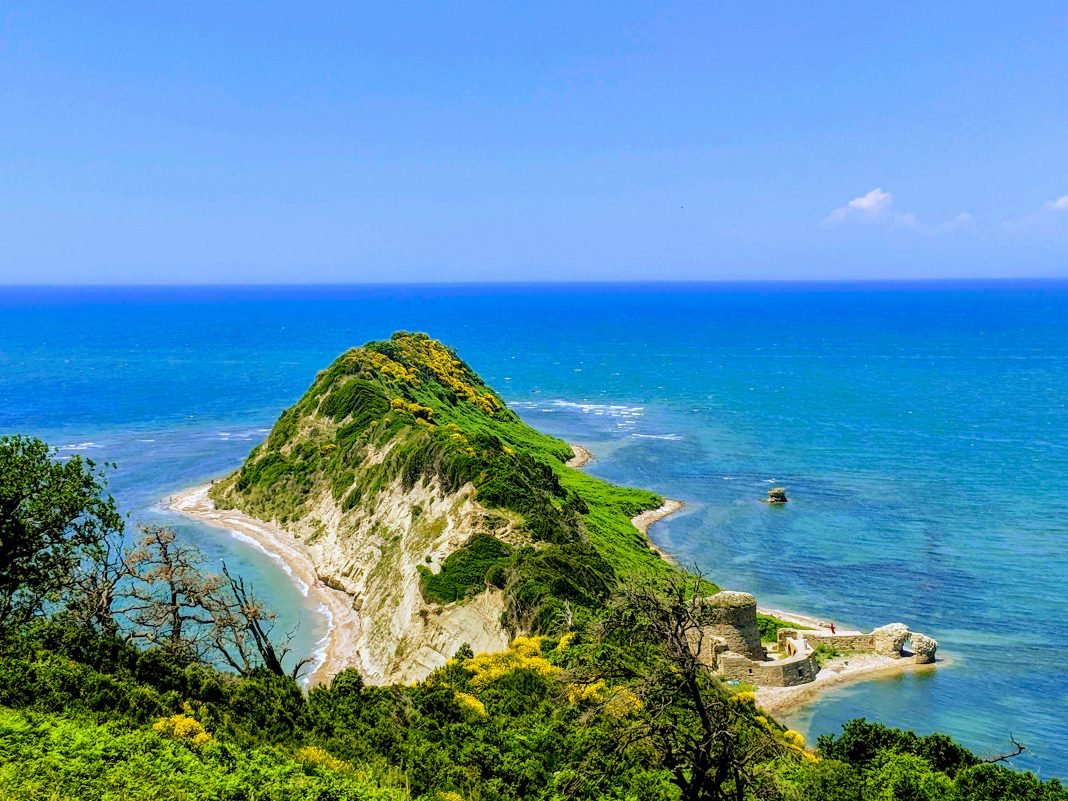
After exploring the unique landmarks of the antique city of Durres, Euronews Albania’s ‘Travelers’ decided to disembark in these two very interesting places close by, which you shouldn’t miss out on.
Around 50 km north of Durres, beyond the Bay of Lalez, a strip of land extends onto the Adriatic Sea, forming a cape that holds within it a lot of history. This is the “Cape of Rodon”.
Renowned Albanian archeologists and researchers like Hasan Ceka and Moikom Zeqo, link the etymology of the name with Illyrian pagan mythology. The Illyrian god of the sea, was called Redon, – a god, similar to the Greek and Roman mythology gods, Poseidon and Neptune.
Apart from this etymologic background that adds to the curiosity of this ancient site, the Cape of Rodon is also home to a church and midlevel castle that have been preserved magnificently.
This castle was built by the Albanian hero, Geroge Kastriot Skanderbeg, thanks to his relations with Ragusa, with which he had signed a deal, – in case of an Ottoman siege, this castle would be used as the last fortress, to escape from.
In fact, when Sultan Mehmet II started his conquest of Kruja, during 1466-1467, the family of Skanderbeg retreated to Rodon, and from there, with around 14 ships, they left for Brindisi, in today’s Italy. The great historian Marin Barleti wrote that the Ottomans destroyed the castle, but around 50 years later, it was rebuilt by the Venetians.
Because of the sea approaching the land through the centuries, parts of the castle’s walls ended up in the water, but the castle can still be easily accessible on the other side, where one of its towers, still remains high up the ground.
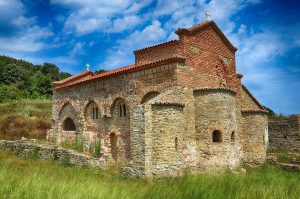
A little further, is the Church of St. Anthony, a church, in which according to legends, the younger sister of Skanderbeg, Mamica, used to come to. This church was designated as a monument of culture back in 1963, and was one of the few that remained, after their massive destructions nationwide by the communist regime, which forced Albania to be an absolutely atheist state. The area became militarized during the dictatorship and this is testified by several bunkers found close by.
There are still drawings on the church walls, especially the ones behind the altar, where apart from the eagle, which was the symbol of the Kastriot family, there are also three birds, which are a Paleo-Christian symbol of the “good Christian” and the drawing in three different positions, with a lowered head, in normal stance and in flight, signify the three worlds: the underworld, the human world and the afterlife. The church was restored after the 90s.
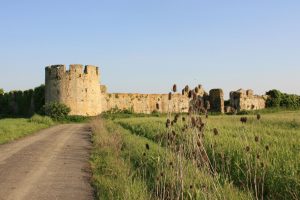
90 kilometers to the south of the Cape of Rodon, in Kavaja, we can find the only castle built in the Balkans on flat terrain, the “Castle of Bashtova” near the village of Vile-Bashtove.
Located close to the Shkumbin river, not too far from the Adriatic Sea, this castle was built by the Venetians, for trade purposes. It mainly served to preserve the harvests and plantations as well as their preparation for export into Venice. This castle with walls reaching up to 10 m in height, was later turned into a military fortress by the Ottomans. They fortified the walls, changed the battlements and heightened the towers.
Nowadays, the castle is in perfect condition and has often been used for cultural activities and other events.




