

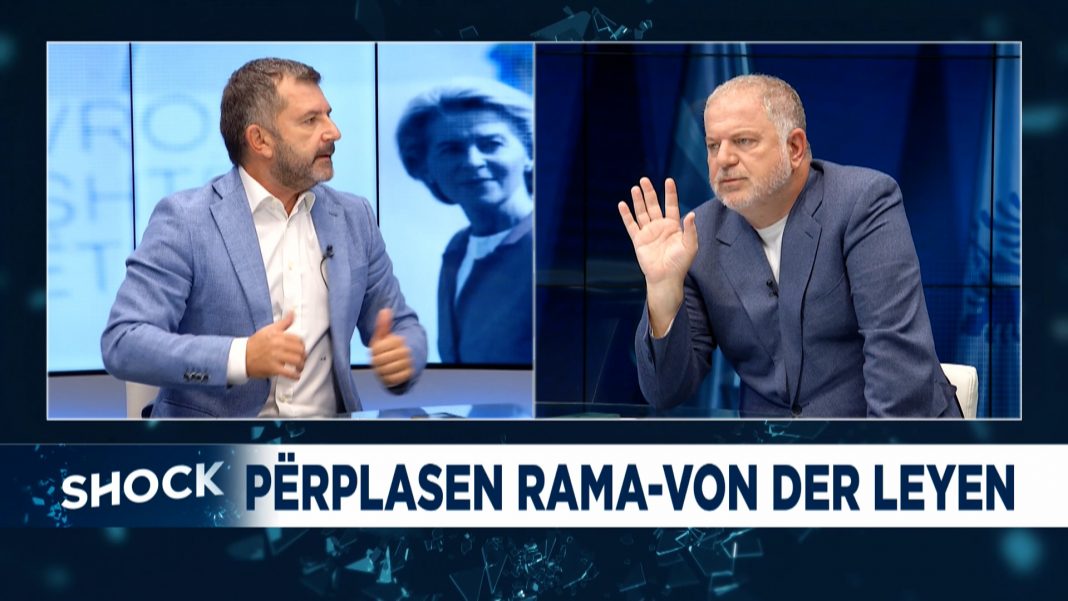
One of the topics discussed tonight on Shock was the approach of the European Union on the Western Balkans.
Analyst Baton Haxhiu said there were no hostilities between the President of the EU Commission Ursula von der Leyen and Prime Minister Edi Rama, but just “some unclarity on the Open Balkan”.
Haxhiu sees the Berlin Process as “Germany’s failed project”, which only served “to bring a dictator”, referring here to Serbian President Aleksandar Vucic.
“I wouldn’t call it a clash, but unclarity on what the Open Balkan stands for”, said Haxhiu. “We should not disrupt the road of a successful start and an unsuccessful ending, perhaps the most unsuccessful ending that the German state had with the Berlin Process. Billions have been spent, it created a dictator (referring to the Serbian president). Fact is that a very powerful man has been created”, he said.
Haxhiu added that Von der Leyen was skeptical about the regional initiative, but PM Rama gave concrete figures on why the approach might be successful.
Andi Bushati emphasized that alike Angela Merkel, even Von der Leyen conveyed a similar message, implying that the EU does not want the Open Balkan.
“I believe that there was a clash and it was evident. Judging Germany and France is not our priority, and the signals coming there must be seen through our own context. There is a clear rejection on the side of the EU, we saw it from Merkel, too”, he concluded.
According to Haxhiu, the German chancellor was very careful when talking about the initiative, in order not to harm the interests of the three countries involved.
He also added that Kosovo’s refusal to join the initiative might be over fears that it may lose part of its sovereignty, becoming an extension of Albania.
Bushati agreed that smaller states are the ones to lose the most from this initiative, and saw it as the reason why Kosovo, Montenegro, and Bosnia and Herzegovina eye initiatives led by the European Union.





