

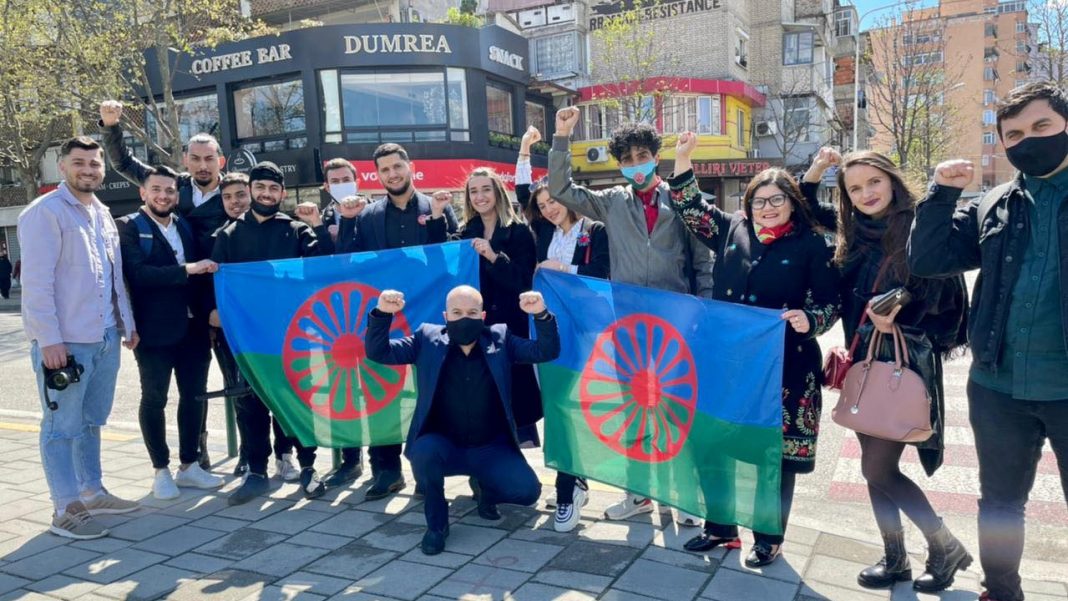
The International Roma Day celebrates the Romani history, traditions, and cultures, but it also calls for social involvement. This day also aims to raise awareness about the various challenges the Roma community is faced with, around the entire globe. This day was officially declared in 1990, in honor of the first major international meeting of Roma representatives during the fourth congress of the International Roma Union. In the most recent report of “Amnesty International” focused on human rights, it says that the year 2020 also registered protests from the Roma minorities in Albania as they hadn’t benefited from the government’s emergency relief plan, which didn’t cover informal employment. On the other hand, the report also pointed out that the Albanian Parliament has now passed an amendment that considerably increases its reach of groups that will benefit from legal protection against discrimination.
In order to delve into the topic of the different concerns troubling the Roma communities in our country, we will be discussing with Emiliano Aliu, Executive Director of “Roma Versitas Albania”.
How does this day find the Roma community in Albania?
ALIU: Today for us, marks a special day as it represents the 50th anniversary of the International Roma day, since the First Congress of the International Roma Union was held, back in 1971. It was later during the 4th Congress, held in 1991 that the International Roma day was officially declared. In 1971, in the Congress bringing together 23 delegates from 23 different countries, the term ‘Roma’ was decided on, thus dismissing all other derogatory terms as well as the Roma flag, which has 3 colors, the color blue representing the sky and infinity, the color green representing the earth and terrain and the red chakra, which is the symbol of movement, fire and progress. So, the Congress decided on the term, the flag as well as our hymn titled ‘Gelem Gelem’. All of these 3 together are important elements for the recognition and identity of the Roma community.
But back to your question, how does the International Roma day find us after 50 years? Sincerely, we have many challenges ahead of us that we need to continue fighting for.
Even though we are in this current situation because of the pandemic caused by COVID-19, the majority of the organizations from the civil society aren’t remaining silent. Not only by celebrating our history, tradition and culture but also by raising their voices about the different problems facing the Roma community in our country. What I can say is that without a doubt, the year 2020 has found Roma minorities in Albania, the region and all of Europe in a much harder situation than the rest of society.
Can you tell us some of the main issues that concern the Roma community?
For years now, these 4 main issues remain Housing, employment, education and representation in decision-making and politics.
Even in the Poznan Declaration (Declaration of Western Balkans Partners on Roma Integration within the EU Enlargement Process) that was also signed by Albanian public officials, they have pledged that these 4 elements or issues will change in the years to come, that they will work to find a solution.
We also have the support of the European Council through the RCC (Regional Cooperation Council, Roma Integration ) which is conducting a monitoring program in Albania and other countries in the Western Balkans, regarding how these pledges are actually being put into action.
And are these promises being kept?
ALIU: Well, this is something that needs to be discussed one step at a time, one issue at a time, as every year a report is written by every state, a yearly report regarding the progression of these promises and how they are being applied.
In Albania, we saw a fulfillment of around 25% in terms of the issue of shelter or the legalization of the properties of Roma homeowners. A possible excuse could be the earthquake of November 2019, or the COVID-19 pandemic. So, it hasn’t been accomplished, the percentage is almost negligible.
Meanwhile, we are currently at a 90% figure in terms of the required education section, but when it comes to high-school education we are placed at 50%, which is where the issue lies. Yes, we can see improvement, we have positive results, but the numbers are still low.
There has been a lot of discussion regarding the willingness to provide registration as well as education. Are there improvements?
ALIU: In fact, we are at a point where registrations are almost not an issue anymore. Because of migration, there have been a lot of cases of children of the Roma community being born outside of the Albanian territory, but in the last three years, this issue is almost entirely solved. And this is a positive thing as it ensures that they get adequate economic assistance as well as other services.
The problem lies with housing. No matter where you are or how, the most important thing is shelter, do you have a roof over your head? Even for those living in shacks or huts, that has been their roof. But now, some of them don’t even have those shacks, they’ve been evicted because of Tirana’s and other cities’ urban developments. More than 10 to 20 % of them are at this very moment, homeless.
Is there a plan for their housing, be it in terms of identifying possible spaces, as there has also been a discussion about not housing them in the same areas that could be considered as ghettos or segregated neighborhoods?
ALIU: For the past 6 years, we have provided several recommendations and guidelines regarding this discussion that to a certain degree have been taken into consideration, because something that could serve as a solution would be the use of public property like objects from the military, but this raised the question about the possibility of creating ghettos or segregated neighborhoods. However, in the entire country, one can find neighborhoods of the Roma community, it’s not like this has been a problem for them. The majority of Roma families that have had the appropriate opportunities, have integrated themselves in society and they feel like everyone else but there are also those that have remained in the ghettos because of unemployment and other economic issues. There are positive practices from the entire region. But there’s a lot left to be done in order to turn the page and make our plans on paper reality and in order to put them to action and practice, we need to join forces.
Is there more awareness amongst Roma families in terms of offering their children an education?
I don’t want to speak only about “Roma Versitas Albania” or about my own personal example, because for me personally, I have a great love for education. I have been one of those students that has made many efforts in order to have an influence and a say in the politics necessary to provide assistance in the education of Roma children. I have helped my own 4 sisters to get an education, even though it was during the harsh years like 1997, but today they are able to make a living. However, the problem doesn’t only lie with awareness. The government has done enough in terms of raising awareness, but that is not enough. The problem lies with the economic conditions of the Roma families, how capable they are to face all the different costs and help their children get an education. But even with small steps, we can slowly move closer and reach our goals.




