

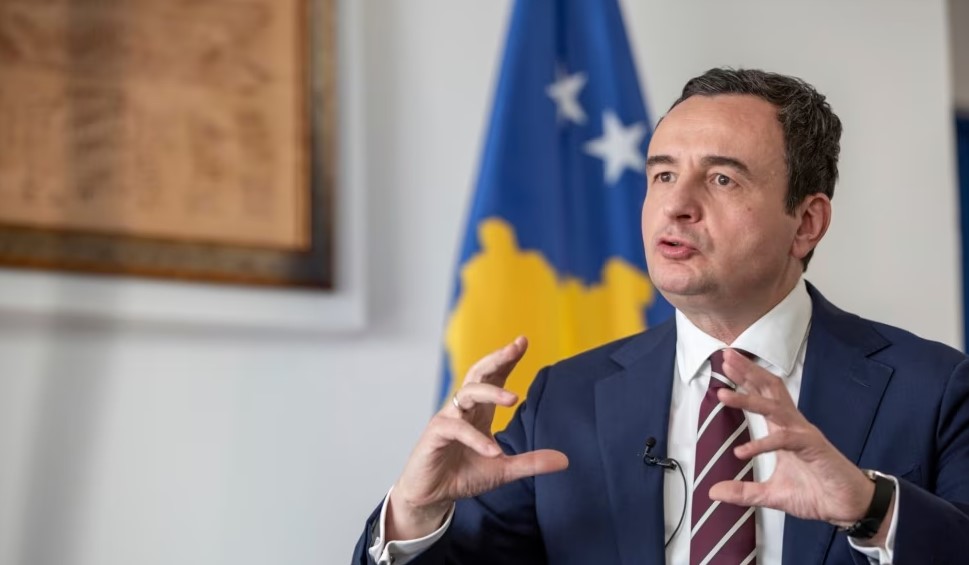
Kosovo’s Prime Minister Albin Kurti said his state needs to be pushed towards European integration in response to security threats coming from Serbia.
During the conference “Parliamentary Diplomacy for Regional Security and Euro-Atlantic Integration”, Kurti said that concerning Serbia, which he described as an “autocratic regime”, the same approach should be used as the European Union and NATO used towards Russia after Russia’s invasion of Ukraine in 2022.
He said that the EU and NATO responded to Russia’s invasion of Ukraine by accepting Finland and Sweden into the alliance and granting candidate status to Ukraine, Moldova, and Georgia.
“The security threats in the Western Balkans from Serbia should be addressed using the same approach, thus granting Kosovo the status of a candidate country for the European Union and membership in the Council of Europe,” Kurti said.
Prime Minister Kurti said that during his two years in office, Serbia deployed its army four times on the border with Kosovo, “sponsored terrorists, and continuously spread lies and false narratives to justify aggressive acts against Kosovo and the region”.
These statements by Kurti refer to heightened tensions in several cases between Kosovo and Serbia, including the erection of barricades in northern Kosovo by local Serbs due to some decisions of the government in Pristina, but also an armed attack by a group of Serbs against the Kosovo Police. The attack in Banjska of Zvecan last September left a Kosovo Police officer dead, and three Serb attackers were killed during the clashes.
Kosovo has blamed Serbia for the attack in Banjska, which it labels as terrorism, but Serbia has said it had no hand in it.
During the conference, Kurti talked about Kosovo’s European and Atlantic integration and said that this journey cannot happen without the support of its international friends but also without internal reforms.
Kosovo applied for membership in the Council of Europe in 2023 and for the EU at the end of 2022.
However, there has been no progress in any of these integration processes, and Kosovo is the only country in the Western Balkans that does not have candidate status.
“The lack of progress in Kosovo’s accession to the EU and the Council of Europe has nothing to do with a lack of democracy and strong protection of minority rights and human rights, but with the behavior of an authoritarian regime because Serbia is not interested in NATO or EU membership. It seeks to block the progress of the entire region by restraining the entire region,” Kurti said.
Kurti made these statements after Serbian President Aleksandar Vučić accused Western states a day earlier of intensifying pressure on Serbia to recognize Kosovo de facto and de jure, to impose sanctions against Russia, and to change its stance toward China.
Serbia, an ally of Russia, has not imposed sanctions on Moscow due to the war in Ukraine, despite calls from the international community. Meanwhile, a week ago, Belgrade said it supported Beijing’s policy that Taiwan’s self-governing island is part of China.
According to Vučić, the ultimate goal of Western states is for a “puppet regime” of the West to come to Serbia because, according to him, “a free and independent Serbia is not popular in Europe”.
During a televised address, Vučić also spoke about the ban on the use of the Serbian dinar in Kosovo. He said that the regulation of the Central Bank of Kosovo (CBK) that only the euro should be the currency for cash payments has worsened the situation in Kosovo.
“We will be forced to make different decisions through which we will act or find alternative solutions to pay our people in ‘Kosovo and Metohija’,” Vučić said.
Serbs in Kosovo have used the Serbian dinar since the end of the last war.
The Serbian state allocates millions of euros for Serbs in Kosovo, paying them in dinars through a parallel system for wages, pensions, and additional assistance.
The international community has called on Kosovo to postpone the decision, which has been in effect since February 1, arguing that it does not take into account the negative impacts on the Serbian community.




