
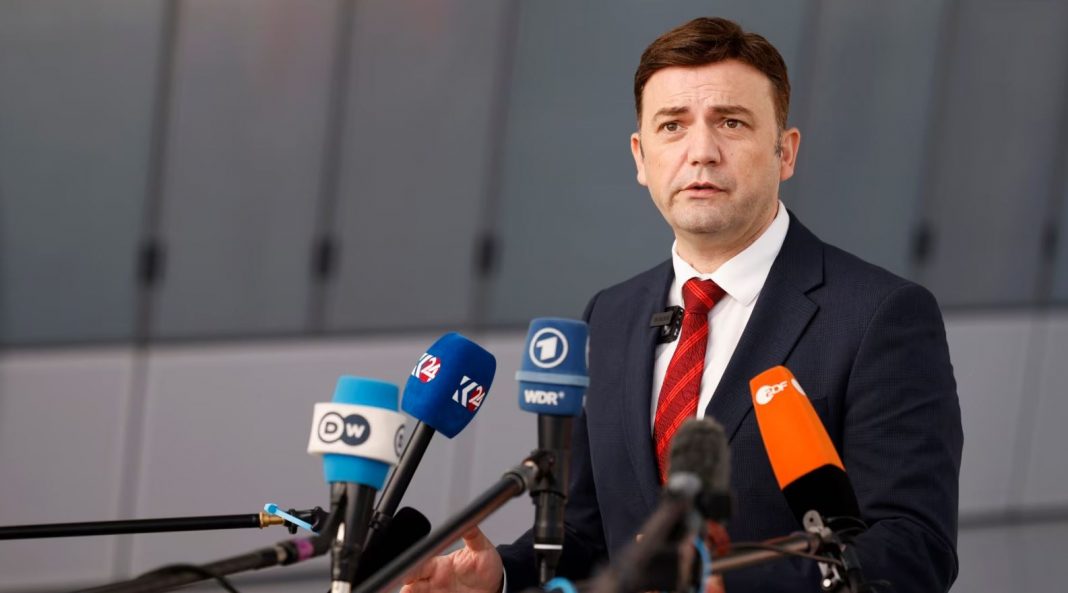
North Macedonia’s Minister of Foreign Affairs, Bujar Osmani, stated that the inclusion of Kosovo’s official politics in the political scene of Albanians in North Macedonia “will not impact the electoral process” but “may reflect the fragmentation of Albanian politics, a tendency fueled by external factors”.
Osmani made these comments after a meeting in Skopje on January 17 with the Minister for Europe and Foreign Affairs of Albania, Igli Hasani, who emphasized “the importance of unification not only as Albanians but also of all progressive forces in the region for the common future of the Western Balkans in the European family”.
Osmani’s assessments followed reactions that continue in North Macedonia after Kosovo’s ruling party, Vetëvendosje Movement (LVV), decided to be part of the Albanian opposition coalition in North Macedonia, known as the European Alliance for Change (LEN).
This was announced on December 24, 2023, during a ceremony for the opening of opposition offices in Skopje, attended by representatives of the Vetëvendosje Movement.
The Macedonian Foreign Minister, Bujar Osmani, who is also the vice president of the Democratic Union for Integration (BDI), said that there have been “such attempts” before, recalling the case of Blerim Reka from Skopje. The Albanian opposition had appointed him as a candidate for the President of North Macedonia in the 2019 elections, and Vetëvendosje representatives were present at his rallies.
After the elections, Blerim Reka continued his activities in Kosovo and was appointed as the Minister of European Integration in the Government led by Vetëvendosje’s leader, Albin Kurti, on February 3, 2020.
“This is nothing new because there have been such attempts for direct support before, as was the case with a presidential candidate who later became a minister in the Government of Kosovo. He received support from high-ranking representatives of Kosovo at rallies and other events. But this showed that the political scene of Albanians in North Macedonia is consolidated. And just as it did not influence back then, I do not expect it to have any impact now in any way,” said chief diplomat Osmani.
Without specifying any party names, Osmani also spoke about “tendencies from outside to fragment the political scene of Albanians in North Macedonia into smaller political parties”, which, according to him, “weaken their proper representation in the state”.
“The fragmentation of the Albanian political scene into smaller political parties weakens their proper representation in the state because there has been a tendency often encouraged by external factors but also by internal dynamics for Albanians in North Macedonia to organize in every city, to have political parties, each city to have its own political leader and to engage with each other, not to have a common political platform that represents Albanians at the state level and conveys their political will to the institutions,” Osmani stated.
Furthermore, he said that such practices are not good because “any legitimization of the involvement of other states with their political parties, including Serbia, Bulgaria, Albania, Kosovo, and others, can shake the established dynamics here, reflecting on ethnic and political relations”.
Earlier, the Prime Minister of North Macedonia, also the leader of the Social Democratic Union, Dimitar Kovačevski, had reacted, expressing his “surprise”, as, according to him, in the past, there were cases when foreign parties supported their sister parties in other countries but did not participate themselves.
Vetëvendosje Movement is not registered as a political entity in North Macedonia, but cooperation between it and three opposition parties – the Besa Movement, Alternative Party, and the Democratic Party of Albanians – is expected to materialize with joint lists for the parliamentary elections scheduled for May 8 this year in North Macedonia.
According to the Electoral Code of North Macedonia, only registered parties in the central registry can participate in elections. The election list may contain the name of a coalition, such as the European Alliance for Change, but within it, the names of political parties that make up the coalition must be emphasized.
Bekim Qoku, an advisor to the Prime Minister of Kosovo, Albin Kurti, is expected to be included in the lists for the parliamentary elections of the European Alliance for Change in North Macedonia.
At the meeting of the Albanian opposition on December 24 in Skopje, Qoku announced that the Vetëvendosje Movement would be the fourth party of the opposition coalition, aiming to bring the “missing change” to North Macedonia.