

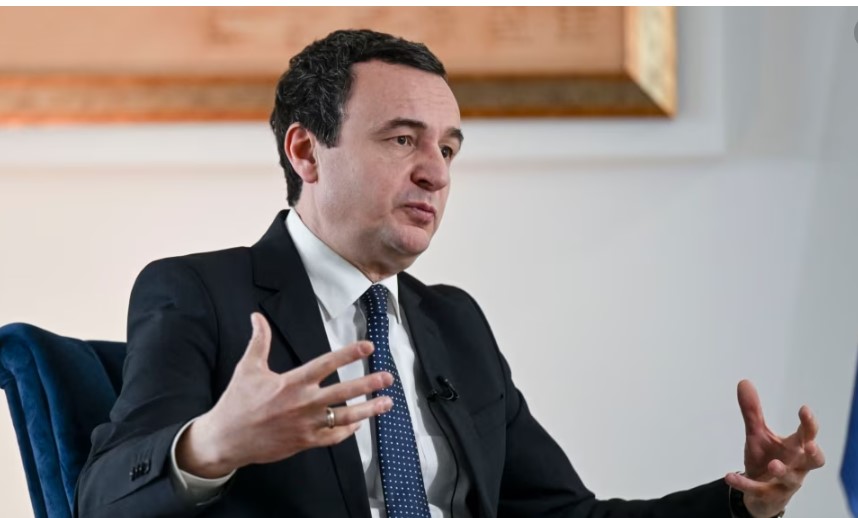
The Prime Minister of Kosovo, Albin Kurti, addressed the Serbian community in Kosovo on Sunday, saying that the regulation of the Central Bank of Kosovo (CBK) does not prevent Serbia from helping them and Kosovo has not banned the dinar, just like no other currency.
He referred to the CBK regulation – which entered into force on February 1 – which stipulates that the only currency for carrying out cash transactions is the euro.
For Kurti, any other interpretation of the regulation amounts to campaigning on false grounds.
As he addressed the Serbian community, he reiterated that the CBK regulation aims to formalize payments.
“So, Kosovo did not ban the dinar, just as it did not ban the dollar, nor the pound, nor the Swiss franc. The only difference is that from February 1, money cannot cross the border in bags, as cannot be done in any democratic state, but can come through bank accounts, withdrawn in euros.”
Serbia has strongly criticized the CBK regulation, interpreting it as the goal of the Government of Kosovo to deport Serbs.
The Serbian state allocates millions of euros to Serbs in Kosovo after paying them – through a parallel system – salaries, pensions and additional assistance.
For years, the Bank of Serbia has sent the dinars to a safe in the municipality of Leposavic, in the north of Kosovo, and they were then transported by the international company Henderson.
The CBK has said that such a practice is illegal, as only it can export and import coins and banknotes within the territory of Kosovo.
Kosovo authorities require that Serbs in Kosovo open accounts in any of the licensed commercial banks.
The Serbian state can then start the funds in dinars, but they are automatically converted to euros along the way.
Kurti reminded the Serbs that they will be able to open accounts in euros, free of charge, and that a part of the Serbs already benefit from the social schemes of the Kosovo state.
“Every month, more than 33,000 members of the Serbian community receive pensions from the Republic of Kosovo, 2,205 families receive social assistance, 4,244 families receive child support and 1,372 families receive support for pregnant women and mothers with children. Everything through the bank account opened in euros”.
Even Kurti, like the Deputy Prime Minister of Kosovo, Besnik Bislmi, has said that there will be a transition period in this process.
The international factor has criticized the Government of Kosovo for not postponing the deadline for implementing the CBK regulation, saying that more time is needed for the Serbian community to adapt to the decision.
In recent days, the CBK has made available a free telephone line, so that Serbs can be informed more about the new regulation.
The Constitution of Kosovo stipulates that there should be only one currency for making cash payments.
Kosovo is not part of the Eurozone – which consists of 20 member countries of the European Union – but has had the euro as its main currency since 2002.




