

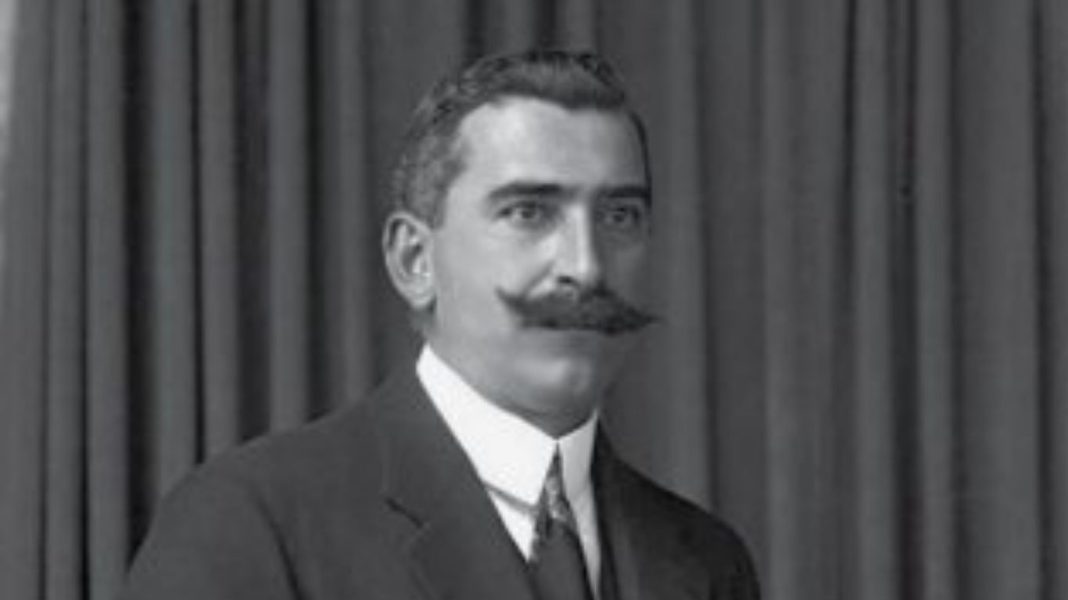
On February 19, 1879, the poet, signatory of the Declaration of Independence, dedicated patriot to the cause of the homeland, Luigj Gurakuqi was born in Shkodër.
In the years 1901-1906, Gurakuqi pursued university studies in Naples and thereafter successfully debuted as a lyric poet, inspired by Filip Shiroka.
With the work “Vargënimi n’gjuhë shqype me nji fjalorth shqyp-frengjisht n’marim” (Naples, 1906), Gurakuqi made the first attempt to codify the metrics of Albanian poetry. Shortly after, he published the work “Abetar i vogël shqyp mas abevet t’Bashkimit e t’Stambollit me tregime n’dy dhialektet” in Bucharest, which stands as the cornerstone of all his endeavors towards the national, educational, and cultural movement at the end of the National Renaissance and the beginning of Independence developments.
He participated in the Congress of Monastir alongside representatives of Shkodra: Gjergj Fishta, Dom Mjeda, Hilë Mosi, and Mati Logoreci. He was elected vice-chairman and member of the commission for the unification of the alphabet. In 1909, as the director of the Elbasan Normal School, he contributed to the crystallization of education on national bases.
In 1912, he was intensively involved in organizing the general uprising. Independence was proclaimed in the declaration formulated by Ismail Qemali, written by Gurakuqi. In the Provisional Government of Vlora, he was elected Minister of Education. In 1913, he participated in the London Conference.
In Hasan Prishtina;s brief cabinet, he was entrusted with the position of Minister of the Interior. Gurakuqi participated in the Congress of Durrës (1918), from where his return to the Ministry of Education was decided. He was a member of the delegation at the Peace Conference in Paris.
He led the June Revolution of 1924 and was appointed Minister of Finance in the government led by Fan Noli. After the suppression of the Revolution, he fled to Italy, to Bari, where on March 2, 1925, he fell victim to an assassination.




