

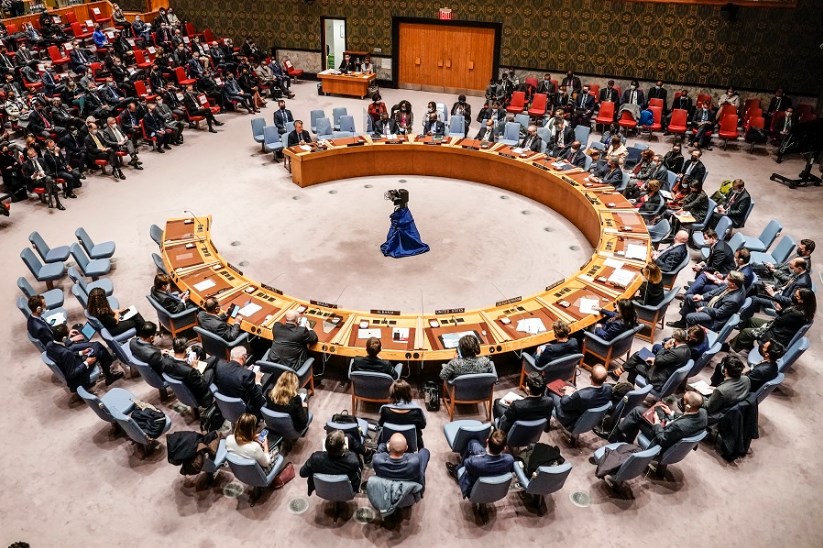
The UN Security Council discussed the new report on Kosovo, a session characterized by high tensions between Pristina and Belgrade, with accusations on both sides that the bilateral dialogue is being obstructed.
In the New York session headed by Russia, members of the Security Council called for an agreement in the next meeting in Brussel and for both sides to refrain themselves from escalating tensions.
Kosovo’s Foreign Minister, Donika Gërvalla said that Serbia is trying to hinder the European integration of the Balkan region.
“It is clear that Serbia does not want an agreement in the dialogue. Otherwise, they’ll obstruct every agreement, because the Serbia of 2023 does not wish to be a part of the EU anymore,” Gërvalla said.
During her speech, Gërvalla mentioned crimes against Albanian citizens during the 1999 war and compared the war in Kosovo to the actual occupation of Ukraine, while accusing “Serbia as the biggest threat to the peace in the Balkans”.
She also complained that the President of the Security Council, Russian Ambassador Vassily Nebenzia, refuted her right to hold a speech in Albanian. Nebenzia denied by saying Gërvalla would have been allowed to speak in Albanian, had she insisted on it.
On the other side, the Serbian Foreign Minister, Ivica Dačić accused Kosovo of not wanting a dialogue. He argued that his counterpart’s speech highlights that they want conflicts to continue.
“It is a necessity that the Community of Serb Municipalities is formed as soon as possible, because this is the only mechanism possible to protect the rights and the security of the Serbian community in Kosovo,” Dačić said during his speech, while also claiming that Pristina is avoiding fulfilling this obligation, on purpose.
“Serbia will never recognize the independence of Kosovo,” Dačić added further, requesting for the full implementation of the UN Resolution 1244, which offered a framework for the conflict settlement, approved in 1999.
During the presentation of the report, the UNMIK chief, Caroline Ziade called for normalization of relations between Kosovo and Serbia, urging both sides to refrain from escalating rhetoric.
“Tensions between Kosovo and Serbia not only distanced both sides from trying to normalize relations through dialogue, but also pushed them close to a physical confrontation,” Ziade mentioned during her presentation.
However, the UNMIK mandate is under scrutiny in Kosovo. Foreign Minister Gërvalla called it a “destabilizing factor” in the region. Even representatives from the USA and Great Britain called for a revision of the UNMIK mandate.